Booking a doctor’s appointment shouldn’t be stressful, but for many patients, it is. Long waits on the phone aren’t fun, not to mention the anxiety of explaining something personal to a receptionist.
This unease seems unnecessary in our modern world. Of US patients with sensitive health issues, 66 percent indicated they would feel more comfortable making appointments with an online chatbot than a staff member.
Imagine calling your doctor’s office at 2 a.m. with a pressing health concern, only to reach an answering machine. Or picture sitting in a waiting room for three hours just to ask a simple question about your medication. These frustrating scenarios are becoming relics of the past, thanks to the revolutionary power of medical AI chatbots.
What is a medical AI chatbot?
Computer programs designed for healthcare interactions, medical AI chatbots use AI to understand patient questions, provide medical information, and assist with healthcare-related tasks.
Unlike other chatbots, medical AI chatbots are trained with medical research and handle sensitive health information while maintaining privacy and upholding security standards.
Key characteristics of medical AI chatbots
- Medical knowledge base: Trained on vast amounts of medical literature, symptom databases, and healthcare protocols
- HIPAA compliance features: Built with healthcare privacy regulations in mind
- Natural language processing (NLP): Complete understanding of medical terminology and patient language variations
- Risk-assessment expertise: Capable of identifying urgent situations that require immediate medical attention
- Integration capabilities: Connectable to electronic health records, appointment systems, and other healthcare tools
Modern medical AI chatbots have evolved far beyond simple question-and-answer systems. Today’s sophisticated virtual medical assistants can understand context, remember previous interactions, and provide personalized healthcare guidance based on individual patient needs.
How medical AI chatbots work, in 5 steps
By understanding the technology behind medical AI chatbots, your healthcare organization can make informed implementation decisions. These systems operate through the following interconnected processes to deliver accurate, helpful responses:
1. A patient messages your organization’s chatbot.
The journey begins when a patient sends a request through text or voice messaging. Here’s what happens:
- Language detection: The system identifies the language being used and prepares for analysis.
- Medical terminology recognition: Advanced systems can understand both medical terms and common patient language.
- Context preservation: The chatbot keeps up with the context of the conversation across multiple interactions.
- Privacy filtering: The system immediately encrypts and protects sensitive information.
2. The chatbot uses NLP to process the request.
NLP represents the core intelligence of medical AI chatbots, enabling them to understand the complexities of healthcare communication. That technology involves the following:
- Symptom recognition: When a patient describes, for example, “feeling dizzy with a headache for three days,” the system identifies key symptoms and their duration.
- Classification of patient intent: The chatbot determines whether the patient is seeking information, wants to schedule an appointment, or needs urgent care guidance.
- Extraction of important medical information: The system identifies specific medical information (such as medications, conditions, body parts, and time frames) mentioned in patient messages.
- Severity assessment: Advanced systems can gauge the urgency of symptoms and determine appropriate response levels.
3. Your training helps the chatbot work faster.
Medical AI chatbots draw from comprehensive healthcare knowledge sources, including
- Medical literature: Peer-reviewed research, clinical guidelines, and treatment protocols
- Drug databases: Collected information on medications and interactions, and dosing guidelines
- Symptom databases: Collections of symptoms and associated conditions
- Institutional knowledge: Hospital-specific protocols, procedures, and contact information
4. The patient’s needs are met efficiently and safely.
The system then generates appropriate responses while maintaining safety standards and using the following:
- Risk stratification: Every response is evaluated for potential risk, with high-risk situations automatically escalated to healthcare staff.
- Source verification: Responses include references to medical sources when appropriate, ensuring transparency and reliability.
- Limitation acknowledgment: The system clearly communicates when questions exceed its capabilities and recommends human medical consultation.
5. Continuous learning makes your chatbot better.
Medical AI chatbots continuously improve through
- Interaction analysis: Learning from successful patient interactions and feedback
- Medical knowledge updates: Regular integration of new medical research and guidelines
- Performance monitoring: Tracked response accuracy and patient satisfaction through comprehensive chatbot testing
- Human oversight: Review by medical professionals to refine chatbot responses
7 real-world applications of medical AI chatbots
Medical AI chatbots excel in numerous practical applications that benefit both patients and healthcare providers. Here are seven key applications demonstrating their versatility across healthcare scenarios.
1. Symptom assessment and triage
One of the most valuable capabilities is preliminary symptom evaluation, which includes
- Initial screening: Patients can describe symptoms and receive guidance on whether immediate medical attention is needed.
- Triage support: Medical AI chatbots can prioritize patients based on symptom severity and urgency.
- Documentation: Your healthcare assistant can collect symptom information and organize it for healthcare providers to review.
- Follow-up questions: The system asks relevant follow-up questions to gather comprehensive symptom information.
Real-world example: A patient experiencing chest pain can quickly interact with a chatbot that assesses symptom severity, asks about accompanying symptoms, and immediately directs them to emergency care or schedules an urgent appointment based on the assessment.
2. Administrative task automation
Medical AI chatbots excel at handling routine administrative functions, such as
- Appointment scheduling: Patients can book, reschedule, or cancel appointments.
- Insurance verification: The chatbot can collect and verify basic insurance information.
- Completion of pre-visit forms: Patients can complete intake forms and medical history updates using the chatbot before appointments.
- Prescription refills: Medical AI chatbots can process routine refill requests and route them to the appropriate healthcare providers.
Real-world example: A busy family practice uses chatbots to handle 80 percent of appointment scheduling requests, freeing staff to focus on complex patient needs and enabling patients to book appointments whenever they have time.
3. Medication management and support
Comprehensive medication support includes
- Medication reminders: Personalized reminders based on individual prescription schedules
- Drug interaction checks: Alerts about potential interactions between medications
- Side-effect information: Detailed information about potential medication side effects
- Adherence tracking: Medical compliance monitoring and encouragement
Real-world example: Patients with chronic disease receive daily medication reminders with educational content about their conditions, resulting in improved adherence rates and better health outcomes.
4. Mental health support
Medical AI chatbots are particularly valuable in mental health applications, assisting with
- Crisis intervention: Thirty-six percent of people familiar with AI mental health chatbots regard them as a minor improvement that provides immediate support for mental health crises.
- Therapeutic conversations: Patients can receive basic counseling support and coping strategies.
- Mental health screening: Medical AI chatbots can conduct initial assessments for anxiety, depression, and other mental health conditions.
- Connections to resources: Chatbots can also connect patients with appropriate mental health professionals and resources.
Real-world example: A university health center’s mental health chatbots provide immediate support for students during off-hours and helps to identify students who need urgent professional intervention.
5. Patient education and health information
These chatbots also serve as 24-7 health information resources. They can share the following:
- Condition explanations: Clear, understandable explanations of medical conditions
- Treatment information: Deep dives on procedures, medications, and recovery processes
- Preventive care reminders: Automated notifications for vaccinations, screenings, and checkups
- Post-care instructions: Guidance for post-procedure or post-discharge care
Real-world example: A cardiac surgery center uses chatbots to provide comprehensive pre- and post-operative education, reducing patient anxiety and improving recovery compliance.
6. Emergency response and urgent care guidance
Critical care applications include
- Emergency triage: Immediate assessment of symptoms that might require emergency care
- First-aid guidance: Basic first-aid instructions for common emergencies
- Poison control: Immediate guidance for emergencies, with direct connection to poison control
- Crisis escalation: Automatic escalation to emergency services when life-threatening situations are detected
Real-world example: Rural healthcare networks use emergency response chatbots to provide immediate guidance to patients in areas with limited access to emergency services, helping patients determine whether to seek immediate care or manage symptoms at home.
7. Chronic disease management
Long-term health condition support involves
- Symptom tracking: Daily monitoring of symptoms for conditions like diabetes, hypertension, and arthritis
- Lifestyle coaching: Personalized advice on diet, exercise, and lifestyle modifications
- Care plan adherence: Reminders and support for following complex treatment protocols
- Provider communication: Regular updates to healthcare providers about patient status and concerns
Real-world example: A diabetes management program uses chatbots to help patients track blood sugar levels, receive nutritional advice, and get medication reminders, resulting in better glycemic control and reduced complications.
AI chatbots & healthcare teams: A collaborative approach
The most successful medical AI chatbot implementations emphasize collaboration with, rather than replacement of, healthcare professionals. These systems work best when thoughtfully integrated into existing healthcare workflows, enhancing staff approaches and serving as intelligent assistants for various healthcare team members.
For physicians, chatbots offer the following:
- Pre-visit preparation: Collection and organization of patient information before appointments, allowing doctors to focus on diagnosis and treatment
- Clinical decision support: Access to medical literature and treatment guidelines during patient consultations
- Documentation assistance: Automated generation of visit summaries and treatment notes
- Patient follow-up: Continuous monitoring of patient symptoms and medication adherence between visits
For nurses, chatbots can help with
- Patient education: Automated delivery of post-care instructions and health education materials
- Medication support: Assistance with medication questions and adherence monitoring
- Symptom tracking: Continuous monitoring of patient symptoms and automatic alerts for concerning changes
- Resource coordination: Help connecting patients with appropriate healthcare resources and services
For administrative staff, chatbots can take the following off their plates:
- Appointment management: Automated scheduling, reminders, and basic patient intake processes
- Insurance processing: Initial insurance verification and basic eligibility checks
- Patient communication: Routine follow-up communications and appointment confirmations
- Data entry: Automated collection and entry of basic patient information
A collaborative approach creates a more efficient healthcare system in which technology handles routine tasks while professionals focus on complex clinical decisions, patient advocacy, and compassionate care.
Launch your healthcare chatbot in 2 minutes
While sophisticated medical AI chatbots offer powerful capabilities for healthcare organizations, most businesses can start with a much simpler approach and achieve immediate results.
For general healthcare-related businesses (like wellness centers, fitness facilities, health product retailers, and medical practices handling basic inquiries), Noupe provides an uncomplicated solution:
- Instant implementation with just one line of code
- Automatic learning from your existing website content
- 24-7 customer support capability
- No monthly subscription fees
- No training or scripts required
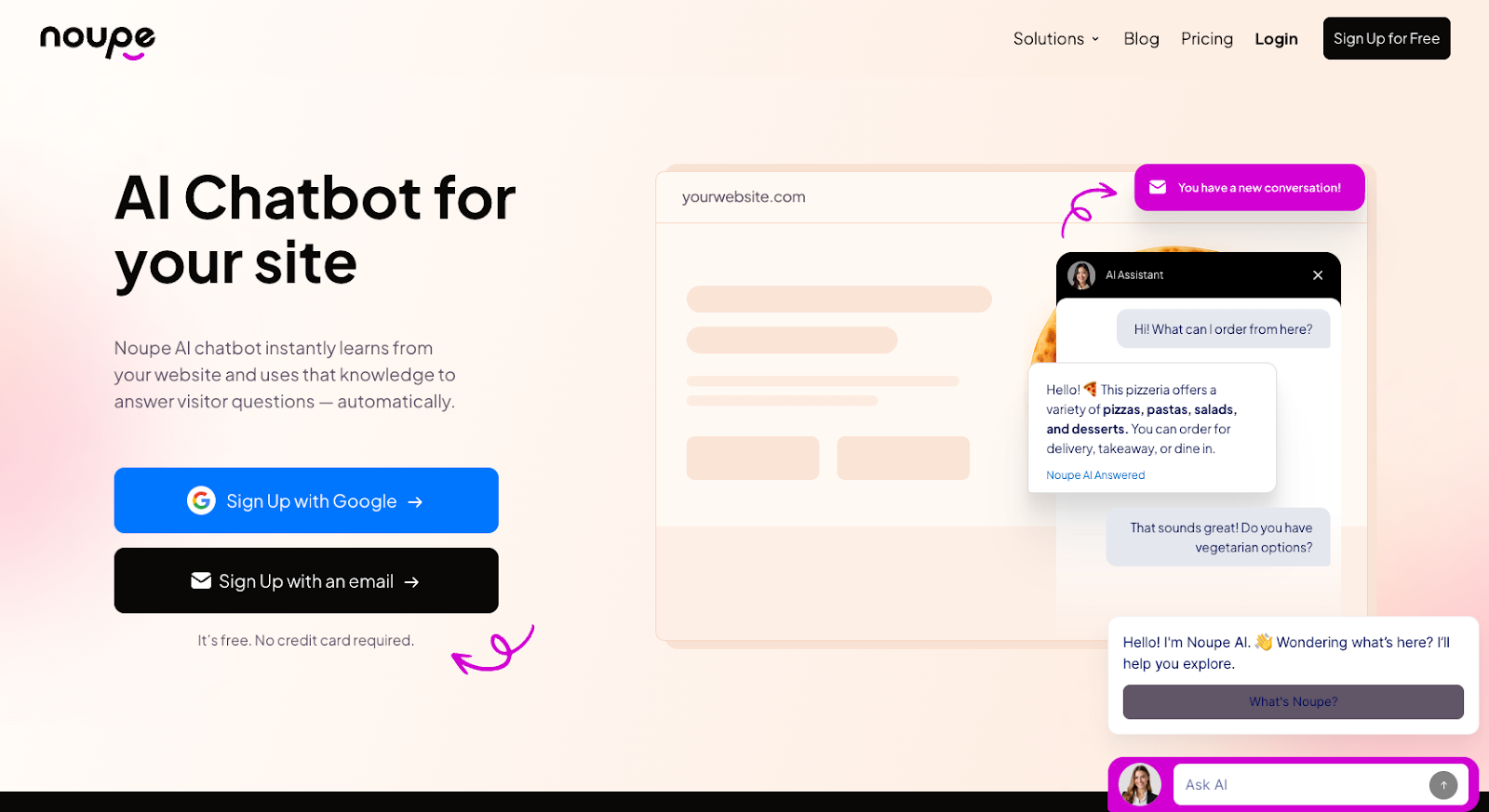
Get started with Noupe in 3 simple steps
- Get your embed code: Add your website address, and Noupe will read your content and learn instantly.
- Add Noupe to your website: Drop the embed code into your site.
- Go live in minutes: Noupe chats with your visitors and sends conversations to your inbox.
It’s worth noting that if your organization handles sensitive patient data, conducts symptom assessments, or requires integration with electronic health records, then you’ll need specialized medical AI chatbots with clinical decision support and medical certifications.
As medical AI technology continues advancing, with features like image analysis, voice pattern recognition, and genetic integration, the future promises even more personalized and precise healthcare experiences for patients worldwide. Try Noupe, and start integrating this effective technology into your workflows now.

