Summary
- Building AI-Powered Chatbots Without Programming (edX x IBM) – Best beginner-friendly no-code course using IBM WatsonAssistant.
- Chatbots – Johns Hopkins University (Coursera) – Best academic foundational course covering chatbot design, AWS Lex, and ML evaluation.
- Designing a Customer Support Chatbot Using Flowise (Coursera Project) – Best no-code customer-support chatbot project for teams wanting fast implementation.
- Mastering Dialogflow: Build Smart Chatbots With Google AI (Udemy) – Best Dialogflow-focused training for building Google AI chatbots without coding experience.
- AI Chatbot Development & Marketing Masterclass 2025 (Udemy) – Best for marketers and founders who want chatbot development + chatbot marketing strategies.
- Build Your Own Chatbot (CognitiveClass / IBM) – Best free IBM Watson chatbot training for beginners with hands-on lab exercises.
- Customer Service With Python: Build a Chatbot Using ChatGPT (Coursera Project) – Best short Python + ChatGPT project for practical customer-service automation.
- Create Your First Chatbot With Rasa & Python (Class Central / Coursera Project) – Best introduction to Rasa for developers wanting open-source industrial chatbot skills.
- Understanding Bots: Chatbot Architecture (Skillsoft) – Best high-level architectural overview for PMs, analysts, and tech leads.
- GenAI Chatbots: Create and Deploy OpenAI-Powered Chatbots (Coursera Project) – Best GenAI project course for building and deploying OpenAI chatbots with FastAPI and Dash.
TL;DR
- Chatbot courses help you learn NLP, conversation design, integrations, and evaluation so you can build real, production-ready chatbots.
- Chatbots are ideal for aspiring chatbot developers, digital marketers, and product managers who want hands-on, job-ready skills.
- This guide compares 10 top chatbot courses & certificates, covering level, topics, format, and pricing model so you can pick the right chatbot training course for your goals.
- Options include no-code chatbot development, Python + Rasa, Dialogflow, customer-support bots, and OpenAI-powered GenAI chatbots.
In short
A chatbot course gives you structured, end-to-end skills to design, build, and ship conversational AI agents, instead of just copying prompts from tutorials.
Why take a chatbot course?
Modern chatbot call centers, AI assistants, and customer support bots are now standard in SaaS, ecommerce, banking, healthcare, and education. Chatbots can cut support costs by up to ~30% by handling routine questions at scale, while keeping response times fast.
At the same time, AI skills are exploding in demand. Recent reports show that roles listing AI skills can carry ~50%+ wage premiums and that AI skills are spreading beyond engineers to analysts, PMs, and marketers.
A good chatbot course (or AI chatbot course) typically teaches you how to:
- Understand chatbot and AI agent architecture (intents, entities, context, tools, RAG).
- Use NLP/NLU platforms like Dialogflow, Rasa, Watson, or OpenAI APIs.
- Design conversational flows and UX that feel natural and goal-oriented.
- Integrate chatbots into websites, CRMs, and help desks.
- Evaluate and improve chatbots using real user data and analytics.
If you’re interested in AI agents more broadly, the chatbot courses are a practical on-ramp: most now cover GenAI-powered chatbots, context-augmentation, and multi-tool workflows that look a lot like modern AI agents.
In short
Most chatbot training courses mix technical skills with conversational design, so you can go from “what is a chatbot?” to ship a real AI assistant.
What you’ll learn in a chatbot course
Across the best chatbot courses in 2026, you’ll usually cover:
- Chatbot & AI agent fundamentals: What chatbots are, where chatbots are used, the difference between rule-based chatbots and GenAI / AI agents, and common architectures (NLU, dialog manager, tools, memory).
- NLP / NLU and conversation design: Intents, entities, training phrases, prompt design, and how to structure multi-turn dialogues that feel human.
- Bot tooling and platforms: Hands-on work with platforms like IBM WatsonAssistant, Dialogflow, Rasa, Flowise, and OpenAI — plus integrations into websites, CRMs, and support tools.
- Deployment and integration: How to embed chat widgets on websites, integrate with APIs, and connect to channels like WhatsApp, Facebook Messenger, or phone support.
- Testing, analytics, and optimization: Using logs to refine intents, improve accuracy, and measure helpdesk metrics such as cost savings, resolution rates, and CSAT.
Some courses emphasize no-code chatbot builders, while others dive deep into Python programming and GenAI APIs. The list below includes both styles so you can match your learning path to your current skills.
The 10 best chatbot courses to take in 2026
1. Building AI-Powered Chatbots Without Programming (edX x IBM)
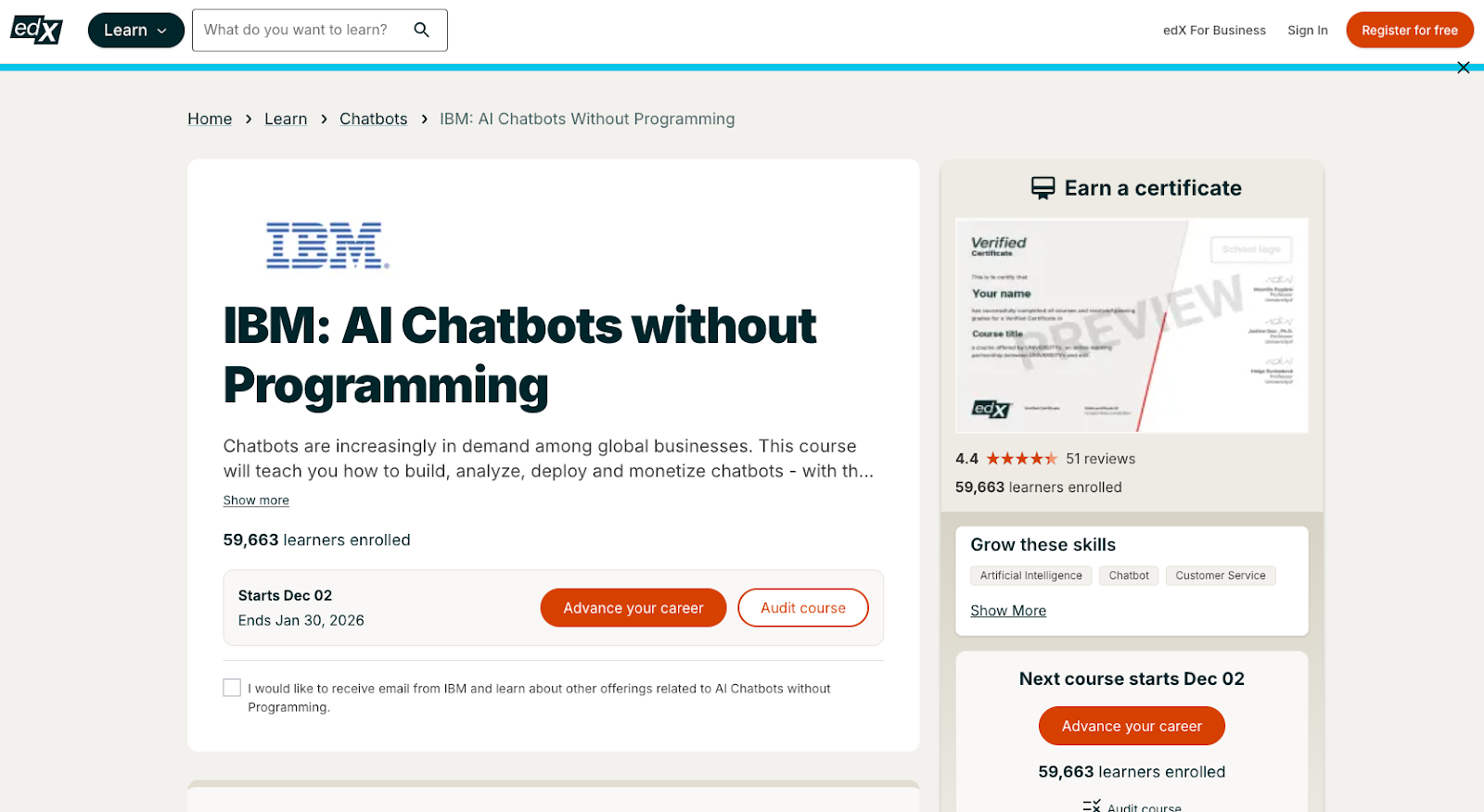
Best for: Beginners who want a no-code chatbot course that still teaches serious design and deployment skills with IBM’s tooling.
Online / In person?: Online, self-paced via edX.
Instructor: IBM experts (delivered as an IBM/edX program).
Exam required?: No proctored exam, but graded assignments and quizzes for the verified track.
Course length: Short, self-paced course designed to be completed in a few weeks at a light weekly load.
Course level: Beginner / foundational.
Key topics covered:
- What chatbots are and why chatbots are “revolutionary” for businesses.
- Principles of good chatbot design and action workflows.
- Differences between decision-tree chatbots and generative AI chatbots.
- Building and deploying chatbots using IBM WatsonAssistant without code.
Limitations:
- Focuses heavily on the IBM ecosystem, so you’ll need separate training if you want Rasa or Dialogflow.
- Not meant as a deep programming or data science course — it’s about application, not ML theory.
Certification or credentials offered:
- “AI Chatbots Without Programming” digital badge from IBM/edX on completion of the verified track.
Cost / pricing:
- Free to audit on edX; paid “verified” option for graded assignments and certificate.
2. Chatbots – Johns Hopkins University (Coursera)
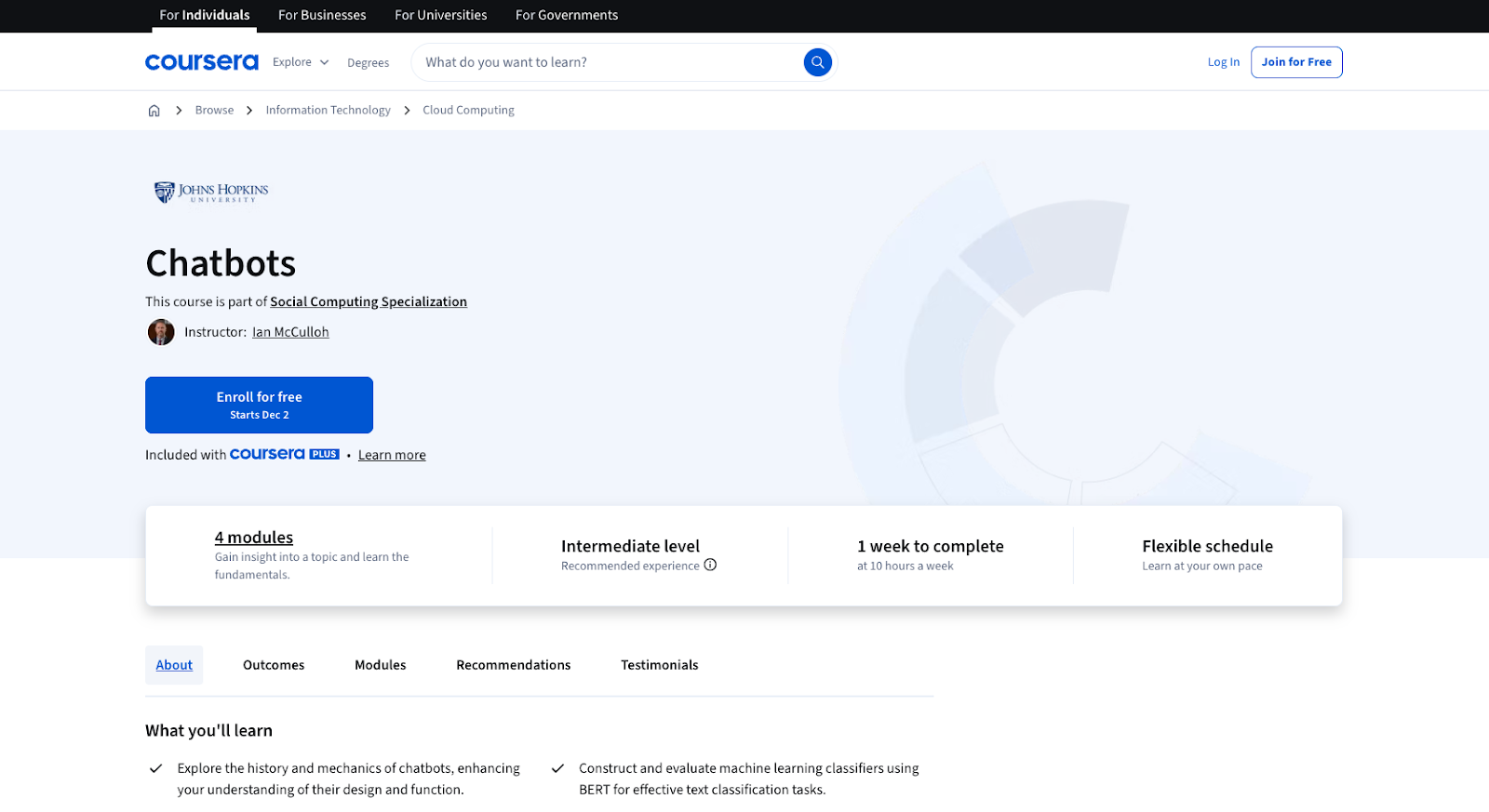
Best for: Learners who want a university-backed overview of chatbot design, AWS Lex, and ML classifiers.
Online / In person?: Online via Coursera.
Instructor: Johns Hopkins University faculty (e.g., Ian McCulloh).
Exam required?: No formal proctored exam; graded quizzes/assignments inside Coursera.
Course length: Short course, ~2 hours of core content plus exercises; fits into a weekend.
Course level: Intermediate.
Key topics covered:
- Evolution of chatbots and core building blocks.
- Designing conversational interfaces and flows.
- Building chatbots using Amazon Lex and AWS.
- Using ML classifiers to evaluate and refine chatbot performance.
Limitations:
- Focused on Lex and AWS; if you’re more interested in Rasa, Dialogflow, or OpenAI workflows, you’ll need complementary courses.
- Relatively short; you may want deeper, longer-form follow-ups.
Certification or credentials offered:
- Shareable Coursera certificate on completion.
Cost / pricing:
- Available via Coursera’s subscription / individual purchase; financial aid often available.
3. Designing a Customer Support Chatbot Using Flowise (Coursera Project)
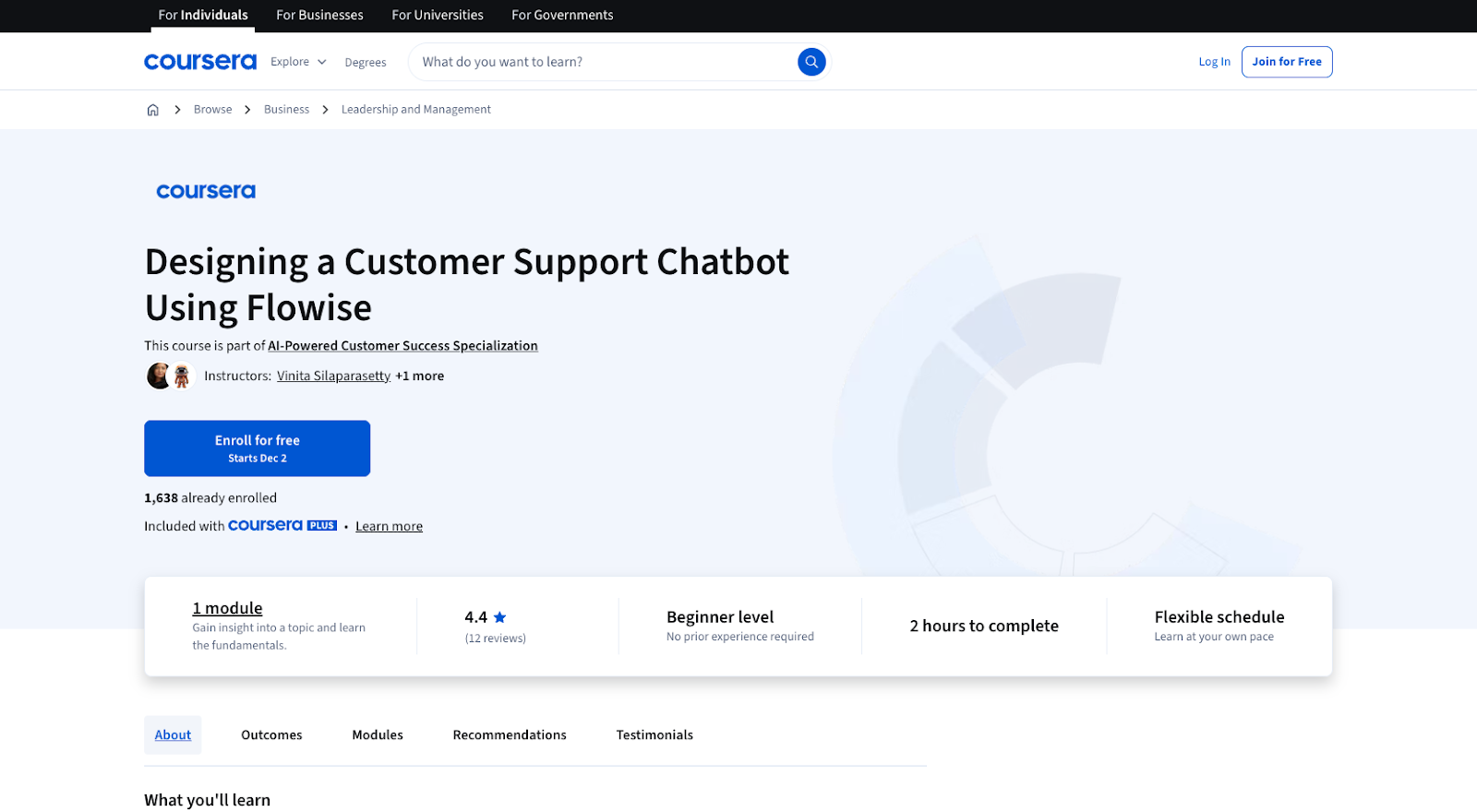
Best for: Non-technical learners who want to build a customer support chatbot without coding, trained on website data.
Online / In person? Online, guided project via Coursera.
Instructor: Coursera Project Network instructors.
Exam required? No; project-based assessment as you build the chatbot.
Course length: Roughly 1–2 hours of guided, hands-on work.
Course level: Beginner (no coding required).
Key topics covered:
- Using Flowise to build chatbots similar to ChatGPT without writing code.
- Training chatbots on specific website data.
- Designing customer support flows and testing responses.
Limitations:
- Very short; it’s a hands-on demo, not a full chatbot curriculum.
- Focused on Flowise; concepts transfer, but UI will differ from other tools.
Certification or credentials offered:
- Coursera guided project completion certificate.
Cost / pricing:
- Available within Coursera’s guided project catalog; often accessible via subscription or low one-time fee.
4. Mastering Dialogflow: Build Smart Chatbots With Google AI (Udemy)
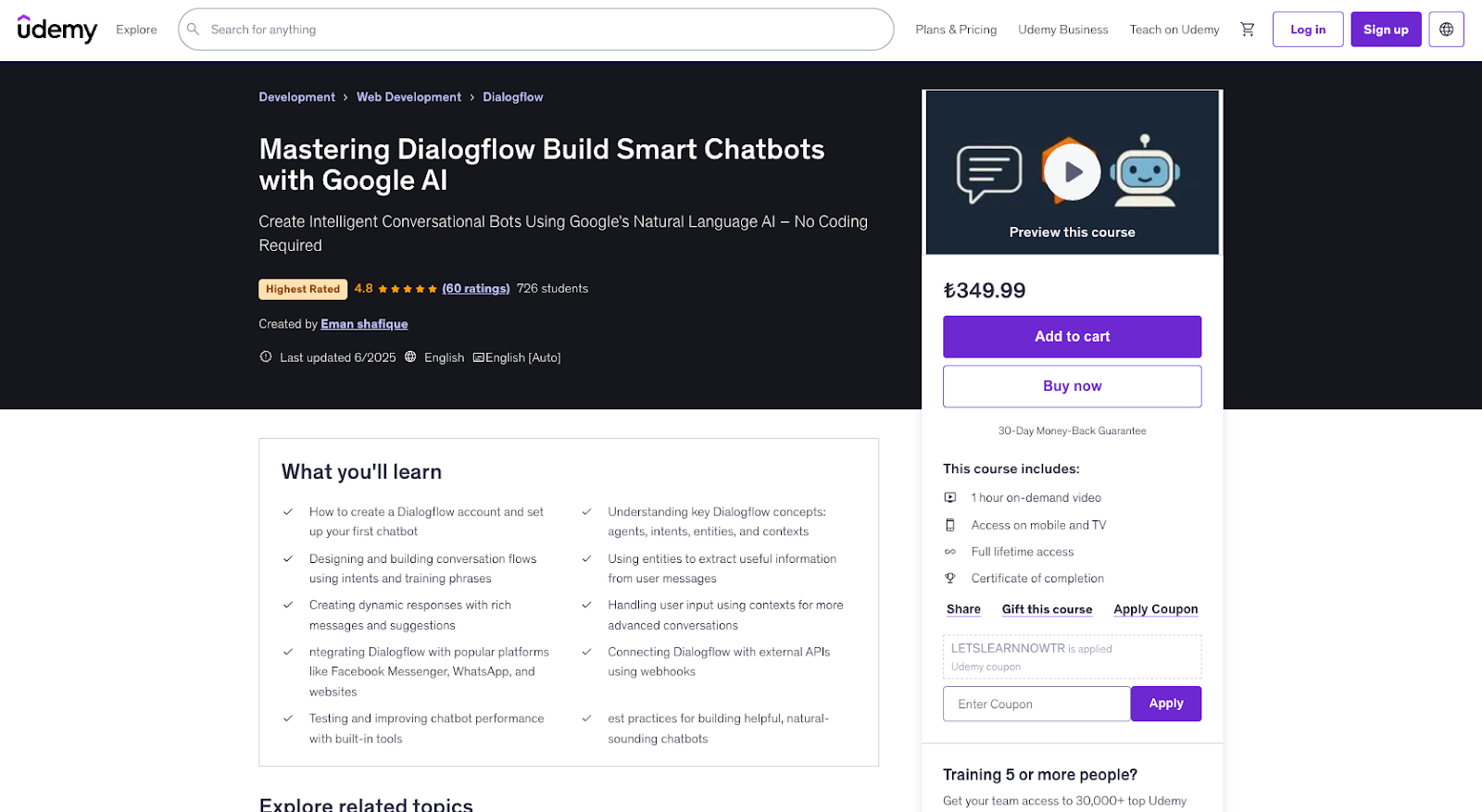
Best for: Learners who want a Dialogflow-focused chatbot programming course with no prior coding required.
Online / In person?: Online, on-demand via Udemy.
Instructor: Eman Shafique (Udemy instructor).
Exam required? No formal exam; course completion based on lectures and exercises.
Course length: ~1 hour 10 minutes of video content across ~24 lectures.
Course level: Beginner.
Key topics covered:
- Dialogflow agents, intents, entities, and contexts.
- Designing conversation flows and follow-up intents.
- Integrating chatbots with websites and Google Assistant.
Limitations:
- Short and focused primarily on Dialogflow ES; may not cover advanced CX or CX-agent patterns.
- Not a full Python or backend development course — integration examples are mostly platform-side.
Certification or credentials offered:
- Udemy certificate of completion.
Cost / pricing:
- One-time purchase on Udemy with frequent deep discounts; lifetime access.
5. AI Chatbot Development & Marketing Masterclass 2025 (Udemy)
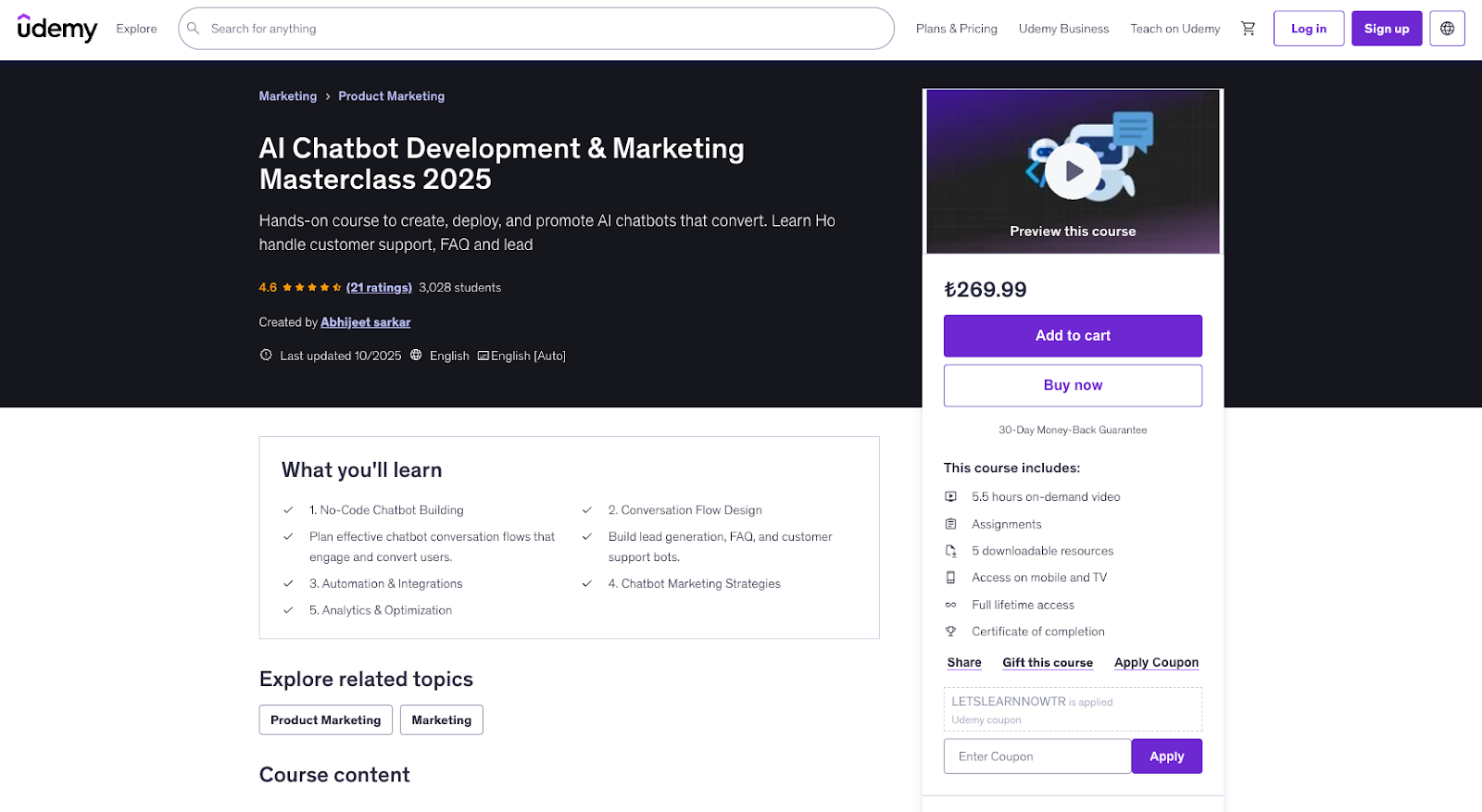
Best for: Marketers, founders, and support leads who want both chatbot development and marketing / growth strategies in one package.
Online / In person?: Online, self-paced via Udemy.
Instructor: Udemy instructor(s) specializing in AI chatbots and marketing (see course page).
Exam required?: No formal exam; project-based learning and exercises.
Course length: Multi-hour course (several hours of content with practical examples).
Course level: Beginner to intermediate.
Key topics covered:
- Building, deploying, and promoting AI chatbots that convert.
- Chatbots for customer support, FAQ automation, and lead generation.
- Marketing funnels, campaign ideas, and performance tracking for chatbot experiences.
Limitations:
- Less focused on deep NLP or engineering; more about practical implementation + marketing.
- Some tooling specifics can age as platforms update; you may need to adapt examples.
Certification or credentials offered:
- Udemy certificate of completion.
Cost / pricing:
- One-time Udemy fee, frequently discounted; lifetime access.
6. Build Your Own Chatbot (CognitiveClass / IBM)
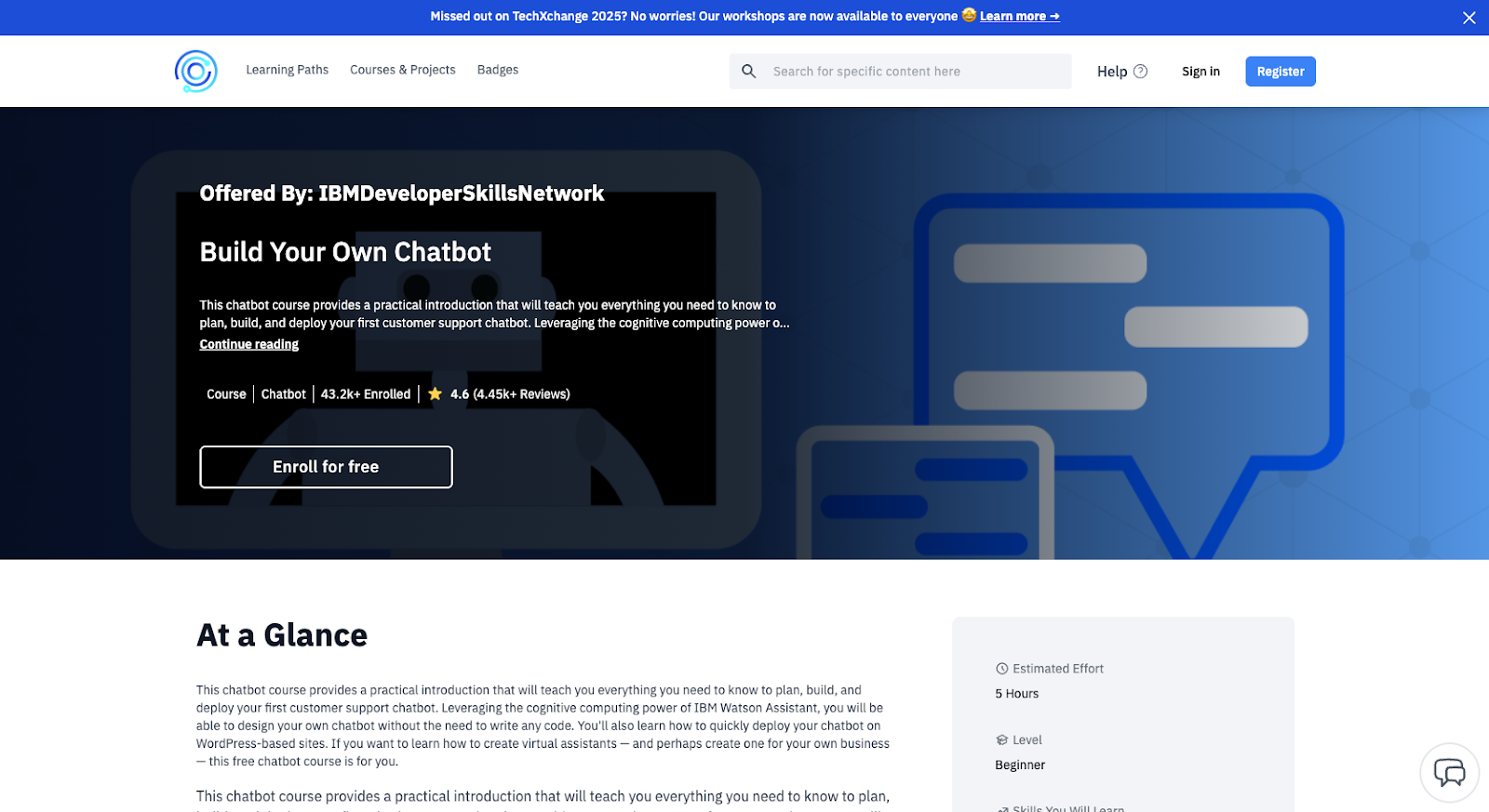
Best for: Beginners who want a free chatbot course that walks from planning to deployment with IBM WatsonAssistant.
Online / In person? Online, self-paced via CognitiveClass.
Instructor: IBM / CognitiveClass instructors.
Exam required?: Includes assessments; no high-stakes exam.
Course length: About 5 hours of content.
Course level: Beginner.
Key topics covered:
- Planning, building, and deploying a first chatbot.
- Using IBM WatsonAssistant to design chatbots without coding.
- Deploying chatbots on WordPress-based sites.
Limitations:
- Heavily focused on Watson; limited coverage of Rasa, OpenAI, or Dialogflow.
- More of an introduction than a deep dive into complex architectures.
Certification or credentials offered:
- Free CognitiveClass certificate and often an IBM digital badge for completion.
Cost / pricing:
- Free.
7. Customer Service with Python: Build a Chatbot Using ChatGPT (Coursera Project)
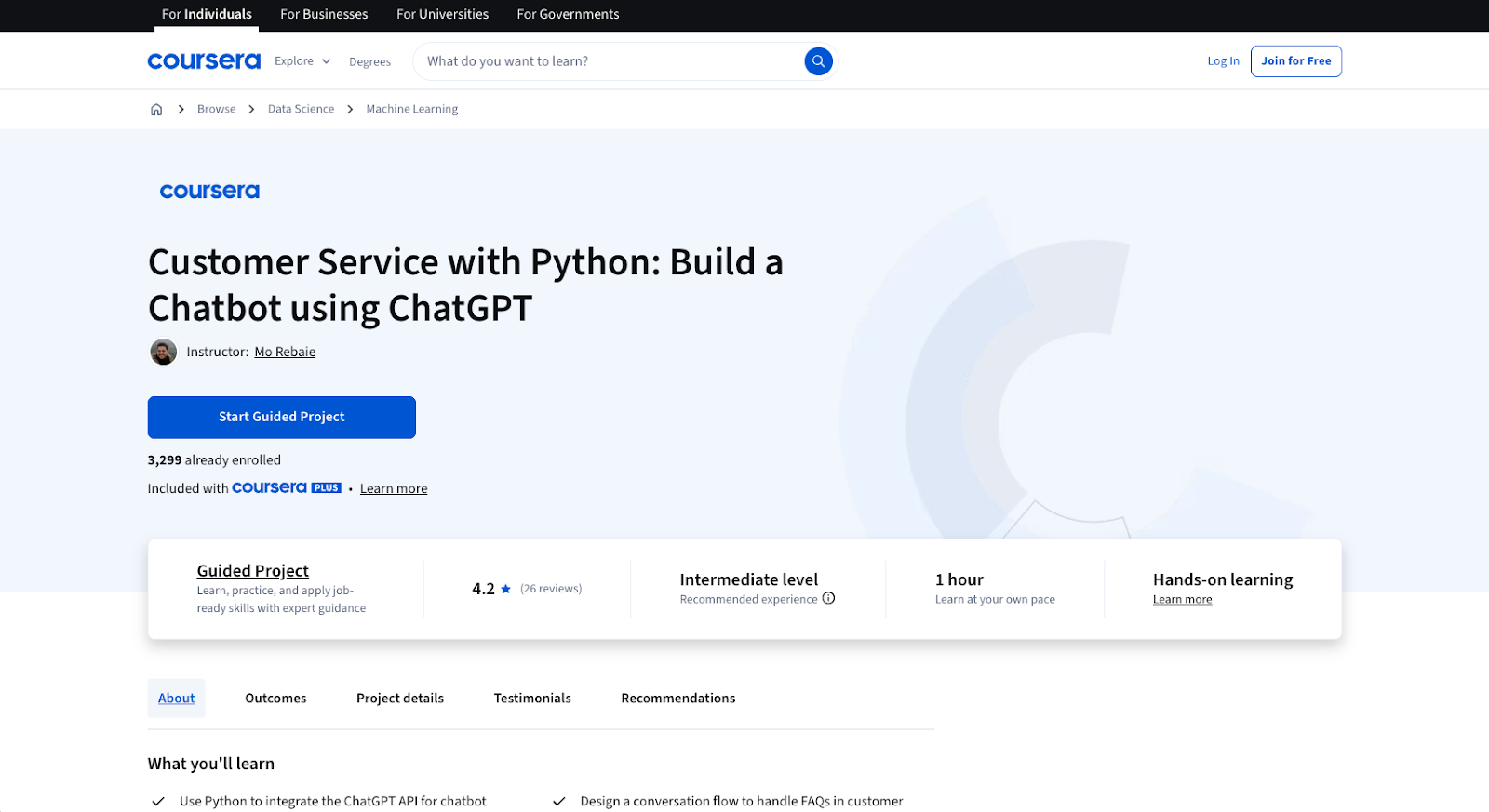
Best for: Developers and technical professionals who want a Python + ChatGPT customer service chatbot in a short, guided format.
Online / In person?: Online, guided project via Coursera.
Instructor: Mo Rebaie (Coursera Project Network).
Exam required?: No; you follow step-by-step tasks and build a working bot.
Course length: ~2-hour guided project.
Course level: Intermediate (basic Python recommended).
Key topics covered:
- Setting up a Python environment and configuring the OpenAI / ChatGPT API.
- Designing conversation flows for customer service FAQs.
- Building, testing, and iterating on an AI chatbot for specific e-commerce use cases.
Limitations:
- Very focused on a single project; not a full semester-style course.
- You’ll need separate training if you want to go deep into RAG, vector databases, or full production deployment.
Certification or credentials offered:
- Coursera project completion certificate.
Cost / pricing:
- Part of Coursera’s guided project catalog; usually available via subscription or low one-time fee.
8. Create Your First Chatbot With Rasa & Python (Class Central / Coursera Project)
Best for: Developers who want to learn the Rasa framework + Python for industrial-grade chatbots.
Online / In person?: Online, project-based via Coursera Project Network; also listed on Class Central.
Instructor: Amit Yadav (project instructor).
Exam required?: No formal exam; you build a working Rasa chatbot.
Course length:
- ~2-hour long, project-style course.
Course level: Beginner (basic Python helpful).
Key topics covered:
- Rasa architecture and components (NLU, Core, stories).
- Building intents, entities, and simple dialogs in Rasa.
- Creating and testing a simple AI-powered chatbot using Rasa and Python.
Limitations:
- Project-based; not a full multi-week Rasa specialization.
- Focused on fundamentals; doesn’t cover large-scale deployment or complex RAG pipelines.
Certification or credentials offered:
- Coursera guided project certificate; some listings mention shareable credentials.
Cost / pricing:
- Included in Coursera’s guided project offerings; accessible via subscription / one-off purchase.
9. Understanding Bots: Chatbot Architecture (Skillsoft)
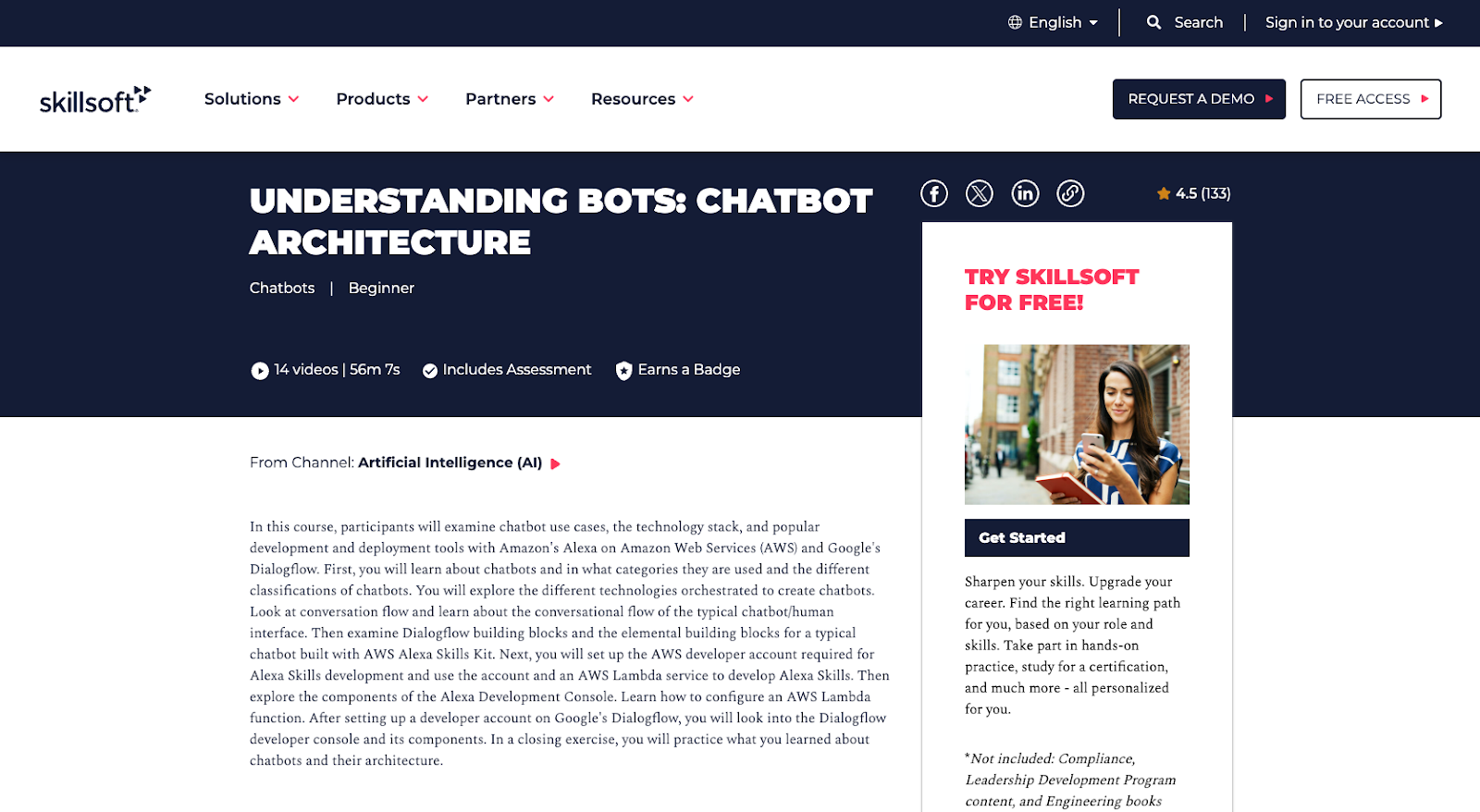
Best for: Product managers, architects, and technical leaders who want a big-picture view of chatbot architecture in under an hour.
Online / In person? Online course via Skillsoft and partner platforms.
Instructor: Skillsoft AI channel instructors.
Exam required? Includes an assessment and can award a badge.
Course length: ~56–57 minutes.
Course level: Beginner.
Key topics covered:
- Chatbot use cases and categories.
- Chatbot technology stack and architecture fundamentals.
- Popular development and deployment tools: Amazon Alexa, AWS, Google Dialogflow.
Limitations:
- High-level overview — not a hands-on coding or builder course.
- Access and pricing depend on your organization’s Skillsoft subscription.
Certification or credentials offered:
- Skillsoft badge / completion certificate.
Cost / pricing:
- Typically part of corporate / library Skillsoft subscriptions; some training providers sell it as a standalone online course.
10. GenAI Chatbots: Create and Deploy OpenAI-Powered Chatbots (Coursera Project)
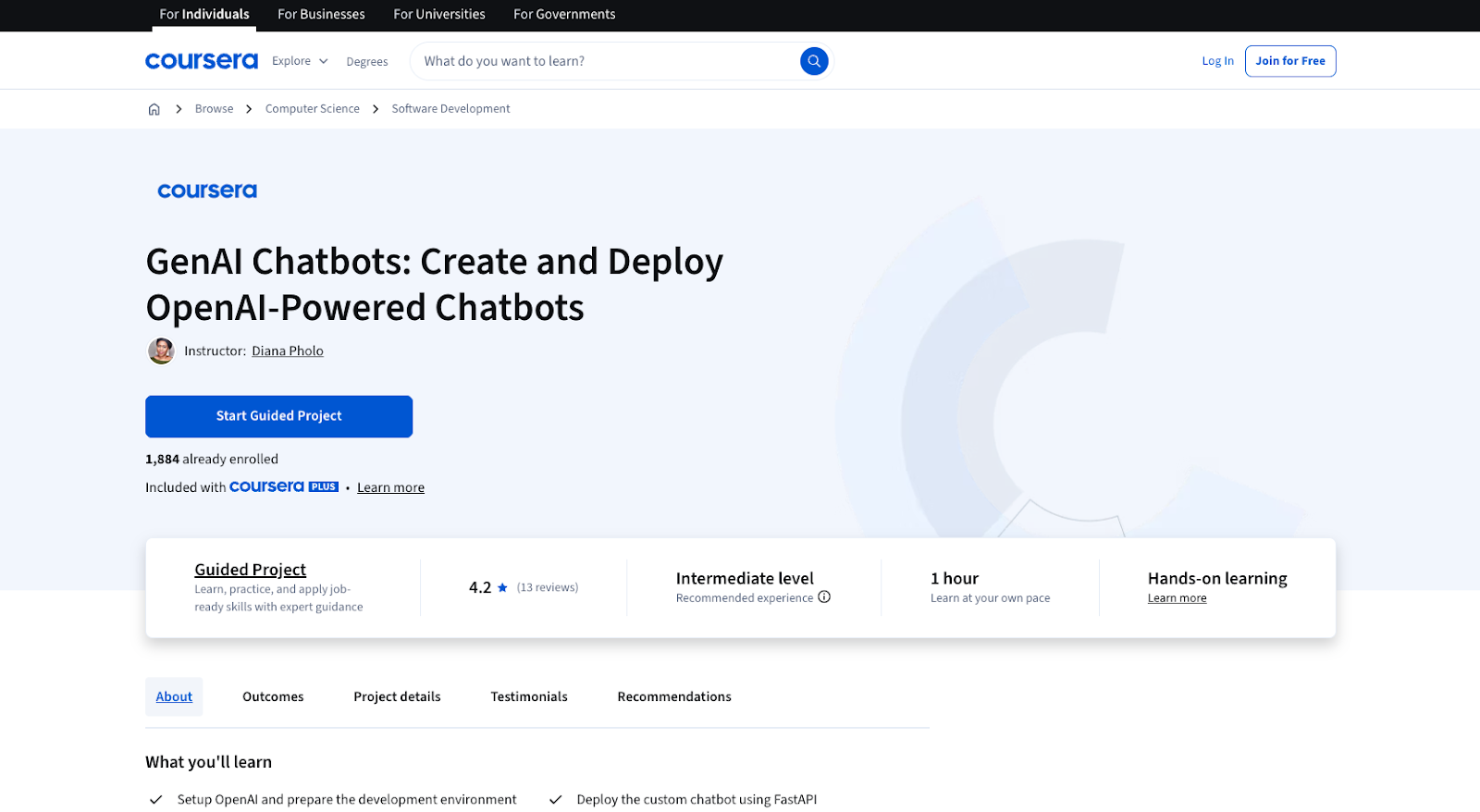
Best for: Developers who want to build OpenAI-powered GenAI chatbots with a real backend stack (FastAPI + Dash).
Online / In person?: Online guided project via Coursera.
Instructor: Diana Pholo (Coursera Project Network).
Exam required?: No; learning is through building and deploying the project.
Course length: ~1–2 hours guided project.
Course level: Intermediate (basic Python / web dev recommended).
Key topics covered:
- Setting up OpenAI and preparing the development environment.
- Implementing a GenAI chatbot using FastAPI and context-augmentation / RAG.
- Building a Dash frontend for interactive chatbot UI.
Limitations:
- Short guided project — assumes you’ll expand on the pattern afterwards.
- Focused on one tech stack; you’ll need additional learning for broader infrastructure topics.
Certification or credentials offered:
- Shareable Coursera project certificate.
Cost / pricing:
- Available through Coursera guided projects, usually via subscription or affordable one-off access.
In short
If you’re skimming, start here — then jump to the detailed course breakdowns that follow.
Best chatbot courses by goal (2026)
| Goal / Category | Best Course | Why It’s Best |
|---|---|---|
| Best no-code chatbot course for beginners | Building AI-Powered Chatbots Without Programming | Ideal for learners with no coding background; teaches chatbot fundamentals using visual, no-code tools. |
| Best foundational academic chatbot course | Chatbots – Johns Hopkins University | University-level theory + practical applications; strong academic grounding. |
| Best customer-support chatbot course (no-code) | Designing a Customer Support Chatbot Using Flowise | Hands-on project; perfect for teams building support bots using Flowise. |
| Best Dialogflow programming course | Mastering Dialogflow: Build Smart Chatbots With Google AI | Deep dive into Dialogflow ES & CX; ideal for technical builders. |
| Best marketing-focused AI chatbot course | AI Chatbot Development & Marketing Masterclass 2025 | Combines chatbot building with marketing automation and funnel strategy. |
| Best free IBM Watson chatbot training | Build Your Own Chatbot | Free, beginner-friendly, IBM Watson-based training with hands-on labs. |
| Best Python + ChatGPT customer service project | Customer Service with Python: Build a Chatbot Using ChatGPT | Practical project-based learning with Python + OpenAI APIs. |
| Best Rasa + Python framework intro | Create Your First Chatbot With Rasa & Python | Teaches industry-grade open-source chatbot development using Rasa. |
| Best chatbot architecture mini-course | Understanding Bots: Chatbot Architecture | Quick architectural overview; great for product managers or tech leads. |
| Best GenAI / OpenAI chatbot project | GenAI Chatbots: Create and Deploy OpenAI-Powered Chatbots | Practical, fast-track course for building and deploying OpenAI-based bots. |
In short
AI has moved from being a futuristic niche skill to becoming a core capability across almost every digital role.
Start your AI learning journey today
AI is now embedded in product management, marketing, customer success, engineering, and operations. Recent job reports show that roles listing AI skills are growing quickly and can command significant wage premiums, while employers increasingly expect non-engineers to be comfortable using AI tools.
The good news:
- You don’t need to be a full-time developer to start. No-code and low-code chatbot courses give marketers, PMs, and support leaders a real entry point.
- Developers can go deep with Python, Rasa, FastAPI, and OpenAI APIs, building AI agents that power real products.
- Skills you gain building chatbots — NLP, integration, prompt design, and system thinking — transfer directly to broader AI agent and GenAI work.
If you’re serious about AI, picking one of the chatbot courses above and actually shipping a small project is one of the fastest ways to move from curiosity to capability.
FAQ
Yes — there are paid roles and gigs focused on training and improving chatbots and AI agents. Paid roles and gigs include:
- Conversation designers and chatbot trainers who write training phrases and flows.
- AI trainers and data labelers who review model outputs and provide corrections.
- Support and CX specialists who tune chatbots based on customer feedback.
Chatbot courses can help you qualify for paid roles and gigs by giving you hands-on evidence that you can design, test, and refine real systems.
There’s no single “best” ChatGPT course for everyone, but for chatbot-specific, hands-on learning:
- Customer Service with Python: Build a Chatbot Using ChatGPT (Coursera Project) is a strong pick if you want a short, Python-based customer service chatbot build.
- GenAI Chatbots: Create and Deploy OpenAI-Powered Chatbots (Coursera Project) is better if you want a full stack with FastAPI and Dash around an OpenAI chatbot.
Your “best” option depends on whether you prefer no-code, Python scripting, or full backend work.
ChatGPT and “chatbot AI” solve related but different problems:
- ChatGPT (or similar LLMs) is a general-purpose AI model you can chat with or call via API.
- A chatbot (or AI agent) is a full system built around one or more models — with conversation flows, integrations, guardrails, and UX.
For real products, the best answer is usually “both together”: you use ChatGPT (or another model) as the engine and wrap it in a chatbot architecture with context, business rules, and integrations. Chatbot courses teach you how to design that full system, not just how to prompt a model.

