
Summary
- Noupe is the lightweight website chatbot for small to midsize teams that want instant, site-trained answers with zero technical setup.
- Replicant is the voice automation platform for enterprises handling large call volumes and looking to fully resolve Tier-1 conversations without human agents.
- Synthflow AI is the voice-first AI solution for scaling B2Bs and enterprises that need human-like phone agents with no-code flow design and deep integrations.
- Sierra AI is the conversational AI platform for telecom and service companies that need empathetic, reasoning-driven agents across voice and chat.
- Poly AI is the omnichannel, voice-first AI solution for consumer-focused enterprises that require on-brand conversations at global scale.
- Parloa is the compliant, enterprise-grade AI agent platform for regulated industries that need secure, controlled voice and chat automation.
- Cognigy is the low-code conversational AI platform for large contact centers that need advanced NLU, multilingual support, and intelligent routing.
- Decagon is the omnichannel AI engine for CX teams that want centralized logic, always-on support, and deep system-level control.
- Amazon Lex is the developer-centric conversational AI service for businesses already invested in AWS and looking for flexible, usage-based pricing.
- Google Dialogflow is the conversational AI platform for teams building customizable voice assistants and chatbots within the Google Cloud ecosystem.
Kore.ai stands out as a robust conversational AI platform for large organizations. Teams often use it for voice and chatbot solutions that can handle high volumes of customer and employee interactions. The platform includes design tools, natural language understanding (NLU), analytics, and deployment options across contact center and internal help desk channels.
However, there are still instances where you might need to search for a different option. Cost is often the first concern. Prices start high, and limited public pricing makes budgeting tricky.
The platform can also feel heavy. People without a technical background may need extra time to feel comfortable, and early builds sometimes require rework. Integrations add another layer of effort since setup can involve many moving parts. Working with the software development kit comes with a learning curve as well, which slows teams down.
Our guide covers Kore.ai competitors and their key features to help you find the right fit. We also do a quick overview of Kore.ai beforehand, so it’s easier to compare your options.
What is Kore.ai? A quick overview
Kore.ai serves companies that need large scale conversational AI across help desks and internal workflows. As an experience optimization platform, it brings design, testing, governance, and analytics into one place.
The platform spans web chat, mobile apps, voice channels, and social platforms, so organizations can reach people where they already are. Supporting more than 30 channels, it’s well suited for enterprise environments that use many communication tools at once.
A drag-and-drop builder gives nontechnical staff a way to shape dialogs while developers get deeper tools to extend logic and build custom integrations.
The platform’s AI focuses on intent recognition and sentiment signals to keep conversations aligned with user needs. Built-in search functions help find the right answers from knowledge sources. Security is a major part of the system, with compliance aligned to standards like GDPR and SOC 2 for organizations in regulated fields.
However, the platform still comes with challenges that lead some companies to look elsewhere. Price is a major deal-breaker, since industry conversations often put starting costs near $300,000 a year. Pricing is not listed publicly, and plans are only offered through sales, which can slow evaluation for teams on tight timelines.
There is also a steep learning curve, which can mean large deployments stretch across months. To make matters worse, documentation does not always feel clear and support response times vary.
What do all these hurdles mean? A demand for Kore.ai alternatives.
The best 10 Kore.ai competitors and alternatives
We’ve put together a list of Kore.ai alternatives to make your decision process easier. Let’s look at each of these tools individually.
| Tool | Key feature | Best for | Pricing model | Ease of use |
|---|---|---|---|---|
| Noupe | Self-learning AI from site content | Small to midsize sites | Free; $34 to $99/mo | Effortless, instant setup |
| Replicant | Full voice conversation automation | Large call volume | Custom | Moderate, enterprise-focused |
| Synthflow AI | Human-like voice agents | Enterprises & scaling B2Bs | $29 to $1,400/mo + custom | Moderate, drag-and-drop flows |
| Sierra AI | Empathetic support & Agent OS | Telecom & service companies | Outcome-based | Moderate, learning curve |
| Poly AI | Omnichannel voice-first AI | Consumer-focused companies | Contract-based | Moderate, setup required |
| Parloa | Low-code AI + advanced voice | Compliance-heavy sectors | Custom | Moderate, Azure-dependent |
| Cognigy | Low-code editor + NLU | Large contact centers | Custom | Moderate, deployment takes two to four months |
| Decagon | Agent Operating Procedures (AOPs) + omnichannel AI engine | Omnichannel CX teams | Custom | Moderate, enterprise-oriented |
| Amazon Lex | Voice & chat AI via AWS | AWS users | Pay-as-you-go | Moderate, dev knowledge needed |
| Google Dialogflow | Customer experience (CX) & Essentials (ES) conversational agents | Personalized chat/voice assistants | Monthly + $600 free credit | Moderate, technical setup |
1. Noupe
Best for: Small to midsize sites
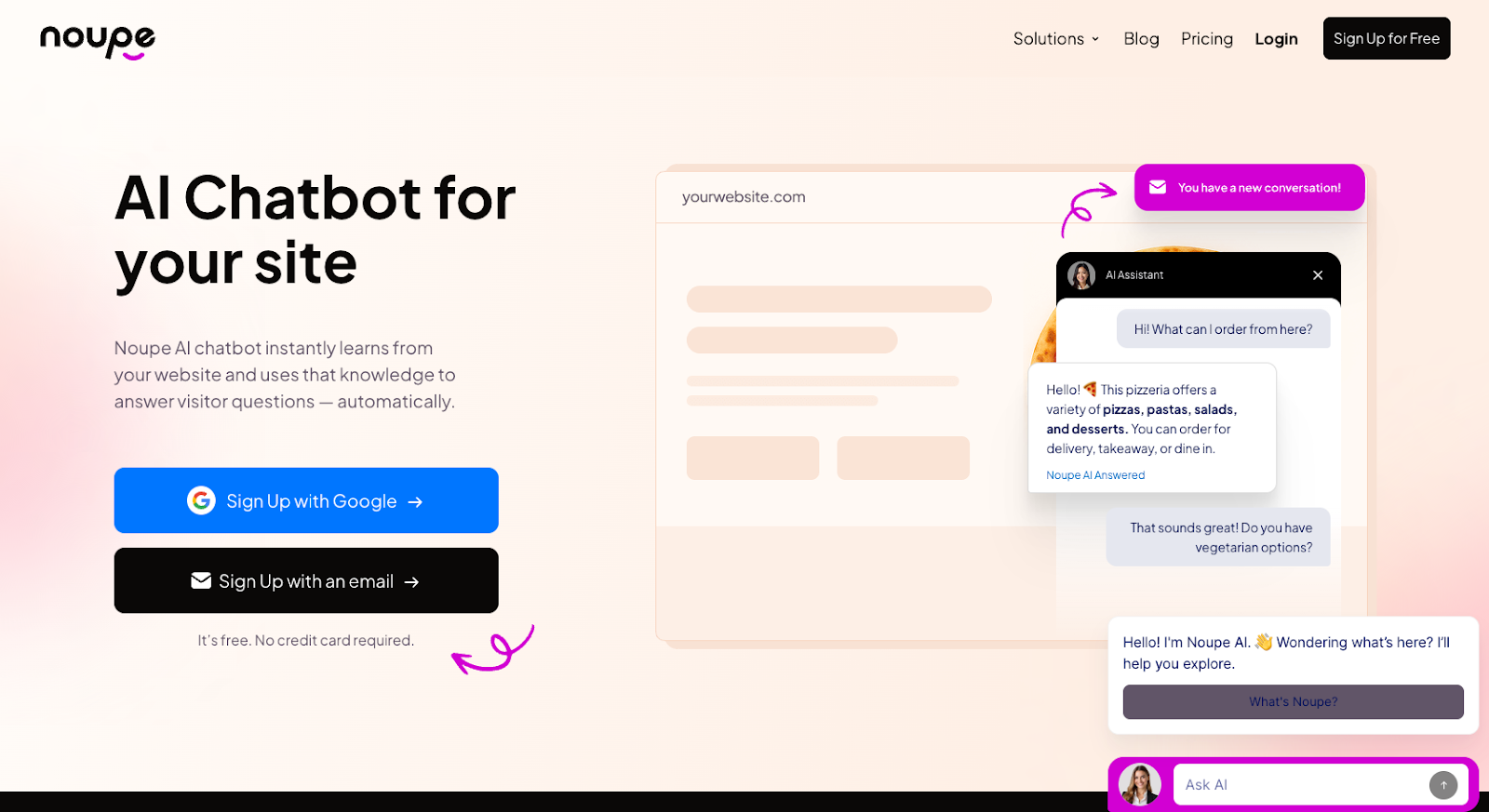
Noupe gives companies a fast way to add an AI chatbot to a website. It reads public pages and uses that information to answer visitor questions without a long setup cycle. Just enter a URL and drop a small code snippet to start handling basic support.
Key features
- Self-learning: It pulls key details from public content so responses match what visitors see on the site.
- Instant setup: The platform uses a simple embed code and helps you avoid technical barriers.
- Appearance settings: You can customize the widget to blend with your site.
- Conversation forwarding: The tool forwards conversations to an inbox, keeping human teams aware of visitor needs and opportunities.
- Language detection: It replies based on the visitor’s language without manual routing.
Limitations
Some businesses want deeper connections to CRMs or ticketing tools, and Noupe does not cover that ground. The feature set focuses on simple question handling, so teams that need complex sequences or higher logic may feel restricted.
Pricing: Noupe has a free plan with basic features. For more advanced capabilities, get the Basic plan for $8 and Pro for $16 per month, when billed annually.
2. Replicant
Best for: Organizations with large call volumes that want to automate Tier-1 conversations
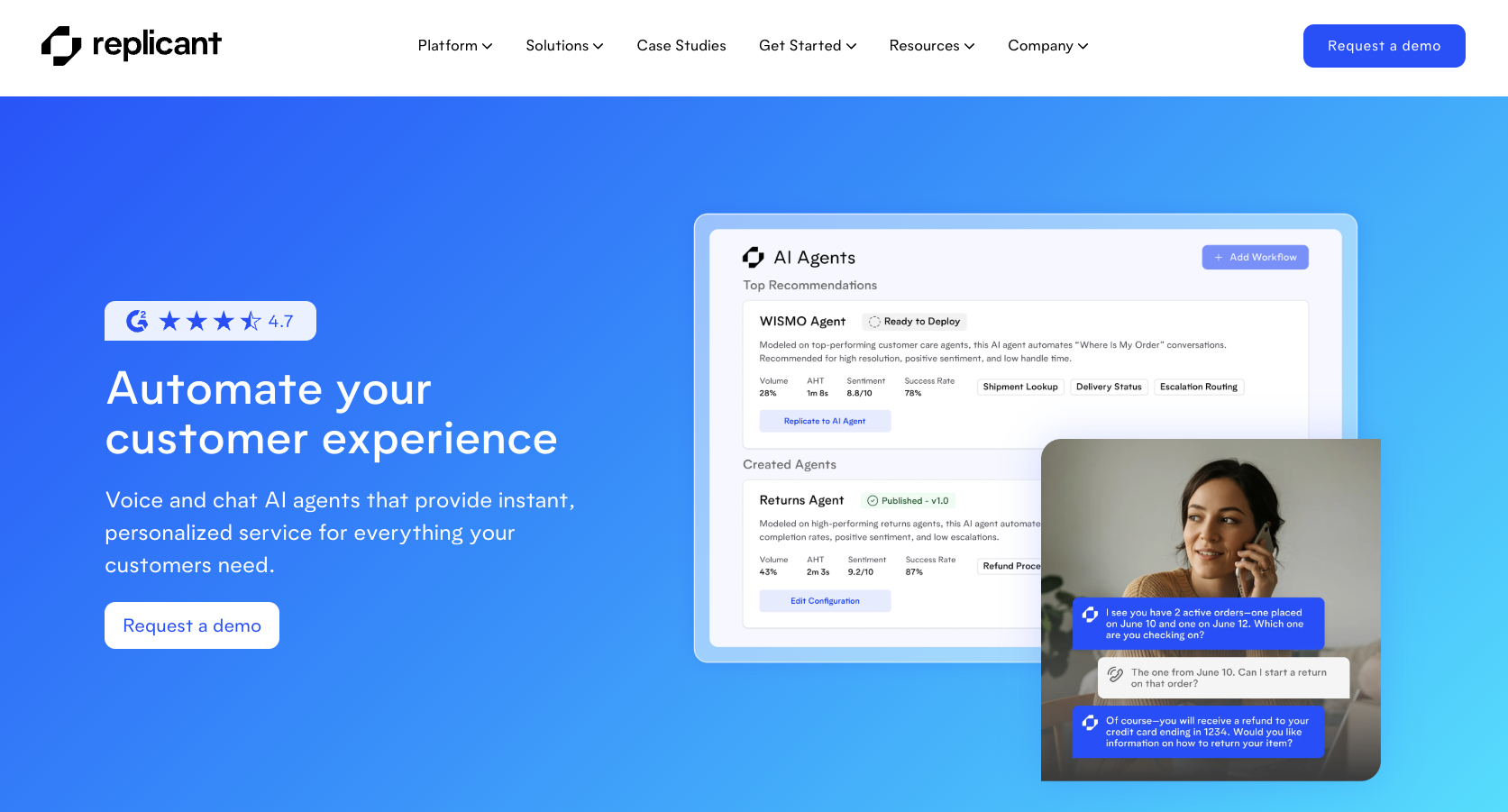
Replicant is an excellent alternative to Kore.ai chatbot for voice-based customer service at scale. It can take an entire conversation from start to finish, resolving customer requests without an agent stepping in.
Key features
- Multichannel support: It supports customer experience across voice and digital chat.
- Real-time integration: It integrates with CRM and backend systems to keep data updated and accurate.
- No-code tools: You can adjust flows without developer help.
- Managed services: These include ongoing tuning, testing, enhancements, and call flow design.
Limitations
Replicant is geared toward enterprise environments and may be more than what small businesses need. If your needs are limited to simple chat or low call volumes, it may feel excessive.
Pricing: Custom pricing is offered based on volume.
3. Synthflow AI
Best for: Enterprises and fast-scaling B2Bs
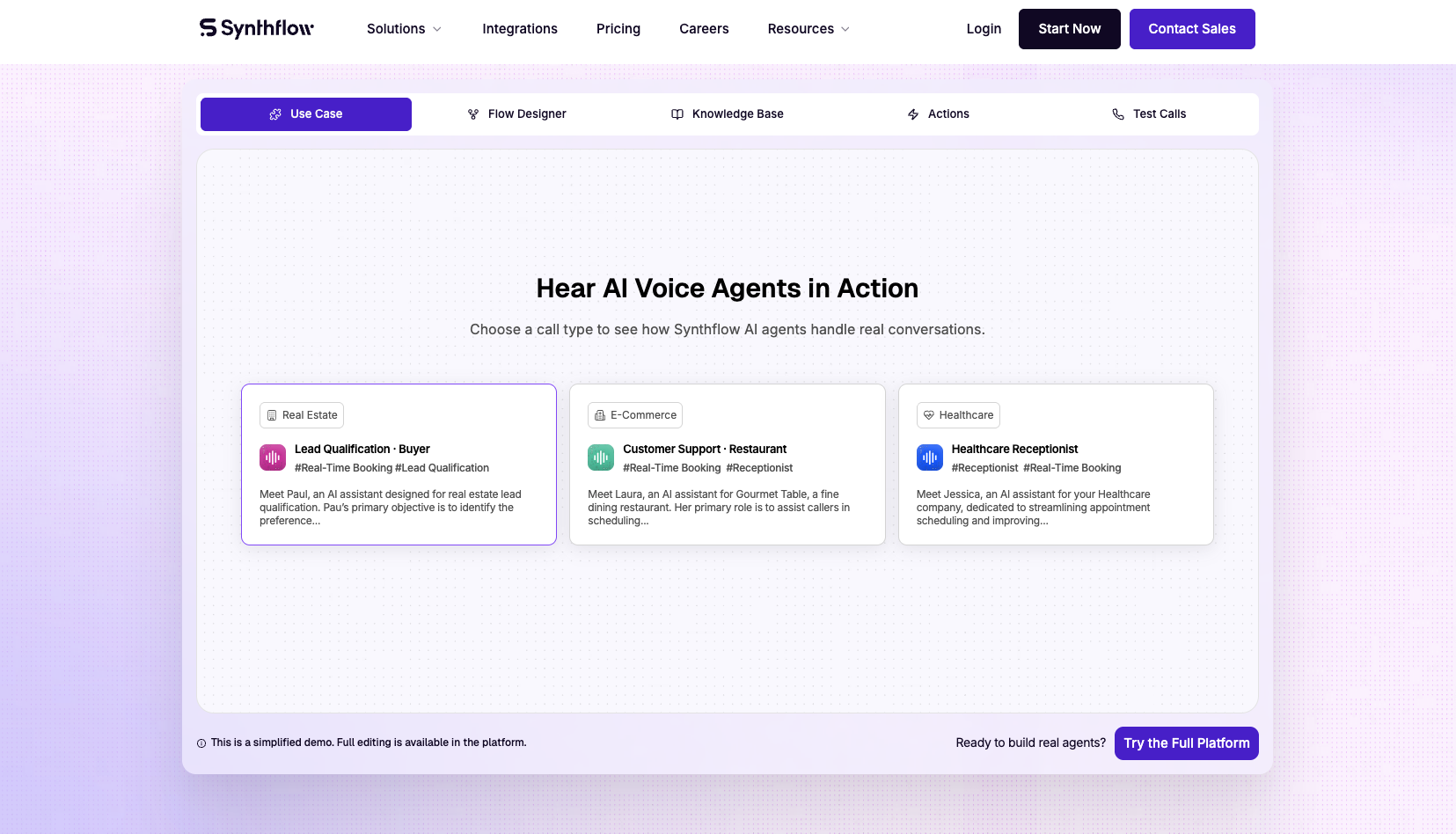
Synthflow AI is a voice-first platform that uses human-like AI agents to manage real-time phone conversations. Its recent Voice Engine 2.0 enhances voice clarity and conversational flow. The best part is that it handles natural interjections smoothly to make calls feel authentic.
Key features
- No-code flow designer: It offers a drag-and-drop studio for building multi-prompt dialogs without coding.
- Built-in noise cancellation: The platform uses Krisp.ai to remove background sounds for clearer voice recognition.
- Voice variety: You get more than 300 AI voices and options to clone custom voices for unique personas.
- Integrations: Synthflow AI supports more than 200 third-party tools, including CRMs and ticketing systems for synced data.
Limitations
Synthflow AI can get pretty expensive pretty fast, especially as the number of calls increases. Lower-tier plans also have limited minutes, so you can’t fully test the service before committing to the more expensive plans.
Pricing: The Starter plan is $29 per month, and the Pro costs $450 per month. Businesses with higher call volumes can get the Growth plan for $900 per month or Agency plan for $1,400 per month. A custom plan is also available.
4. Sierra AI
Best for: Telecommunications and service-focused companies
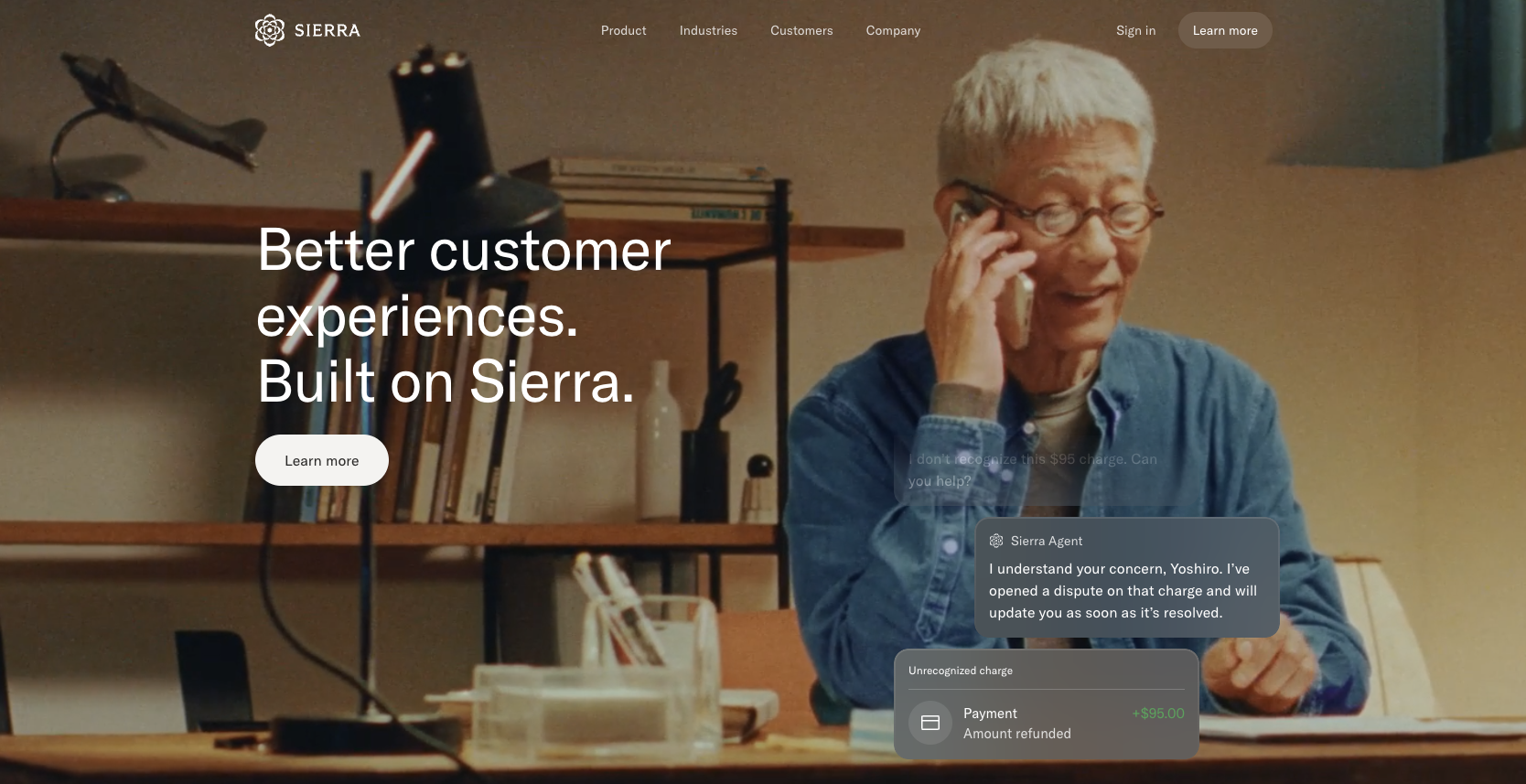
Sierra AI helps businesses deploy AI agents that handle customer service and operational tasks with reasoning and action capabilities. Because it supports both voice and chat, you can scale AI-driven service across the board.
Key features
- Empathetic support: It detects customer emotions and responds appropriately.
- Agent OS: You can build and manage AI assistants within the platform without any technical know-how.
- Multilingual support: The platform supports multiple languages to deliver consistent service globally.
- Performance monitoring: There are tools to track metrics such as fallback rate and resolution accuracy.
Limitations
There is a learning curve for new users, made steeper by a complicated setup process. You also don’t get a lot of prebuilt solutions, so you’ll need to build chatbot use cases from scratch.
Pricing: Customer pricing is available based on an outcome-dependent model. (You pay a fee when the AI agent resolves a customer’s issue.)
5. Poly AI
Best for: Consumer-focused companies that require voice-first AI
Poly AI delivers voice-first conversational AI that helps enterprises handle customer interactions with on-brand conversations across multiple channels. Its AI Agent Studio lets teams build custom AI experiences, and support for more than 45 languages makes it suitable for organizations with a global customer base.
Key features
- Omnichannel delivery: Poly AI supports voice, chat, SMS, social media, and more.
- Data collection: The tool captures and analyzes every call in real time to provide actionable insights.
- Integrations: It offers both out-of-the-box and custom integrations to connect with existing tech stacks.
- Analytics: You get real-time insights with no data gaps.
Limitations
Pricing is not publicly available, but reviews show that a contract-based agreement is required, which doesn’t always suit smaller businesses. Analytics are also not as advanced or comprehensive as competitor tools.
Pricing: Prices are available upon request.
6. Parloa
Best for: Organizations in compliance-heavy sectors
Parloa offers personalized AI agents for businesses looking to deploy generative AI at scale in customer support. Teams can manage AI behavior, filter content, isolate sensitive data, and monitor conversations in real time. The platform meets high security standards, including ISO 27001, ISO 17442, SOC 2, GDPR, HIPAA, and PCI DSS v4.0.
Key features
- Low-code AI agent studio: You can build AI dialogs using flowcharts and natural language prompts.
- Advanced voice features: The tool supports barge-in for real-time interruptions and DTMF input for keypad-based numeric choices.
- Azure-powered speech tech: It uses Microsoft Attack Surface Reduction (ASR) and text-to-speech engines for high-quality speech output.
- Content filtering: It blocks off-brand or inappropriate responses to protect company reputation.
Limitations
Reliance on Microsoft Azure services may affect performance and cost. You also have to fine-tune prompts and ASR grammars to achieve optimal voice quality.
Pricing: Custom pricing is available upon request.
7. Cognigy
Best for: Large enterprises with contact centers that require automated support
Cognigy is a customer service automation platform serving enterprise contact centers that rely on voice-driven support across multiple channels and languages. Teams can use Nodes to shape interactions, such as Question Nodes to request information and Voice Nodes to process spoken input in real time.
Key features
- Built-in NLU engine: It recognizes user intent even in complex conversations and personalizes responses based on previous interactions.
- Intelligent routing: It directs users to the correct flow or agent using confidence levels and context.
- Low-code editor: Nontechnical editors can build bot logic without having to learn how to train a chatbot.
- Analytics: You can use the dashboards to see metrics like NLU accuracy and interaction counts.
Limitations
Deployment can take two to four months. Plus, high upfront costs and the absence of usage-based pricing may be an issue for some organizations.
Pricing: Prices are available upon request.
8. Decagon
Best for: Organizations that want to deliver omnichannel customer experiences
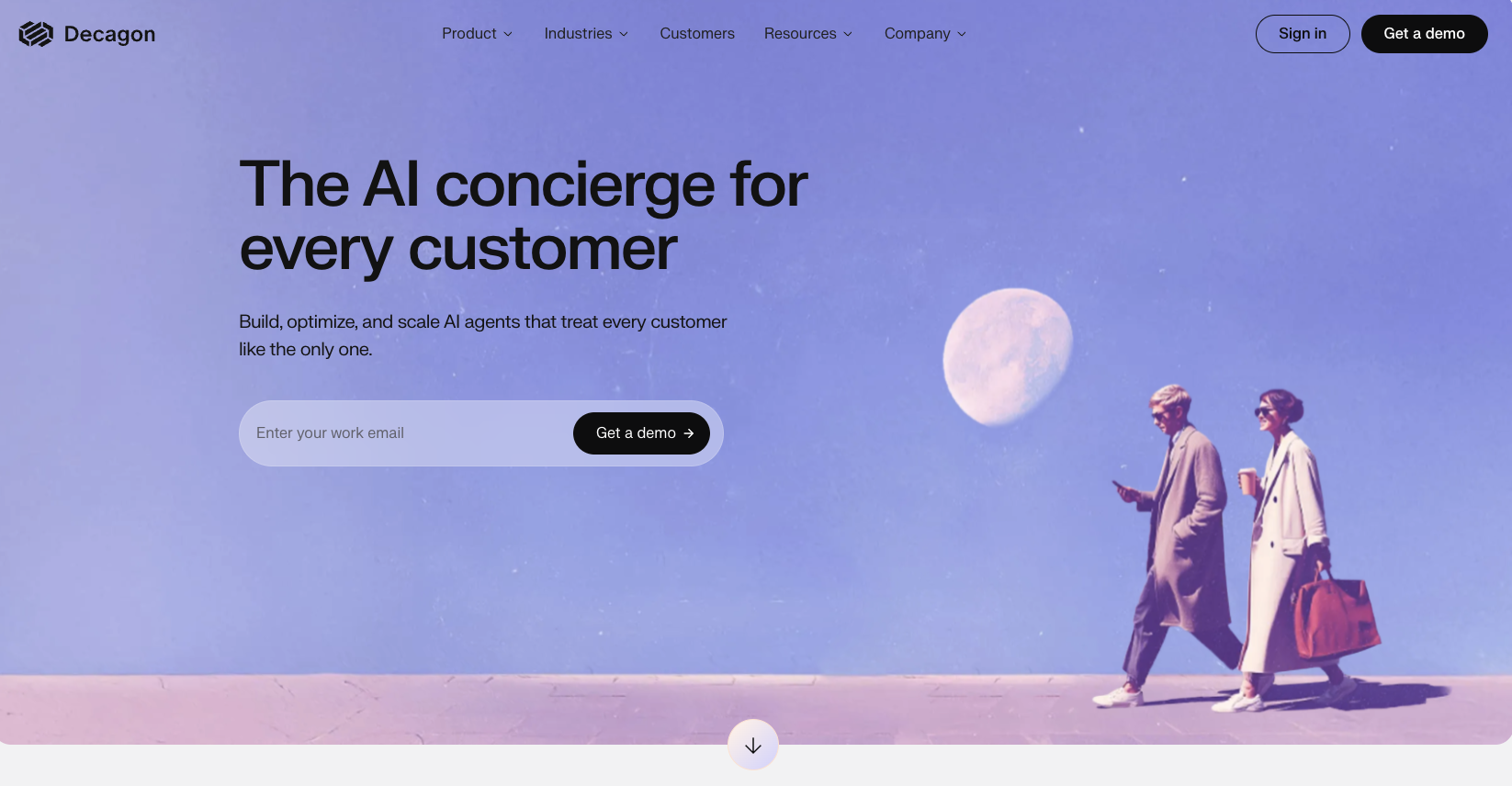
Decagon’s AOPs combine natural language instructions with precise code to allow CX teams to quickly create and iterate on AI logic. Its always-on service keeps interactions available 24-7.
Key features
- Omnichannel support: It provides one AI engine to resolve issues across chat, email, voice, SMS, and custom API surfaces.
- Knowledge graph: The tool combines every customer interaction into a complete context for continuous learning and improvement.
- AI-powered insights: Decagon provides actionable insights and analytics to optimize performance.
- Control over core code: Technical teams can maintain connections with internal systems.
Limitations
The pricing is a bit high since the tool caters to larger enterprises. Users have also reported limited customization, which makes it less flexible compared to other Kore.ai competitors.
Pricing: Pricing is available upon request.
9. Amazon Lex
Best for: Businesses already using AWS infrastructure
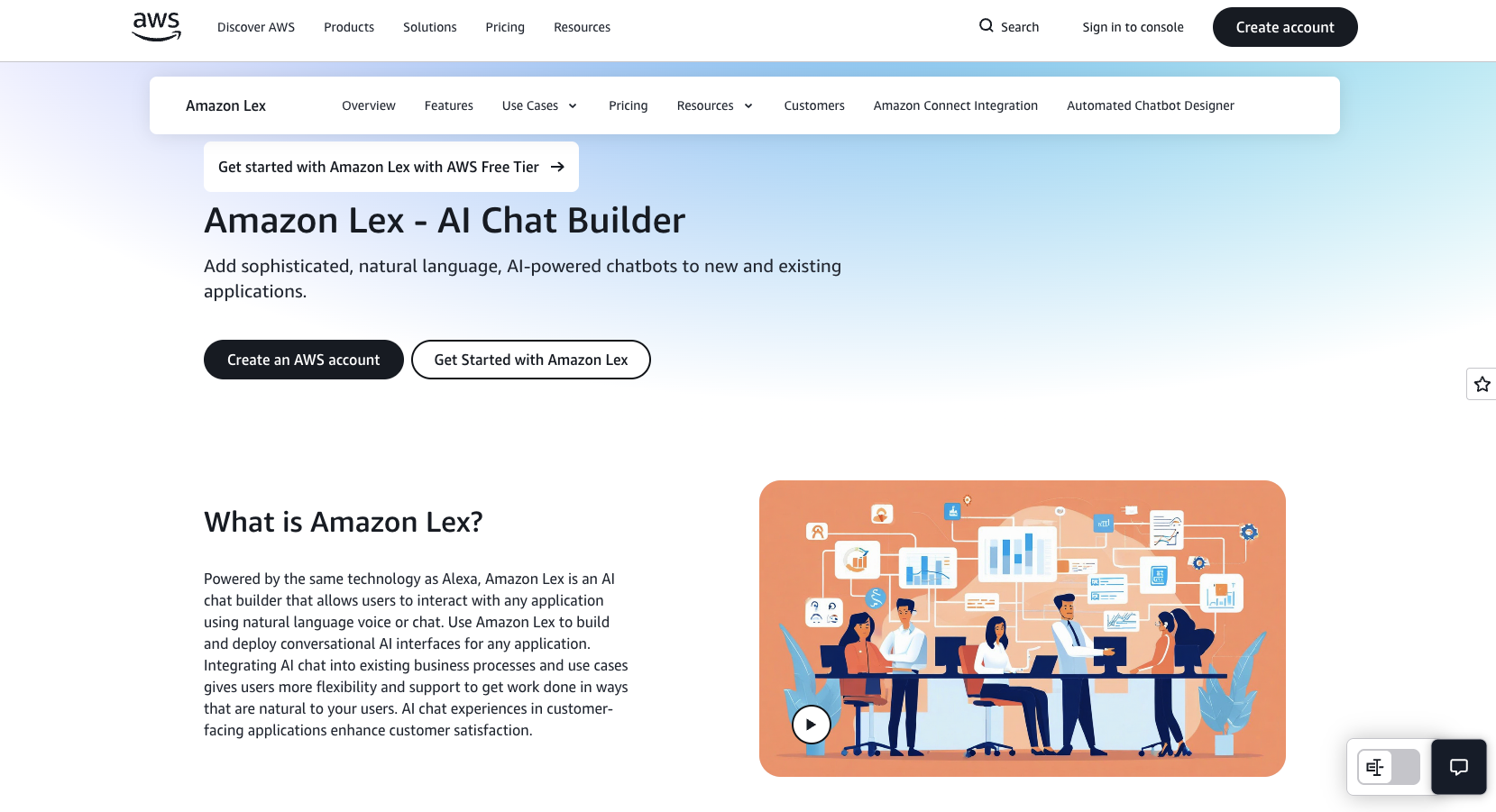
Amazon Lex is an AI chat builder powered by the same technology behind Amazon’s Alexa. It lets you add natural language voice and chat capabilities to applications to create business-specific conversational interfaces.
Key features
- Automation speed recognition: Lex converts spoken language into text to enable voice interactions.
- AWS service integration: It works with other AWS tools and services.
- Omnichannel engagement: You can deploy chatbots across multiple platforms and channels.
- Pay-as-you-go pricing: The platform provides flexible, usage-based pricing, so you don’t need a large upfront investment.
Limitations
Knowing the basics of chatbots isn’t enough to use this tool to its full potential, since complex workflows require custom development expertise. The analytics in Lex are also less advanced than other tools.
Pricing: You pay as you use the tool. The AWS pricing calculator helps you estimate costs.
10. Google Dialogflow
Best for: Organizations that want to personalize voice assistants and chatbots
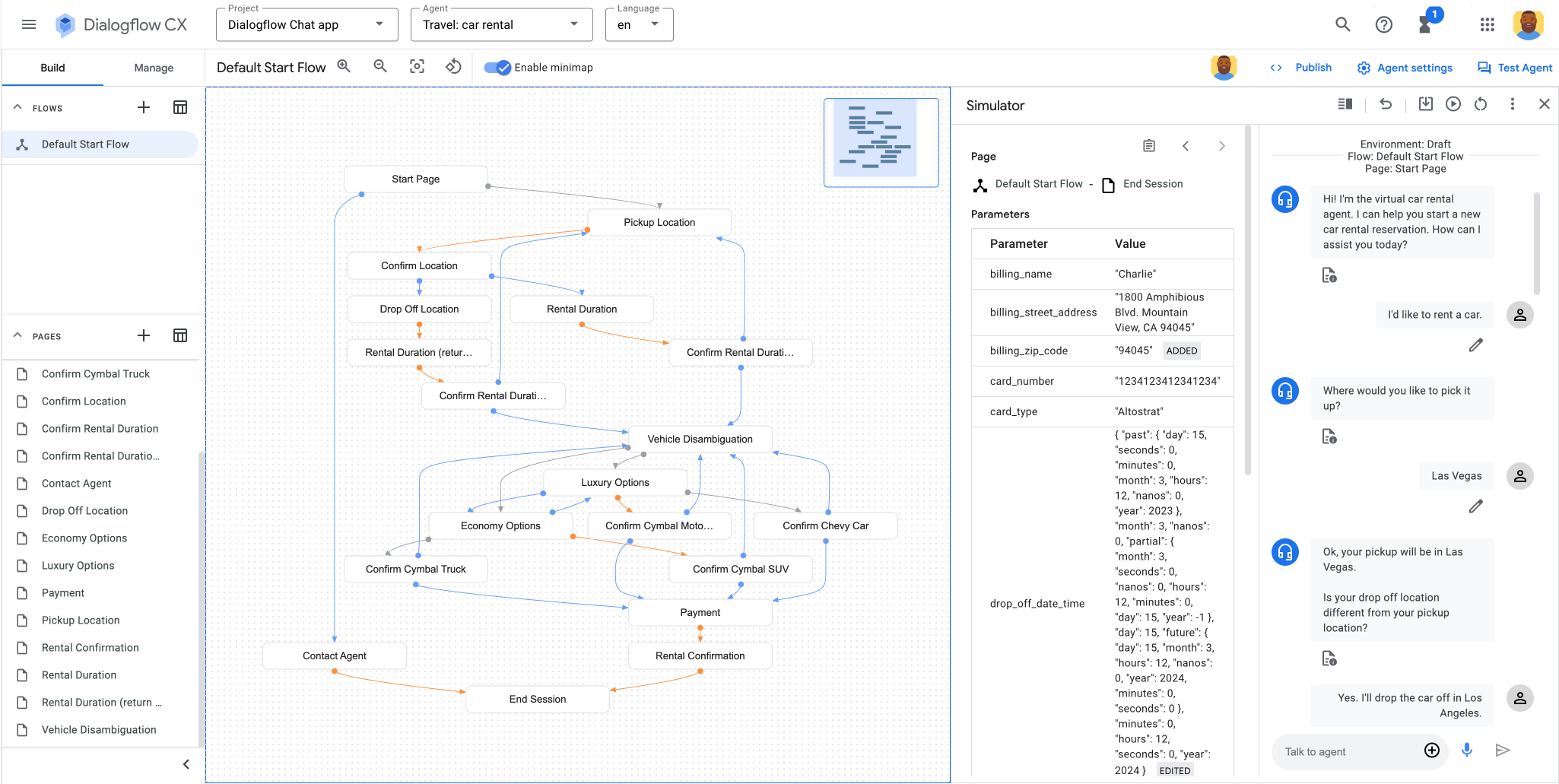
Dialogflow, part of Google Cloud’s Conversational AI suite, is an NLU platform that helps businesses build conversational interfaces. It supports both text and audio input, enabling versatile engagement with end users while providing automated responses via text or synthetic speech.
Key features
- Dialogflow CX and ES: CX offers advanced features for large-scale agents while ES suits simpler agents.
- Synthetic speech responses: It converts text responses into speech for voice interactions.
- Google Cloud integration: The tool works with Google Cloud tools for analytics and management.
- Customizable virtual agents: It helps build agents tailored to your business needs, from simple FAQs to complex multi-turn conversations.
Limitations
Dialogflow implementation can be time-consuming, especially for complex agent designs that often require assistance from developers or external consultants. The CX version introduces a flow-based model with a steep learning curve, which may require teams to retrain. Voice support continues to improve but is not yet best in class.
Pricing: Conversational Agents are billed monthly based on the edition and the number of requests made that month. New customers receive a $600 credit for a free trial of Conversational Agents.
Conclusion
There’s no denying that Kore.ai is a good solution for enterprises that need a powerful AI platform, but its complexity and high entry cost can be real barriers. Fortunately, the market offers several Kore.ai competitors, such as the ones we’ve discussed here.
These tools offer flexible AI chatbot pricing, along with simpler setup and advanced features that the Kore chatbot lacks. So, you’re sorted.