
Summary
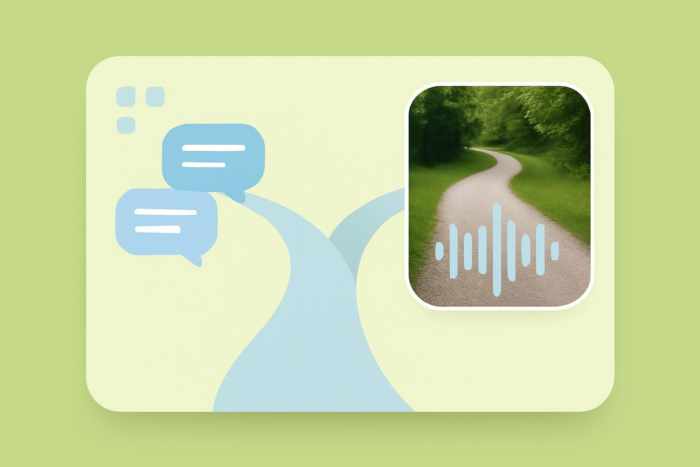
Chatbots and voice bots are two types of AI-powered assistants that help businesses automate support, guide users through tasks, and reduce pressure on human teams. Chatbots are great for private, text-friendly settings, while voice bots are most effective when users need a hands-free, faster alternative to typing. Choosing the right option depends on your channels, audience behavior, and service needs.
TL;DR
- This guide explains what chatbots and voice bots are, how they work, and where each one fits best in real-world customer journeys.
- Chatbots are strongest in digital channels like websites, apps, and messaging, where users want fast, discreet, text-based and guided, step-by-step support.
- Voice bots are strongest in phone and voice channels, where hands-free convenience, accessibility, and natural spoken explanations matter.
- You will also see a side-by-side comparison, use-case breakdowns, and practical advice on when to choose one, when to combine both, and how resources like Noupe can help you design and test your conversational AI strategy.
Chatbot vs voice bot: Core differences
Quick comparison table
| Category | Chatbot | Voice bot |
|---|---|---|
| Interaction mode | Text-based messaging | Spoken, audio-based responses |
| Best for | FAQs, structured tasks, multitaskers | Hands-free tasks, phone-based support |
| Speed | Fast but typing-dependent | Faster for long explanations |
| User comfort | Ideal in quiet or private settings | Ideal when speaking is convenient |
| Accessibility | Best for reading/typing users | Best for visually impaired users |
| Setup complexity | Lower | Higher |
| Channels | Websites, apps, messaging | Phones, smart speakers |
| Use cases | Order tracking, onboarding | Call routing, appointment scheduling |
In short
A chatbot is a text-based AI assistant that handles conversations on websites, apps, and messaging platforms. Chatbots interpret user intent, provide automated responses, and guide people through tasks without human intervention.
What is a chatbot?
A chatbot is a text-based conversational assistant that interacts with users on websites, apps, and messaging platforms. Users often encounter chatbots when tracking orders, troubleshooting software, or signing up for services.
Modern chatbots combine several technologies:
- Natural language understanding (NLU) to identify user intent
- AI-generated responses for natural conversation
- Workflow automation for tasks like onboarding and troubleshooting
- Integrations with CRMs or databases to fetch information instantly
Chatbots act as the first point of contact, handling repetitive questions, guiding users through self-service steps, and providing 24/7 support.
In short
Chatbots are a practical advantage for businesses, helping them deliver faster, more consistent, and more scalable digital support.
6 Benefits of chatbots
Chatbots offer several practical advantages that help businesses deliver faster, more consistent, and more scalable digital support.
1. 24/7 availability
Chatbots provide instant answers at any time, which is critical for global audiences and always-on services. With Noupe, you can add a 24/7 website chatbot in minutes using a single line of embed code and automatic website learning, so visitors always get a response even when your team is offline.
2. Reduced support workload
Chatbots filter repetitive questions so your team can focus on complex, high-value issues. Noupe is designed to handle common website questions automatically by learning from your existing pages, which helps reduce back-and-forth email and basic support requests without requiring you to script every answer.
3. Strong for private, quiet, or discreet contexts
Text chat works well when users can’t or don’t want to speak aloud, such as in shared spaces or sensitive situations. Because Noupe lives directly on your site as a small, unobtrusive widget, visitors can ask questions quietly while staying on the page they’re viewing.
4. Excellent for structured tasks
Chatbots are ideal for step-by-step flows like FAQs, basic troubleshooting, or guiding users to the right page. Noupe scans your content and turns it into a structured knowledge source for the chatbot, helping it route visitors to the most relevant page or answer without you having to build complex workflows manually.
5. Highly scalable
Chatbots can handle many conversations at once, so no one is stuck in a queue. Noupe is built to support growing traffic on websites of all sizes, making it a fit for small businesses, education, and IT teams that need scalable support without a full contact center.
6. Simple to update and deploy
Traditional bots can require complex configuration, but Noupe focuses on zero-setup deployment: you point it at your website, copy the generated code, and the chatbot goes live with your existing content. When you update your site or knowledge sources, Noupe can refresh what it knows without you rebuilding flows from scratch.
In short
Chatbots are not without limitations, as chatbots can struggle with accuracy, empathy, and accessibility in certain situations.
4 Challenges of chatbots
Despite their strengths, chatbots also come with limitations that can affect accuracy, empathy, and accessibility in certain situations.
1. Limited emotional resonance
Chat is efficient, but customers dealing with stressful or personal issues may prefer speaking to a human.
2. Misinterpretation of slang or unclear messages
Simple or rule-based bots may struggle with non-linear phrases, typos, or sarcasm.
3. Slower for users who type slowly
Typing long messages can feel tedious.
4. Not ideal for visually impaired users
Although screen readers help, voice-first support may be a better alternative for many users.
In short
A voice bot is an AI system that uses speech recognition to understand spoken language, automate phone interactions, and guide users through voice-driven workflows.
What is a voice bot?
Voice bots are highly effective for quick, hands-free communication, offering strong accessibility benefits and seamless user experiences. Users commonly encounter voice bots when calling customer support or using voice assistants.
Voice bots are relied on scenarios where:
- Automatic speech recognition (ASR) to convert speech to text
- Natural language understanding (NLU) to identify intent
- Text-to-speech (TTS) to generate spoken replies
- Voice workflows that guide the conversation
Businesses use voice bots to automate call centers, schedule appointments, route inquiries, and support users who prefer speaking instead of typing.
In short
Voice bots are well-suited for fast, hands-free communication, offer strong accessibility benefits, and enable efficient call routing for phone-heavy industries.
5 Benefits of voice bots
Voice bots are built to deliver unique strengths in speed, accessibility, and hands-free interaction, making them well-suited for phone-heavy or multitasking environments.
1. Natural and intuitive communication
Speaking feels effortless for most users, especially when describing complex issues.
2. Hands-free convenience
Voice bots are ideal when users are driving, cooking, moving, or multitasking.
3. Greater accessibility
Voice interactions support visually impaired or mobility-limited users who struggle with typing or screen navigation.
4. Effective for phone-heavy industries
Healthcare, logistics, transportation, and local services benefit from automated call routing and shorter wait times.
5. Reduced call center strain
Voice bots handle routine calls and free up human agents for high-value cases.
In short
Voice bots are prone to misinterpreting speech in noisy environments, often struggle with accents, and require more technical components than chatbots.
4 Challenges of voice bots
Voice bots are limited by factors like background noise, speech variation, and more complex setup requirements.
1. Sensitive to background noise
Busy environments can affect speech recognition accuracy.
2. Not suited to quiet places
Users may feel uncomfortable speaking aloud in shared spaces.
3. Difficulty with accents or rapid speech
Voice AI can misinterpret strong accents or fast talkers, leading to repeated prompts.
4. More complex setup
Voice bots require ASR, TTS, telephony, and workflow design, which increases implementation time.
In short
Chatbots are best suited for text-first experiences, while voice bots are ideal for phone-based and hands-free scenarios. The right choice is determined by where users interact most.
Which should you choose?
Choose a chatbot if:
- Your audience prefers messaging
- You want a highly accessible website or in-app tool
- Your workflows require visual elements or guided steps
- You want quick setup and easy updates
- You’re aiming to reduce repetitive support tickets fast
Choose a voice bot if:
- You receive many phone inquiries
- Customers often multitask
- Accessibility is a priority
- You need fast, natural conversation
- You want to reduce call center strain
Choose both for an omnichannel experience
Many businesses pair a chatbot for web visitors with a voice bot for callers, ensuring users can access support in whatever way they prefer — whether typing, speaking, or seamlessly switching between channels.
In short
Choose chatbots for digital, structured tasks and choose voice bots for phone-based, accessibility-focused, or hands-free interactions.
Chatbot vs voice bot by use case (2025)
| Use Case | Best Use of Chatbots | Best Use of Voice Bots |
|---|---|---|
| Customer service | Website/app support, instant responses | Handling high call volumes, hands-free assistance |
| E-commerce | Order tracking, returns, product FAQs | Shipping updates, urgent delivery queries |
| Small businesses | Low-cost, fast deployment | Reducing phone workload, automating appointments |
| Healthcare | Intake forms, digital triage | Scheduling, after-hours calls, accessibility needs |
| Banking & finance | Secure on-page workflows | Fraud alerts, ID verification, transaction support |
| Accessibility | Text-based, screen-reader friendly | Ideal for visually impaired or mobility-limited users |
| Appointment scheduling | Web-based booking flows | Quick rescheduling while multitasking |
| Complex issues | Step-by-step troubleshooting | Detailed verbal explanations |
| High-emotion scenarios | Quick information | Natural, conversational reassurance |
In short
Noupe is a platform that provides tools and resources to help businesses design, deploy, and refine chatbot and voice bot strategies using practical AI guidance.
Choosing the right conversational AI for your business
Chatbots and voice bots both offer meaningful advantages, but the right choice depends on how your customers prefer to communicate. Chatbots are better when users need privacy, visual guidance, or quick message-based support, while voice bots are ideal for hands-free convenience, accessibility, or situations that benefit from more detailed verbal interaction.
Many companies now deploy chatbots and voice bots together to deliver a unified support experience across channels.
If you’re exploring conversational AI further, Noupe provides practical insights, design guidance, and trends to help you strengthen your automation strategy.
FAQ
Noupe identifies four commonly used chatbot types: rule-based bots, AI/NLU chatbots, hybrid bots, and transactional workflow bots.
Rule-based bots follow predefined scripts, AI bots interpret intent using machine learning, hybrid bots combine scripted and AI logic, and workflow bots guide users through structured actions like onboarding or form submission.
Noupe clarifies that “bot” is a broad term for any automated software task, while a “chatbot” is a bot designed specifically for conversation.
Bots can crawl websites, run automations, or process data, whereas chatbots interact with users through text or voice to answer questions, guide tasks, or provide support.
Noupe classifies Siri as an AI-powered voice assistant rather than a traditional chatbot because it relies on voice recognition, natural language understanding, and system-level automation.
Siri uses advanced AI models to interpret speech, manage device functions, and respond conversationally—but it is built as a voice assistant, not a text-first chatbot.

