

Summary
- Botpress is the open-source, developer-friendly AI agent platform for teams that want deep customization, multi-channel deployment, and advanced NLP with optional code-level control.
- WATI is the WhatsApp-first team inbox and automation platform for SMBs that want WhatsApp-native workflows, collaboration, broadcasts, and CRM integrations in one place.
- ManyChat is the easy, marketing-led automation platform for brands that want WhatsApp campaigns, lead capture, and multi-channel journeys with a drag-and-drop builder.
- Intercom is the enterprise customer messaging platform for larger teams that need scalable support operations, advanced routing, reporting, and AI-assisted resolution with WhatsApp included.
- Yellow.ai is the enterprise conversational AI suite for organizations that need omnichannel automation, strong voice AI, extensive language coverage, and secure custom integrations.
- Chatbase is the fast, no-code AI agent builder for teams that want to train a bot on their own content and publish it across WhatsApp and other channels for support and lead qualification.
- Freshchat is the omnichannel support messaging platform for service teams that want WhatsApp alongside live chat and email, with a shared inbox, bots, routing, and reporting.
With over two billion users across 180+ countries, WhatsApp isn’t just a messaging app; it’s the world’s largest customer service platform waiting to be automated. While 83 percent of consumers use messaging apps like WhatsApp to contact businesses, most companies still rely on manual responses that can’t keep pace with customer expectations.
The reality is stark: 18 percent of e-commerce shoppers abandon their carts due to slow responses from businesses. Meanwhile, 75 percent of messaging app users make purchases after receiving prompt replies. This gap between customer expectations and business capabilities presents a major opportunity for automated software solutions.
Bridging this divide, WhatsApp chatbots provide instant, intelligent responses that operate 24-7 without human intervention. From handling customer inquiries to processing orders and booking appointments, these AI-powered assistants transform how businesses engage with customers on the world’s most popular messaging platform.
For businesses seeking even simpler solutions, Noupe offers instant chatbot creation without WhatsApp integration, providing immediate automated customer support in minutes. For companies looking to leverage WhatsApp’s massive user base and familiar interface, dedicated WhatsApp chatbots offer unmatched reach and engagement opportunities.
What is a WhatsApp chatbot?
A WhatsApp chatbot uses AI or rule-based logic to engage customers through WhatsApp conversations without requiring human agents. These bots operate through the familiar WhatsApp chat interface, making interactions feel natural while answering questions instantly.
Unlike traditional customer service channels, WhatsApp bots use natural language processing (NLP) to understand user intent and provide relevant responses. When a user sends a message to your business account, the bot processes the input, identifies the customer’s needs, and responds with appropriate information or actions, all within seconds.
Modern WhatsApp AI chatbots handle complex conversations far beyond simple FAQ responses. They can process orders, schedule appointments, provide product recommendations, and even execute payment transactions. When queries become too complex, these intelligent systems seamlessly engage human agents, ensuring customers always receive the support they need.
Real-world applications demonstrate the power of WhatsApp automation. For example, Starbucks uses a WhatsApp bot for order management and payments, allowing customers to place orders and pay without waiting in line.
Why your business needs a WhatsApp chatbot
Customer expectations have fundamentally shifted toward instant communication. When potential customers contact your business, they expect rapid resolution of their issues. Traditional manual responses simply cannot meet this demand at scale, creating a critical gap that automated solutions must fill.
The numbers tell a compelling story about response speed impact on business outcomes. Research shows that 53 percent of e-commerce shoppers abandon their carts when they don’t receive instant replies to their questions. This abandonment represents lost revenue that could be recovered with immediate automated responses, keeping customers engaged during critical decision points.
Scale limitations become apparent as businesses grow. A single human agent can handle only a limited number of conversations simultaneously, creating bottlenecks during peak periods or high-volume marketing campaigns. WhatsApp chatbots eliminate these constraints by managing thousands of simultaneous conversations, ensuring every customer receives immediate attention regardless of timing or volume.
Cost efficiency represents another crucial advantage. Manual customer service requires significant staffing investments, especially for 24-7 coverage across multiple time zones. Automated replies through WhatsApp bots dramatically reduce support costs while actually improving customer satisfaction through faster response times and consistent service quality.
The conversion improvement potential is substantial. When customers receive prompt, helpful responses to their inquiries, they’re significantly more likely to complete purchases.
Beyond immediate customer service benefits, WhatsApp automation creates opportunities for proactive customer engagement. Bots can send notifications about order status updates, appointment reminders, and personalized offers, transforming WhatsApp into a comprehensive customer relationship management channel.
WhatsApp business API requirements
Creating WhatsApp chatbots traditionally requires navigating the complex WhatsApp Business API setup process. This involves obtaining a verified WhatsApp Business Account with a dedicated phone number, setting up Facebook Business Manager verification, and working with business solution providers to gain API access, which cancan take weeks or even months.
The traditional approach requires
- A unique WhatsApp business number (separate from personal use)
- Complete Facebook Business Manager verification
- Business documentation and use case explanations
- Compliance with WhatsApp’s commerce and messaging policies
- Two-step authentication and security protocols
For many businesses, these technical requirements create significant barriers to deploying automated customer service solutions quickly.
The streamlined alternative
Instead of navigating complex API requirements independently, businesses can use existing integrations that handle the technical complexity behind the scenes. This approach reduces setup time from months to just a few hours while maintaining full WhatsApp functionality.
With platforms that offer integrated WhatsApp access, businesses can focus on designing effective customer conversations rather than managing technical infrastructure. The result is faster deployment, lower technical barriers, and the same powerful automation capabilities that traditionally required extensive API management.
Best 7 WhatsApp chatbot platforms in 2026
| Platform | Core focus | Pricing model | Key differentiator |
|---|---|---|---|
| Botpress | Customizable AI agents for multi-channel automation | Free tier and pay-as-you-go AI credit, plus Plus, Team, and Enterprise tiers with AI spend | Open-source roots with deep customization and strong multi-channel agent building |
| WATI | WhatsApp team inbox and customer messaging automation | Monthly tiers (Growth, Pro, and Business) | WhatsApp-native workflows with a shared inbox, broadcasts, and CRM integrations |
| ManyChat | Marketing automation for WhatsApp and social messaging | Free tier, Pro monthly, and Elite custom | Campaign-first flow builder designed for lead generation, nurturing, and social integrations |
| Intercom | Enterprise customer service and customer messaging | Per-seat pricing with usage-based components | Mature support operations platform with advanced routing, reporting, and scalable automation |
| Yellow.ai | Enterprise conversational AI and voice automation | Free entry tier and Enterprise custom | Strong voice AI with broad language support for complex global deployments |
| Chatbase | No-code AI bot builder trained on your business content | Free tier, Hobby, Standard, and Pro monthly, plus Enterprise custom | Fast setup by training on documents and URLs, then deploying across multiple channels |
| Freshchat (Freshworks) | Omnichannel support inbox and chatbot automation | Free tier and per-agent tiers (Growth, Pro, and Enterprise) | Unified inbox across chat, email, social, and WhatsApp with routing, SLAs, and reporting |
The landscape of WhatsApp chatbot creation has evolved dramatically, with multiple platforms now offering no-code solutions that make bot building accessible to businesses of all sizes. Each platform brings unique strengths, pricing models, and integration capabilities that cater to different business needs and technical requirements.
1. Botpress
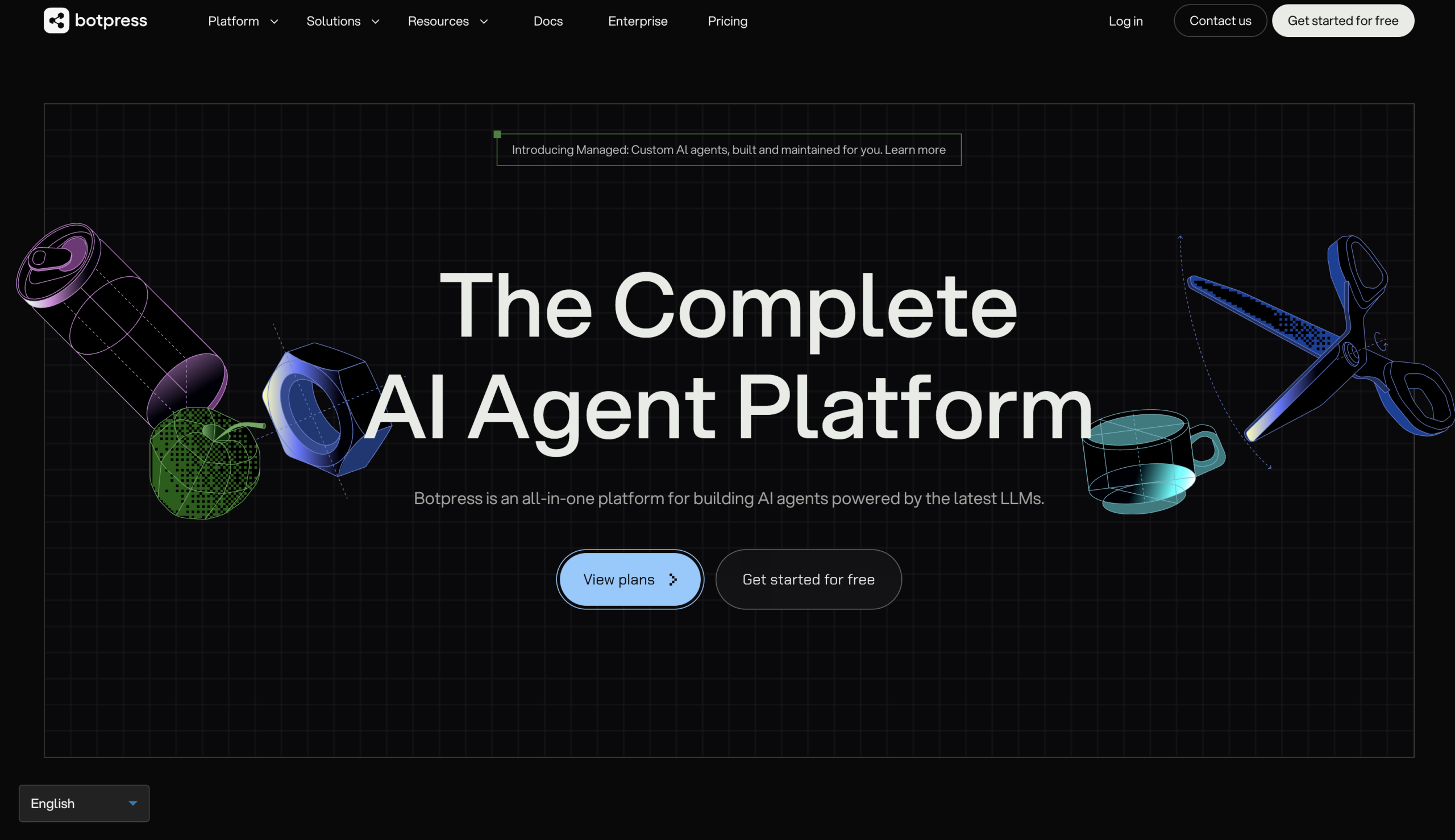
Botpress is a powerful open-source platform that has evolved into a comprehensive AI agent solution, offering extensive customization for developers and businesses with complex requirements.
Key features
- Visual flow builder with advanced AI integration
- Multi-channel publishing (WhatsApp, Facebook, Telegram, Slack)
- Built-in NLP and machine learning capabilities
- Extensive third-party integrations
- Custom code support for advanced users
- Knowledge base integration
- Live chat handoff capabilities
Pricing
- Pay-as-you-go: Free tier with $5 monthly AI credit
- Plus: $89/month + AI spend
- Team: $495/month + AI spend
- Enterprise: Starting at $2,000/month
Pros
- Highly customizable and extensible
- Strong developer community support
- Advanced AI and NLP capabilities
- Generous free tier for testing
- Multiple deployment options
Cons
- Steeper learning curve for nontechnical users
- Complex pricing structure with AI usage costs
- Publishing to Facebook/Instagram requires technical setup
2. WATI (WhatsApp Team Inbox)
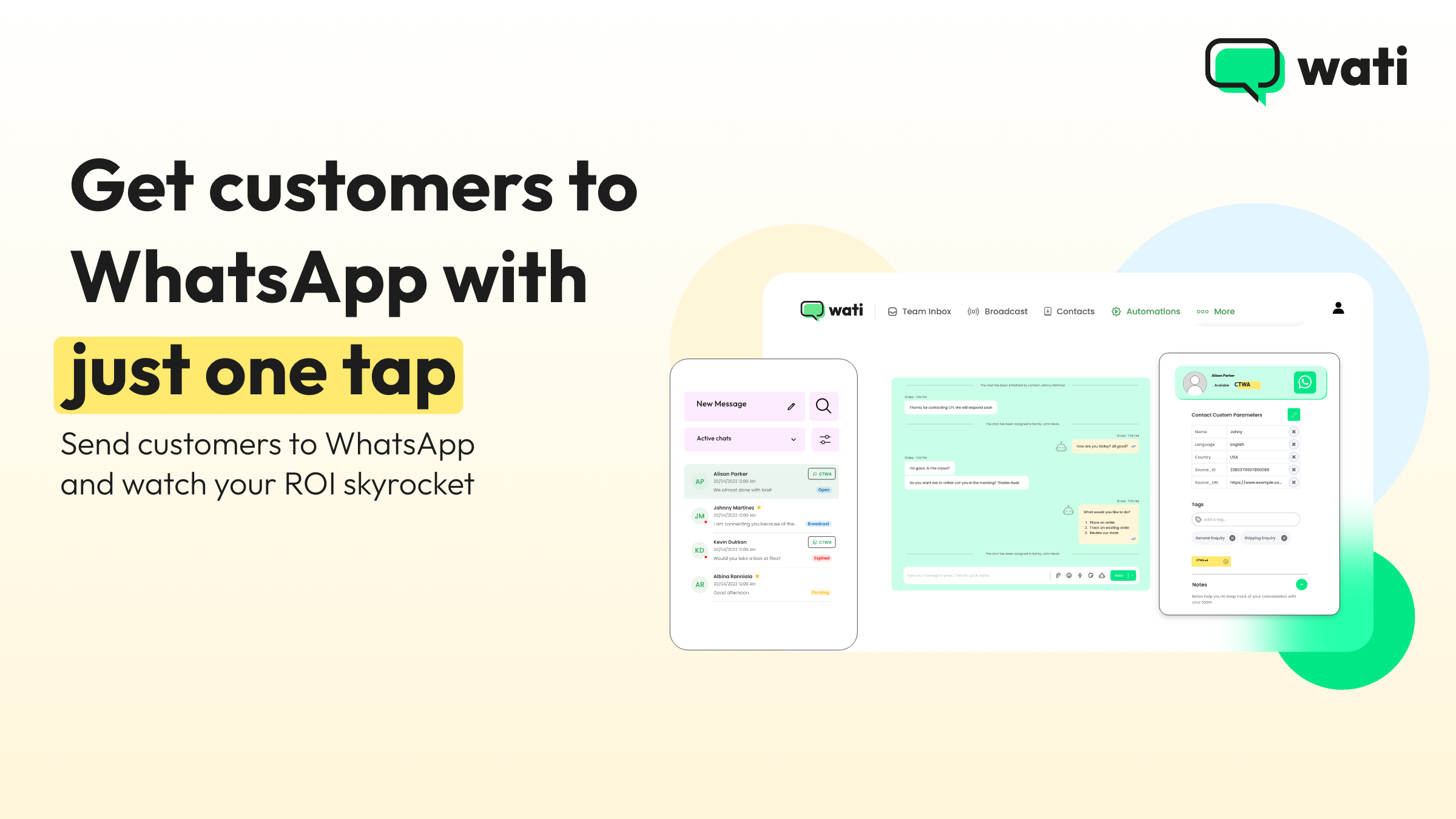
WATI is a WhatsApp-focused platform tailored for small to medium businesses, offering comprehensive messaging automation and team collaboration features.
Key features
- WhatsApp-native design and optimization
- Multi-agent team inbox and collaboration
- Broadcast messaging and campaign management
- No-code chatbot builder with drag-and-drop interface
- CRM integrations (HubSpot, Salesforce, Zoho)
- Analytics and performance tracking
- Automated workflows and triggers
Pricing
- Growth: $49/month — three users
- Pro: $99/month — Enhanced features and higher limits
- Business: $249/month with all advanced features
Pros
- Specifically built for WhatsApp Business API
- Strong team collaboration features
- Good value for WhatsApp-focused businesses
- Comprehensive automation capabilities
- No setup fees
Cons
- Limited to WhatsApp and few other channels
- Can become expensive with high usage
- Complex pricing with conversation markups (up to 20 percent)
- Learning curve for advanced features
3. ManyChat
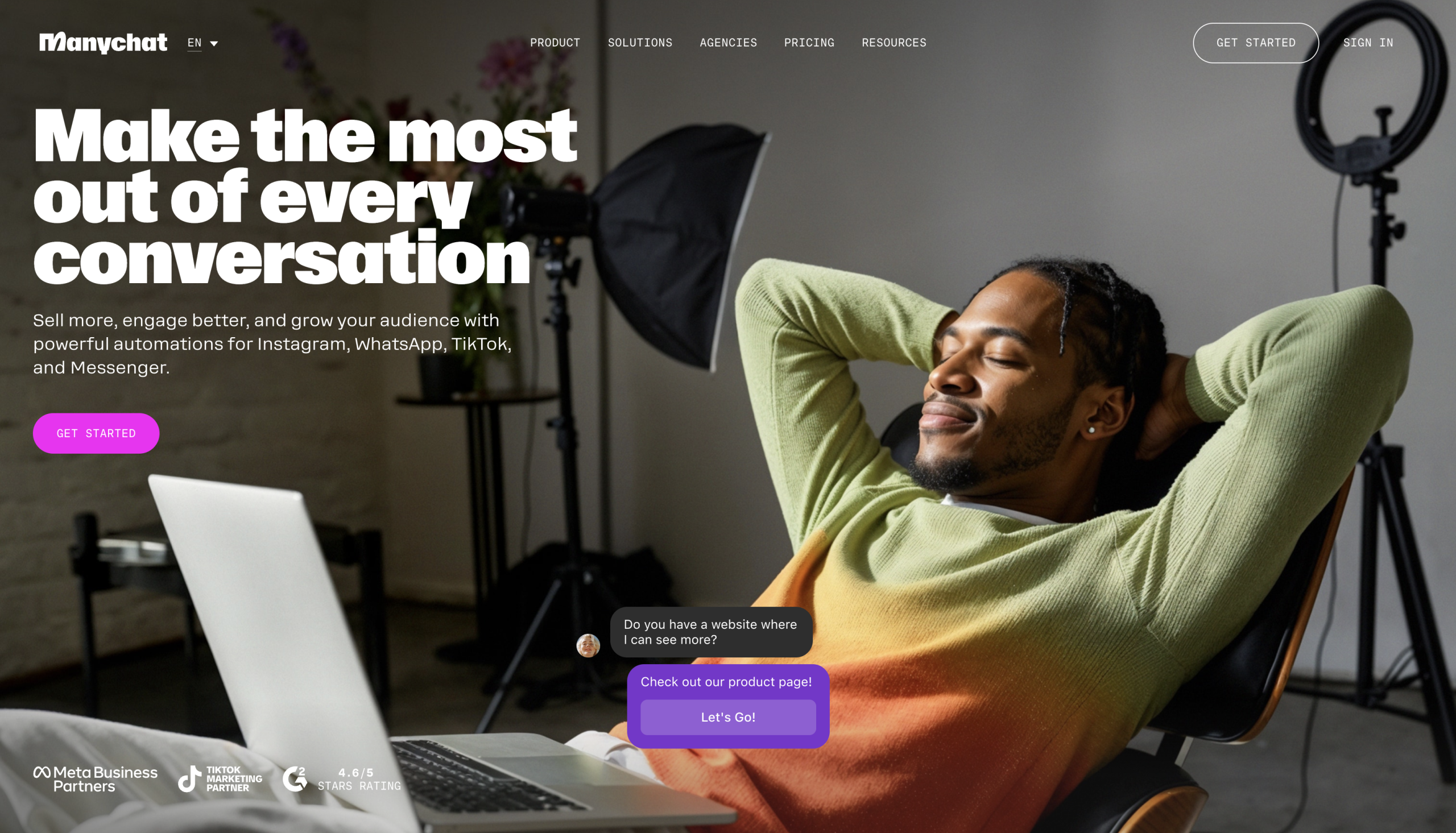
A popular marketing automation platform that excels in creating engaging WhatsApp campaigns, ManyChat streamlines customer journeys with strong social media integration.
Key features
- Visual flow builder with drag-and-drop interface
- Multi-channel support (WhatsApp, Facebook, Instagram, SMS)
- AI-powered features and intents
- Broadcast messaging and sequence automation
- A/B testing capabilities
- E-commerce integrations
- Built-in live chat functionality
Pricing
- Free: Up to 1,000 contacts with basic features
- Pro: Starting at $15/month
- Elite: Custom pricing for advanced AI features
Pros
- Extremely user-friendly interface
- Strong marketing automation features
- Excellent for lead generation and nurturing
- Good integration with social media platforms
- Affordable pricing for small businesses
Cons
- Limited advanced AI capabilities without add-ons
- Separate message creation needed for each channel
- Translation features could be improved
- Basic analytics on lower tiers
4. Intercom
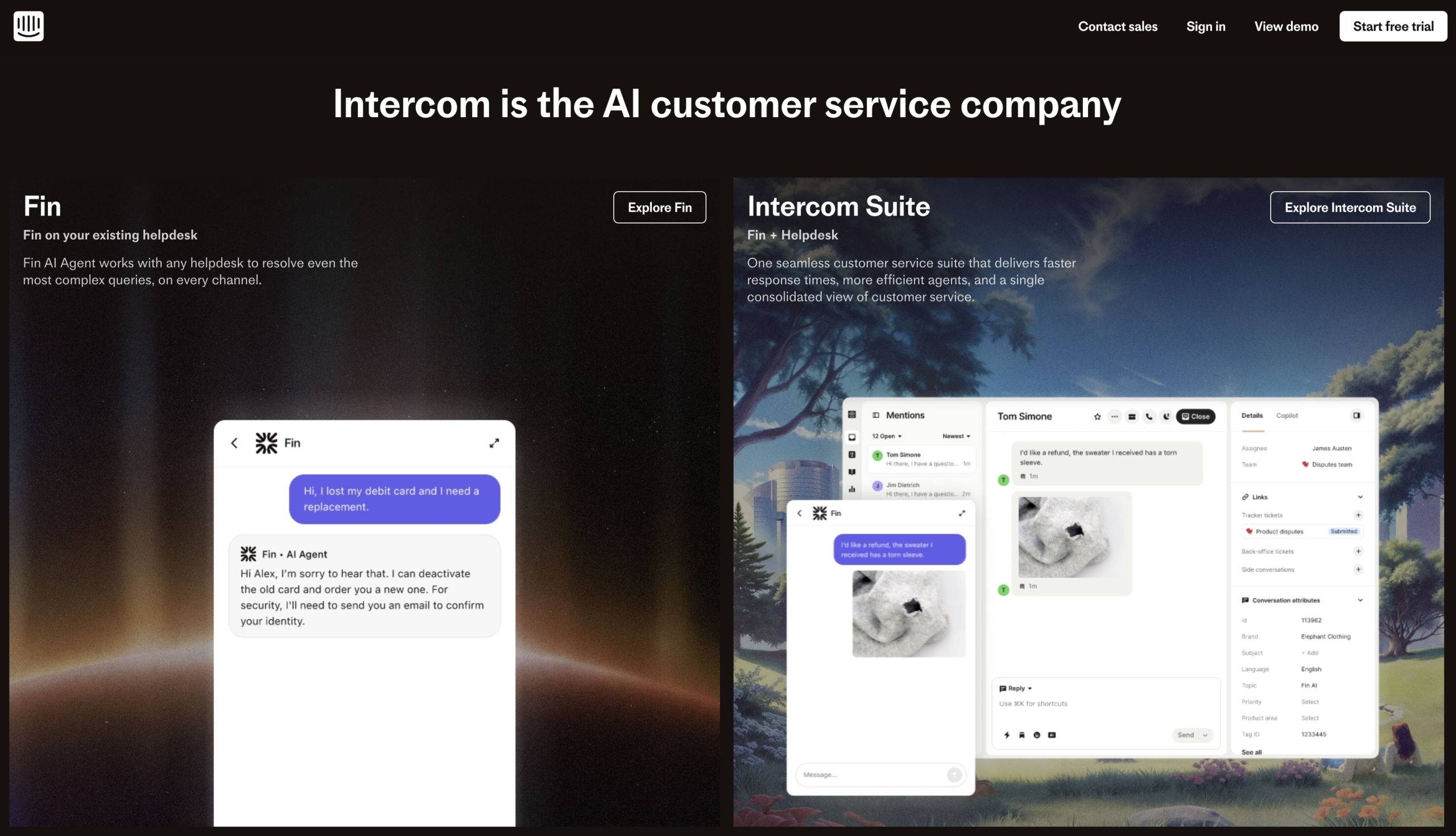
An enterprise-grade customer service platform with robust WhatsApp integration, Intercom is ideal for larger businesses requiring comprehensive customer communication solutions.
Key features
- Advanced conversation routing and assignment
- AI-powered resolution bot with custom training
- Comprehensive reporting and analytics
- Enterprise security and compliance features
- Advanced workflow automation
- Multiple channel support
- Custom app integrations
Pricing
- Essential: Starting at $29/month per seat + $0.99 per resolution
- Advanced: Higher tier with additional features for $85.
- Enterprise: $132 for collaboration, security and multi-brand features.
Pros
- Mature platform with enterprise-grade features
- Strong AI and automation capabilities
- Excellent reporting and analytics
- Proven scalability for large organizations
- Comprehensive integration ecosystem
Cons
- Expensive for small businesses
- Complex pricing structure
- Requires significant setup and training
- May be overkill for simple chatbot needs
5. Yellow.ai
Yellow.ai is an enterprise-focused conversational AI platform with strong voice capabilities and extensive customization options for complex business workflows.
Key features
- Multi-large-language-model architecture with 15+ language models
- Advanced voice AI capabilities (VoiceX)
- 135+ language support
- Enterprise-grade security and compliance
- Custom integrations and APIs
- Advanced analytics and insights
- Omnichannel deployment
Pricing
- Free: one chatbot, two channels, one Custom API integrations for free
- Enterprise: Custom pricing for unlimited number of bots.
Pros
- Advanced AI and voice capabilities
- Strong enterprise features and security
- Extensive language support
- Proven track record with large enterprises
- Comprehensive customization options
Cons
- Complex and expensive for small businesses
- Requires technical expertise for setup
- Limited transparency in pricing
- Primarily designed for large enterprises
6. Chatbase
Chatbase is a no-code AI agent builder that allows businesses to train chatbots on their own content and deploy them across channels, including WhatsApp. It’s designed for fast setup and is especially useful for support, lead qualification, and knowledge-based automation.
Key features
- WhatsApp deployment with Business API integration
- Train bots on your own data sources (documents, URLs, FAQs)
- Multi-channel publishing (WhatsApp, website, Messenger, Instagram, Slack)
- AI-powered natural language understanding
- Embeddable website chat widget
- Custom prompts and response control
- Human handoff workflows
- Analytics and conversation insights
Pricing
- Free: Limited messages and basic features
- Hobby: Starting at $19/month
- Standard: Starting at $49/month
- Pro: Starting at $99/month
- Enterprise: Custom pricing
Pros
- Extremely easy to set up and train
- Strong AI performance for FAQ and knowledge-based bots
- Multi-channel support from a single dashboard
- Clean and beginner-friendly interface
- Flexible customization options
Cons
- Usage-based limits can increase costs at scale
- Advanced automation flows are less robust than enterprise platforms
- Requires WhatsApp Business API setup for full WhatsApp deployment
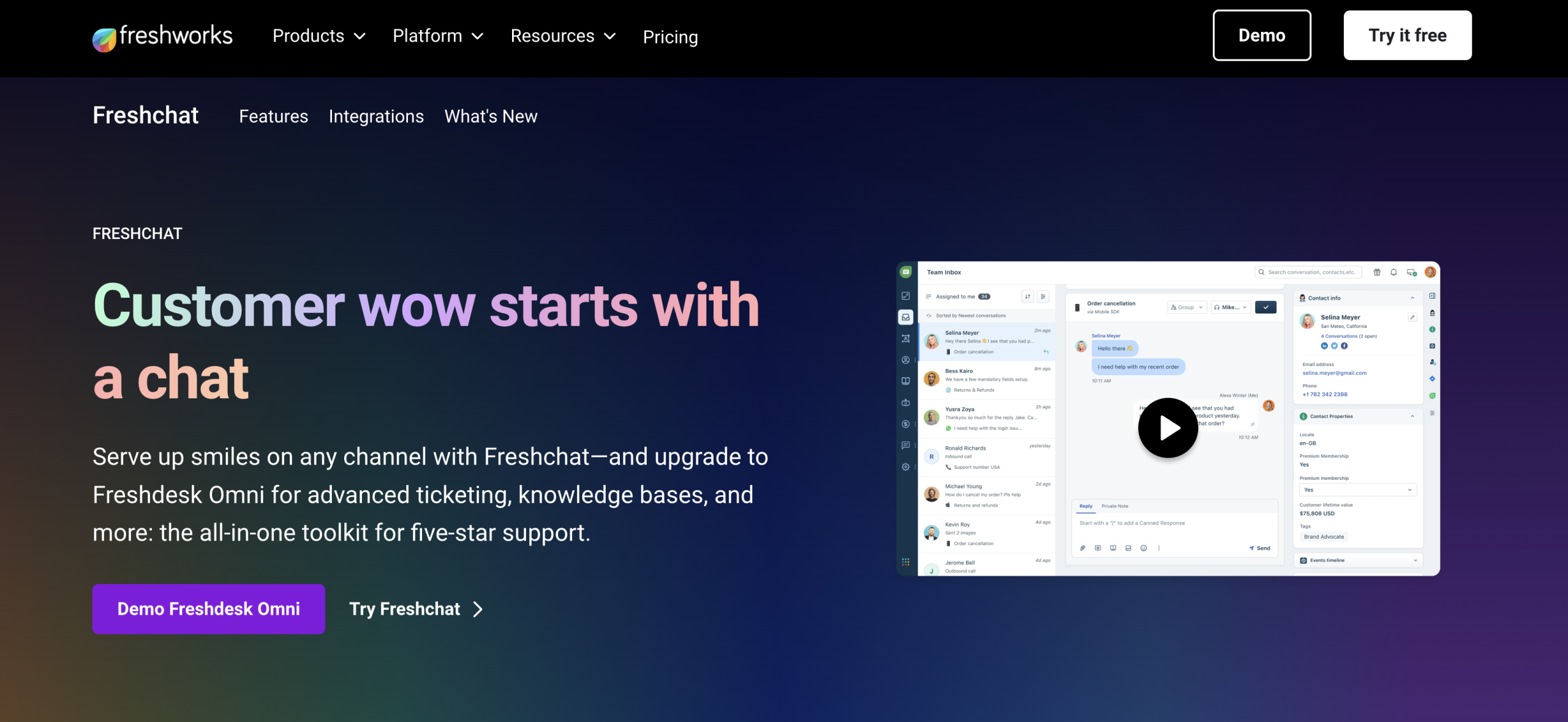
7. Freshchat (Freshworks)
Freshchat is an omnichannel messaging platform built for customer support teams that need WhatsApp integration alongside live chat, email, and social messaging. It combines automation with a shared team inbox and strong reporting capabilities.
Key features
- WhatsApp Business integration
- Omnichannel shared inbox (chat, email, social, WhatsApp)
- AI-powered chatbots for automated support
- Advanced routing and assignment rules
- CRM integrations and customer timeline view
- Performance analytics and reporting dashboards
- Canned responses and automation workflows
- Enterprise-grade security and compliance
Pricing
- Free: Basic features for up to 10 agents
- Growth: Starting at $19/agent/month
- Pro: Starting at $49/agent/month
- Enterprise: Starting at $79/agent/month
Pros
- Strong team collaboration features
- Unified inbox across multiple channels
- Robust reporting and SLA management
- Scalable for growing support teams
- Reliable WhatsApp integration
Cons
- Can be more complex than pure chatbot builders
- Per-agent pricing may become expensive for larger teams
- Advanced features locked behind higher-tier plans
WhatsApp chatbot use cases by industry
Different industries use WhatsApp automation to solve specific business challenges and improve customer experiences. By understanding these applications, businesses can identify opportunities to implement chatbots in their specific market context.
- Retail and e-commerce
- Online retailers use WhatsApp bots to automate order management, recommend products, and recover abandoned shopping carts. Customers can check order status, track shipments, and receive personalized product suggestions through conversational commerce. The bots can also handle returns, exchanges, and instant customer support during the purchase decision process.
- Healthcare
- Healthcare providers deploy WhatsApp chatbots to schedule appointments, answer patient questions, and send prescription remidners. Patients can book appointments, receive test results, and get answers to common medical questions without calling busy reception lines. This automation reduces administrative workload while improving patient access to information and services.
- Banking and financial services
- Banks use WhatsApp automation to handle account inquiries, transaction notifications, and fraud alerts. Customers can check account balances, receive instant transaction confirmations, and report suspicious activity through secure conversations. The bots provide 24-7 access to basic banking services while escalating complex issues to human agents when necessary.
- Travel and hospitality
- Hotels and travel companies automate booking management, guest services, and check-in processes through WhatsApp. Guests can modify reservations, request room service, and access local recommendations through conversational interfaces. Airlines use bots to provide flight updates, handle booking changes, and manage customer service inquiries efficiently.
- Real estate
- Real estate agents use WhatsApp bots for property inquiries, viewing appointments, and lead qualification. Potential buyers can browse property listings, schedule viewings, and receive market updates through automated conversations. The bots can also handle document sharing and provide mortgage information to qualified prospects.
- Education
- Educational institutions use WhatsApp automation for student support, course information, and enrollment assistance. Students can access schedules, receive exam notifications, and get answers to administrative questions through automated systems. The bots can also facilitate communication between students, faculty, and administrative staff.
- Each industry benefits from WhatsApp’s high engagement rates and the familiar interface that customers already use daily. The key to successful implementation lies in understanding specific customer needs and designing conversation flows that provide genuine value while reducing operational overhead.
WhatsApp chatbot features and capabilities
Modern WhatsApp chatbots aren’t just text responses. They offer interactive, human-like conversations that connect with customers and get results. Understanding these capabilities helps businesses design better automated solutions.
Message types and rich media
WhatsApp bots can send and receive various message formats, including text, images, videos, documents, and location sharing. This multimedia capability enables businesses to share product catalogs, instructional videos, invoice documents, and location-based information seamlessly within conversations. Interactive buttons and quick reply options guide customers through structured workflows while maintaining conversational flow.
AI integration and MLP
Advanced WhatsApp AI chatbots use NLP to understand customer intent beyond just matching keywords. These systems interpret variations in phrasing, extract relevant information from complex questions, and maintain context throughout extended conversations. Machine learning capabilities allow bots to improve responses over time based on customer interactions and feedback.
CRM integration and lead management
WhatsApp chatbots connect directly to CRM systems, automatically capturing lead information and updating customer records based on conversation history. This integration enables personalized responses based on purchase history, previous interactions, and customer preferences. Sales teams gain full access to conversation histories and can seamlessly continue relationships that bots initiated.
Analytics and performance tracking
Comprehensive analytics track message delivery rates, response times, conversation completion rates, and customer satisfaction scores. These metrics identify opportunities for optimization by providing insights into bot performance. and identify opportunities for optimization. With sentiment and conversation flow analysis, advanced platforms reveal customer behavior patterns and preferences.
Personalization and dynamic content
Sophisticated bots deliver personalized greetings, product recommendations, and content based on customer data and interaction history. Dynamic content generation enables contextual responses that feel relevant and helpful rather than generic and automated. This personalization capability significantly improves customer engagement and conversion rates.
Escalation and human handoff
Smart escalation systems recognize when conversations require human intervention and seamlessly transfer customers to appropriate agents. These handoffs include complete conversation history and context, enabling agents to continue conversations without requiring customers to repeat information. Escalation triggers can be based on keywords, sentiment analysis, or conversation complexity.
The combination of these features enables businesses to create comprehensive customer service solutions that handle routine inquiries automatically while ensuring complex issues receive appropriate human attention. The key is balancing automation efficiency with the human touch that customers value for important decisions and problem resolution.
Consider Noupe for instant chatbot deployment
Not every team needs to start with the WhatsApp Business API on day one. If you want the speed and ROI of automation now, but you’re not ready to navigate WhatsApp verification, templates, compliance, and API setup, Noupe is a practical first step.
Noupe lets you spin up an AI support chatbot in minutes and start handling repetitive questions immediately, things like shipping and returns, pricing, hours, basic troubleshooting, and lead capture. That means you can reduce response delays, protect conversions, and deliver 24/7 coverage right away, without waiting weeks for approvals or building complex flows.
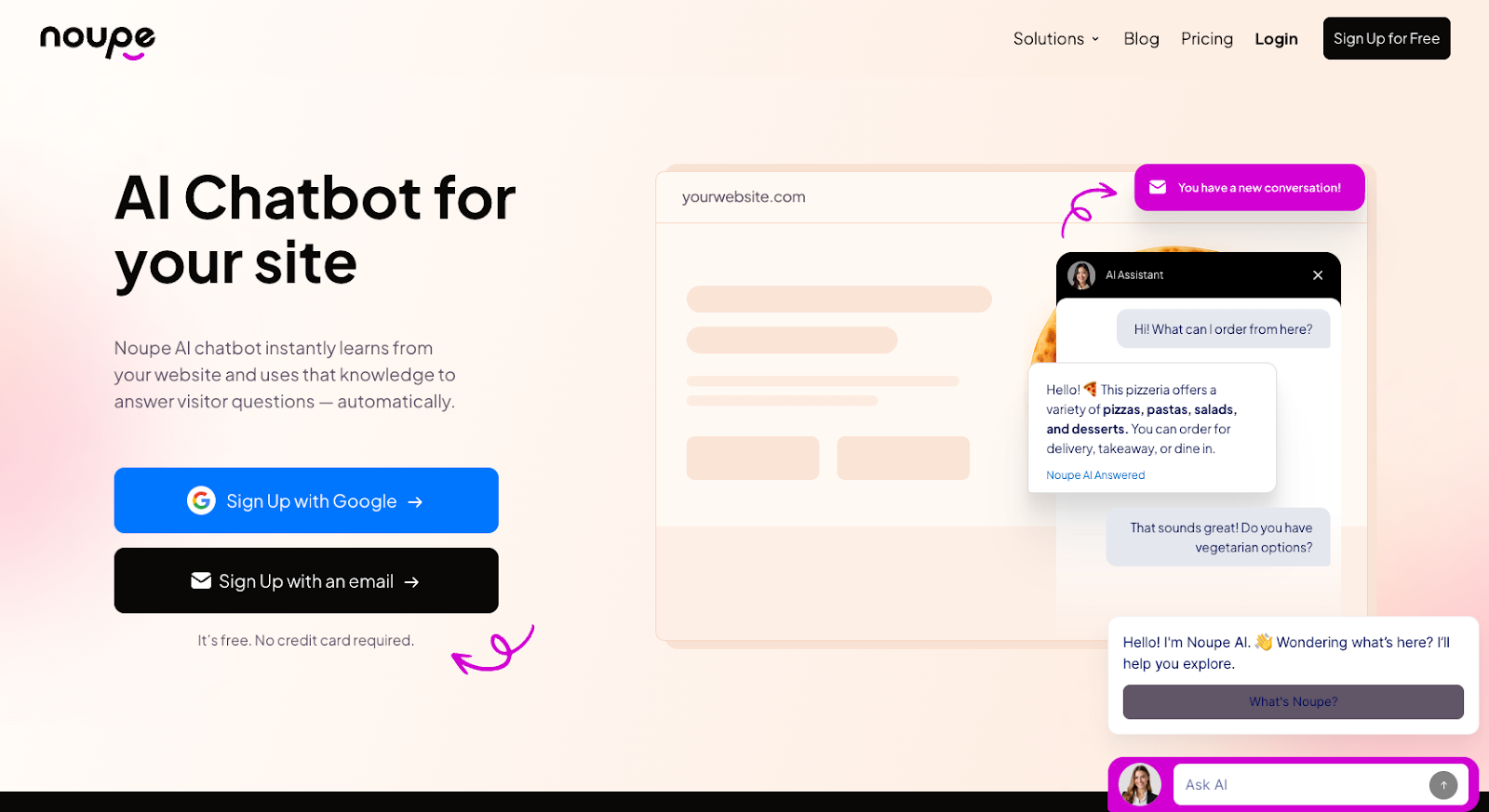
Noupe offers a Free plan (100 monthly conversations), plus paid tiers like Basic (1,000 monthly conversations) and Pro (7,500 monthly conversations). Pricing is available as monthly billing, or discounted annual billing, with the paid tiers removing Noupe branding.
It’s also a smart way to “test and learn” before committing to a full WhatsApp rollout. You can validate your top customer intents, refine your FAQs and tone, and see which questions drive the most drop-offs, then carry those insights into a dedicated WhatsApp chatbot once you’re ready for the channel’s full reach.
If your priority is fast deployment and immediate customer support automation, Noupe helps you start now, prove value quickly, and upgrade to WhatsApp integration later with a clearer playbook.

