
You can tell a lot about customer support software after a week of real use. When things get busy and orders flood in, chats light up, and the DMs won’t quit, you start to notice which platform quietly helps and which one adds to your stress. I’ve spent months inside two of the biggest tools that promise to help: Gorgias and Zendesk. While they aim to solve the same problems, they couldn’t feel more different.
Gorgias moves like an e-commerce native. You click into a message and instantly see the customer’s last order, tracking information, and refund history without digging through tabs. Its AI Agent 2.0, launched in 2025, doesn’t just answer faster, it also sells smarter, pulling details straight from your catalog and suggesting products that actually fit. It turns e-commerce customer service into part of the sales experience.
Zendesk takes a different route. It’s the all-in-one for companies juggling email, chat, social, and now voice in one place. The newest Resolution Platform brought in voice AI agents, smarter routing, and an Admin Copilot that lets you set up automations just by describing what you want. It’s AI in customer service that feels like it finally understands how your team works.
Both promise solid omnichannel support, but the real difference lies in how they make your day-to-day work feel. Gorgias lightens the load, while Zendesk builds the system around you.
Gorgias vs Zendesk: What is Gorgias?
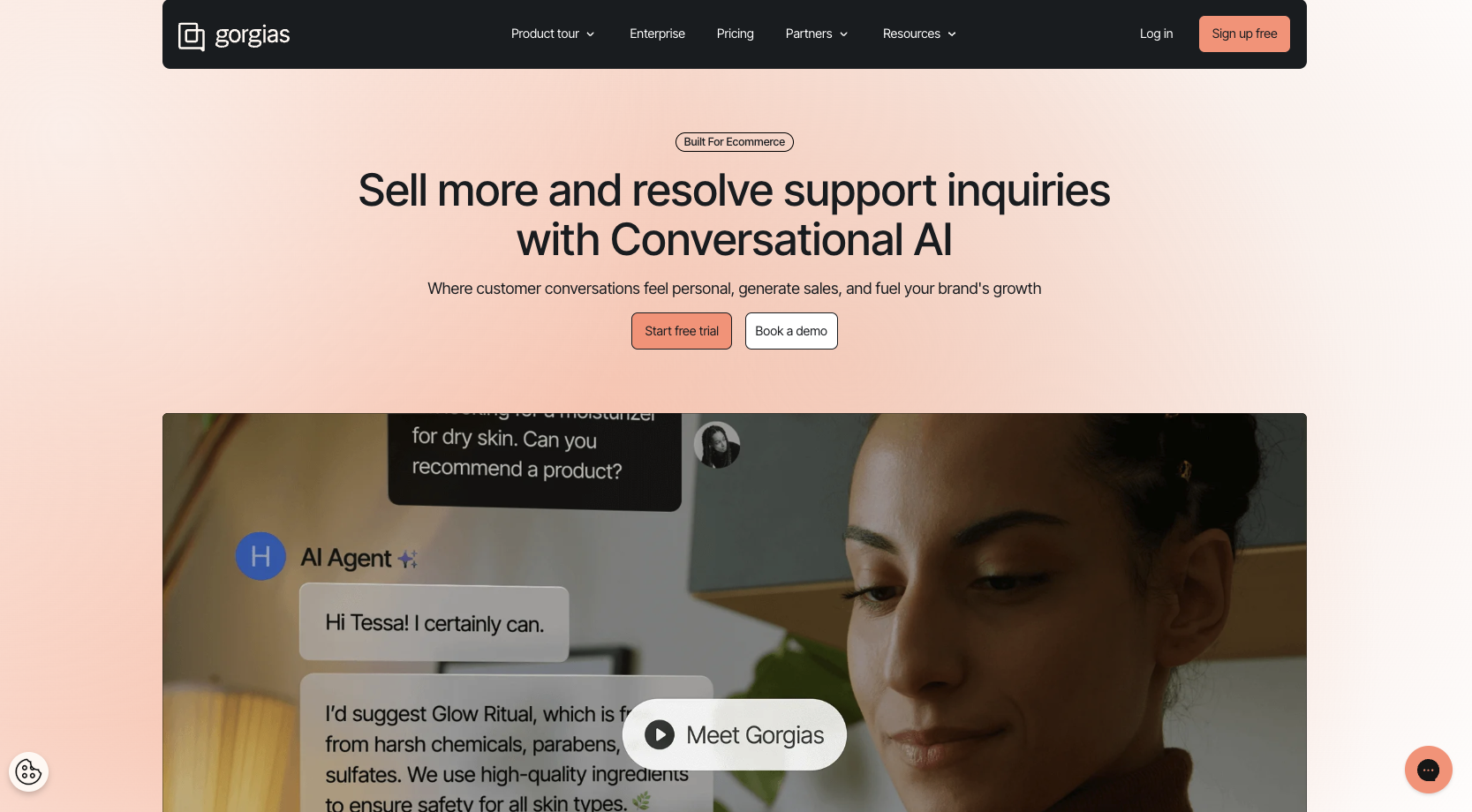
If you run an online store, Gorgias feels instantly familiar. The layout, shortcuts, and even the data you see first speak the same language as your storefront.
What stands out is how Gorgias pulls e-commerce context right into the ticket. You’re answering a message, and there’s the customer’s last order, lifetime spend, and even the coupon they used, all without switching tabs. It’s the kind of help desk solution that makes agents sound smarter simply because the information’s already there.
Its AI Agent 2.0 takes that a step further. It reads your catalog and turns questions like “Will this fit?” into confident, accurate answers. It can recommend products, offer dynamic discounts, and even spot upsell moments automatically.
Automation feels natural here too. The rules system can auto-tag tickets, pull shipping data, and send macros for things like “Where’s my order?” Gorgias claims up to 60 percent ticket automation, and that number feels believable once you’ve tuned the triggers.
Plus, the built-in reporting gives a quick snapshot of revenue from support interactions, response times, and channel mix, ideal for a store owner who wants quick clarity rather than data-science-level breakdowns.
However, you’ll notice the platform’s e-commerce bias quickly. It doesn’t scale neatly for SaaS or finance use cases, and complex workflows can get messy once you move beyond retail. The reporting tools are improving, but deeper analytics still require exports or external dashboards. Also, because pricing scales by ticket volume, busy shopping seasons can surprise you with AI usage costs.
Zendesk vs Gorgias: What is Zendesk?
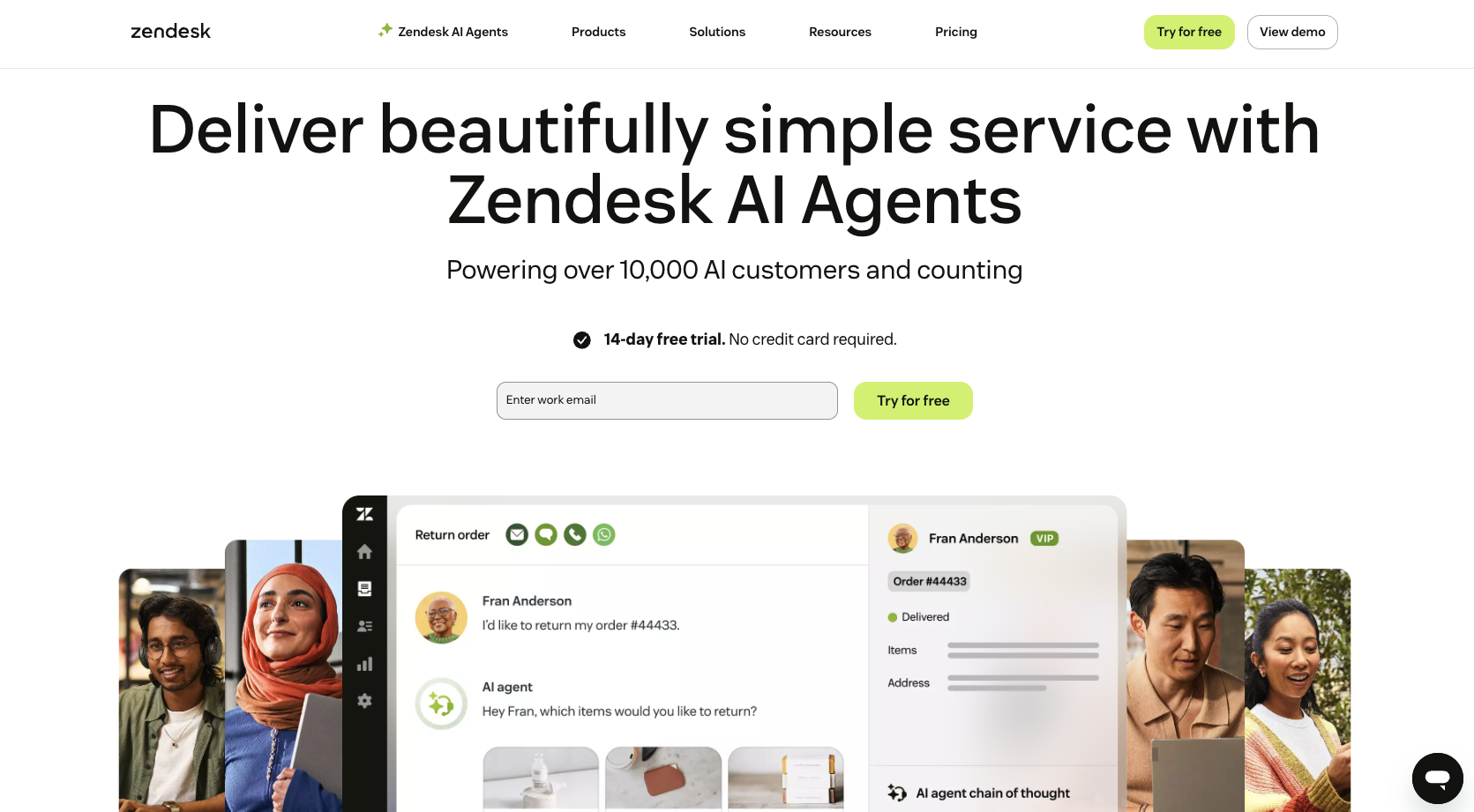
Zendesk has been around long enough to become shorthand for enterprise support, and there’s a reason for that. Once your team grows beyond a handful of agents, structure matters, and Zendesk delivers structure in spades.
It feels heavier than Gorgias at first. But that weight translates into power: advanced routing, layered automations, and permission controls that let multiple departments share one customer support software stack without tripping over each other.
The 2025 update completely reshaped Zendesk’s approach to AI in customer service. Voice AI agents can now handle full phone calls on their own, looping in a person only when something complex comes up. Agent Copilot helps by writing responses, trimming long message threads, and learning directly from the company’s knowledge base.
Admin Copilot takes the same idea and turns it into workflow building. You simply type what you want it to do, like “send refund tickets to billing and add a follow-up tag,” and it handles the setup. Zendesk’s Knowledge Graph ties everything together by connecting tools such as Confluence, Asana, and Docusign, so every AI-generated message comes from verified information instead of guesswork.
It’s an excellent choice if your business spans multiple channels or brands or if compliance and analytics drive your decisions. The trade-off is setup. Expect to spend time configuring workflows and permissions before you feel that “smooth” Zendesk rhythm. Also, most of the advanced AI features live in the higher-tier plans.
Gorgias vs Zendesk: Core features compared
| Feature | Gorgias | Zendesk |
|---|---|---|
| Best for | E-commerce brands that need fast, context-rich support | Larger teams that need structured, scalable support operations |
| Omnichannel coverage | Email, live chat, Facebook, Instagram, SMS, built around store conversations | Email, chat, social, and voice, unified into one continuous thread |
| E-commerce context in tickets | Native order, tracking, refund history, coupon usage, and customer spend shown inside the ticket | More general-purpose support workspace, e-commerce context typically comes via setup/integrations |
| AI & automation | AI Agent 2.0, rules/macros, Auto QA | Resolution Platform (Agent Copilot, Admin Copilot for workflow setup, voice AI agents), advanced routing |
| Integrations & customization | Plug-and-play with Shopify/WooCommerce/BigCommerce and common e-comm tools, simpler customization | Large marketplace and deep customization via builders and workflows |
| Reporting & analytics | Store-owner metrics like support-driven revenue, response times, channel mix | Enterprise-grade analytics |
| Pricing | Ticket-based pricing, paid plans start at $10 per month (50 tickets/month), billed annually | Per-agent pricing, paid plans start at $19 per agent/month. Suite plans start at $55 per agent/month, billed annually |
Gorgias vs Zendesk: Feature comparison
When you’ve spent real time using both Gorgias and Zendesk, you’ll start noticing the small moments that never show up in product pages: the way an AI reply either nails a customer’s tone or makes them feel ignored, or the difference between a system that keeps your day humming and one that adds friction. Here’s how they actually compare when you’re in the trenches.
Omnichannel support
This is the feature that makes or breaks your day if your support life happens across every platform known to humanity: email, chat, phone, and social.
With Zendesk, you feel like you’re sitting inside mission control. Every channel sits side by side, stitched into one continuous conversation. When a customer starts on Twitter, follows up via email, and calls the next morning, all three moments are stacked neatly into the same thread. There’s no hunting for context; it’s all there.
The addition of voice AI agents means even your phone queue has a sense of calm now. Routine calls get handled automatically, while complex ones get routed to humans without losing context.
Gorgias doesn’t try to be everything to everyone. Instead, it’s laser-focused on e-commerce. When you open a ticket, you instantly see the order, tracking data, and customer history inside the same window. No switching tabs, no app fatigue.
It handles email, live chat, Facebook, Instagram, and short message service (SMS) beautifully, and the 2025 update made its AI smart enough to understand your catalog. When a shopper asks, “Does this come in blue?,” the AI answers using live product data rather than a generic response.
Zendesk gives you coverage; Gorgias gives you clarity.
Automation and AI capabilities
This is where both tools have completely transformed themselves. What used to be simple macros and canned replies now feels like a proper assistant, one that understands your tone, your products, and your workflow.
In Gorgias, the shift came with AI Agent 2.0. The first time you watch it handle a product question, you realize it’s reading from your actual catalog. Ask about shipping times or compatibility, and it replies with specifics.
It can even recognize buying intent, offering an upsell or small discount to close the loop. Before long, the system feels like a teammate that never needs a break. Auto QA quietly reviews each conversation in the background, pointing out tone problems or inaccurate replies so you can fix them early without hovering over every message.
Zendesk took the broader enterprise route. Its new Resolution Platform turned AI into an ecosystem. You’ve got Agent Copilot writing and summarizing replies; voice AI agents that fully manage phone calls; and Admin Copilot, which lets you describe automations in plain English. Tell it to “Tag refund requests and assign to billing,” and it does it instantly.
The Knowledge Graph connects to your company’s documents: Confluence, Docusign, Asana, and beyond, so Copilot pulls verified data instead of guessing. When Knowledge Graph is paired with HyperArc analytics, you can finally see how AI impacts your resolution times and cost per ticket.
If Gorgias feels like an intuitive coworker who knows your store inside out, Zendesk feels like a well-trained operations manager who keeps everyone on schedule. Gorgias automates for empathy; Zendesk automates for scale.
Integration and customization
Integrations decide how many tabs you’ll keep open every day and how close you get to that elusive “single source of truth.”
Gorgias excels at plug-and-play simplicity. You connect Shopify, BigCommerce, or WooCommerce, and everything just works. Orders sync both ways without any technical setup. You can handle refunds, update customer information, or check subscription details without jumping between tabs. It also plays nicely with Klaviyo for email and Attentive for SMS, which helps teams see the full picture of a customer’s journey from first click to follow-up.
There aren’t as many deep customization options as you’d find elsewhere, but that’s part of the charm. Fewer moving parts means fewer things to break and more time to spend actually helping customers.
Zendesk is an open playground. With over 2,000 apps in its marketplace, it’s easy to embed into just about any stack: Salesforce, Jira, HubSpot, you name it. Its connectors feed data from external sources like Confluence or Docusign straight into its Knowledge Graph, while the Action Builder and App Builder tools mean you can create new automations without writing code. It’s more setup time but limitless control once you’re done.
If Gorgias is a ready-to-drive Tesla, Zendesk is a custom-built performance car; you’ll spend time tuning it, but you’ll love it once it’s dialed in.
Reporting and analytics
Data tells the story of how your team’s really performing, but each platform measures success differently.
Gorgias shows you what matters to a store owner: revenue generated from support, response times, and channel efficiency. You can open the analytics tab and instantly see whether your support team is helping or hurting conversions. It’s designed for speed. The Auto QA system adds a layer of quality control, surfacing weak responses before they become habits.
Zendesk, meanwhile, is a data powerhouse. Its HyperArc analytics provide live dashboards tracking customer satisfaction scores, Service-Level Agreement (SLA) compliance, backlog, and AI engagement. The Copilot activity dashboard goes further, showing how AI impacts agent efficiency and customer satisfaction in real time. It’s the kind of reporting that enterprise leaders obsess over because it connects people, processes, and cost.
When you’re small, Gorgias’s simplicity keeps you moving. When you’re scaling, Zendesk’s visibility becomes your best defense against chaos.
Gorgias vs Zendesk: Pricing plans
Gorgias prices by ticket volume. That sounds straightforward until you hit a holiday rush and realize “volume” can double overnight. Here’s what it looks like right now:
- Starter: from $10/month (50 tickets): Perfect for testing the waters or running a small boutique shop.
- Basic: from $60/month (300 tickets): Adds rules, macros, and multi-agent access, enough for a small team.
- Pro: from $360/month (2,000 tickets): Ideal for growing stores. You unlock integrations and analytics.
- Advanced: from $900/month (5,000 tickets): For brands with multiple storefronts or bigger customer bases. Includes priority support.
- Enterprise: Custom pricing: Tailored for high-volume operations that need dedicated account management and advanced AI usage.
The catch: If your business has big seasonal swings, your bill will too. Gorgias is great value when you’re consistent but unpredictable when you’re not.
Zendesk offers pricing per agent rather than per ticket, starting at
- Support Team: $19/user/month
- Suite Team: $55/user/month
- Suite Professional: $115/user/month
- Suite Enterprise: $169/user/month
Every tier unlocks new levels of automation, analytics, and channel management. If your ticket count fluctuates but your team size doesn’t, this model can feel easier to control.
Both systems now weave AI into pricing. Zendesk treats its voice AI agents and Builders as add-ons, while Gorgias ties AI cost to usage volume. Neither is cheap, but when configured right, both can save far more than they spend.
Choosing the right platform for your business
This is the question that decides everything: Which tool actually feels right once you start using it every day? After living with both, here’s how I think about it.
Choose Gorgias if you’re an e-commerce brand that lives and breathes speed
If your store runs on Shopify, WooCommerce, or BigCommerce, you’ll see right away how naturally Gorgias fits in. It doesn’t feel like a separate system you have to manage. It feels like part of your store. You can check orders, send refunds, or add a discount without moving between tools.
It’s especially strong if your team’s small but fast. The AI does most of the repetitive lifting, leaving humans to handle tone and empathy. When you’ve got social DMs, live chat, and emails all pinging at once, that focus matters.
Gorgias also treats service as a sales opportunity. Agents can upsell mid-conversation, offer dynamic discounts, or recover abandoned carts. That blend of e-commerce customer service and revenue is what makes it special.
It’s the better fit if you
- Run a digital-first store that thrives on speed and personal connection
- Care more about sales impact than enterprise governance
- Need automation that sounds human out of the box
Choose Zendesk if your support operation looks like a small company of its own
Zendesk shines when your world is complex, with multiple products, regions, or support tiers. Once you invest the setup time, it becomes the backbone of your customer operation. Voice, chat, social, and email all merge into one workspace.
The 2025 updates made it smarter, too. Agent Copilot keeps conversations concise, and Admin Copilot lets you automate workflows by simply describing them. Its HyperArc analytics and compliance controls make scaling painless.
It’s the better fit if you
- Manage large teams or multiple departments
- Need deep reporting and visibility for leadership
- Value governance, SLAs, and customization over simplicity
Enhancing customer support with Noupe
Even with tools as strong as Gorgias or Zendesk, there’s always that moment when customers need answers faster than your team can type. That’s where Noupe stands out, offering a lightweight, no-code chatbot that plugs into your website and starts helping within minutes.
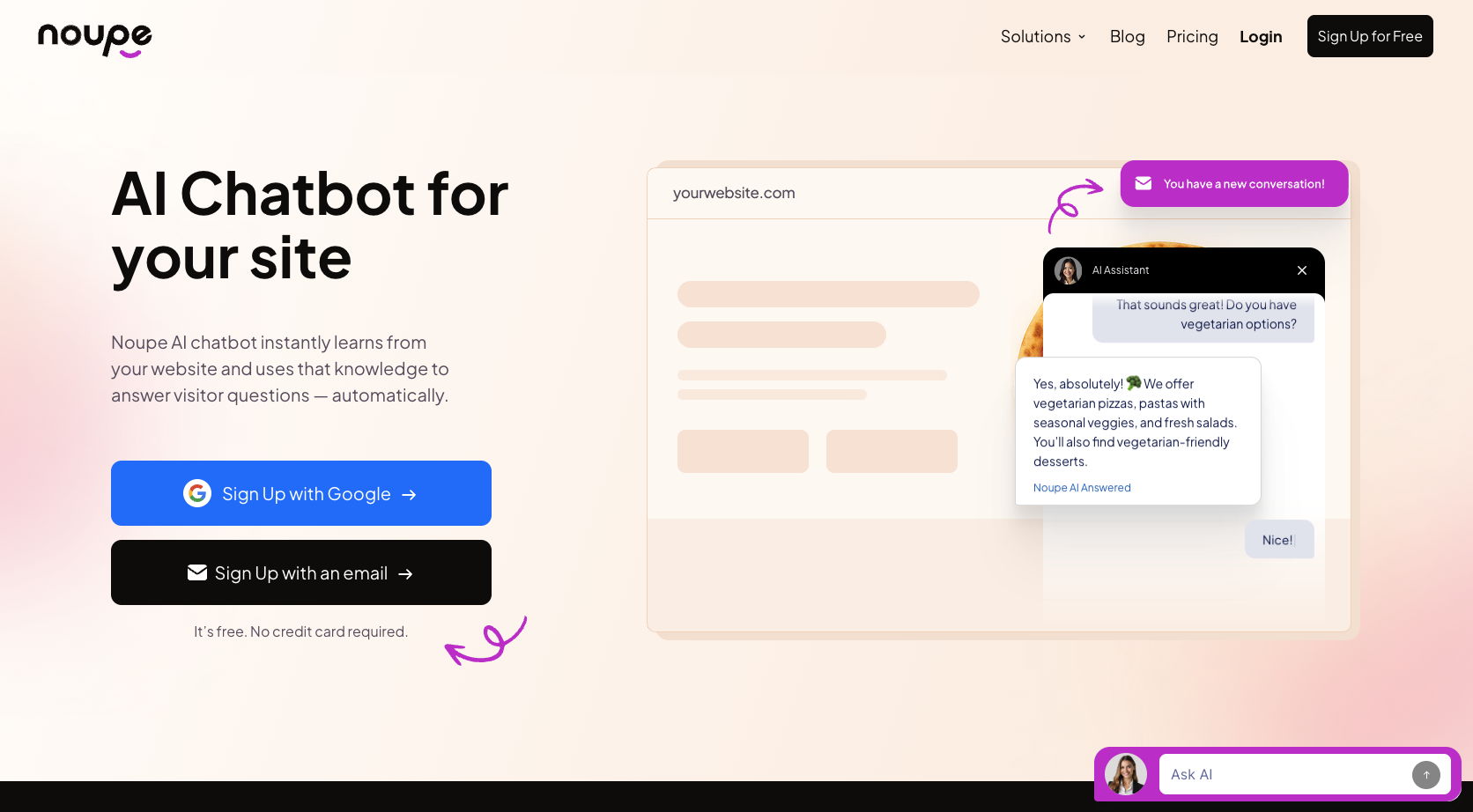
Once it’s on your site, it reads what’s already there: your product pages, FAQs, and support articles, and builds its own understanding of your business. You don’t spend hours training it; it just learns from your content.
Here’s what you actually get out of it:
- Setup that takes minutes: Paste one line of code, and it’s live.
- Answers based on your real website content: It reflects your tone because it learns from your words.
- Automatic handoff: If a question needs a human, the full chat drops straight into your inbox or help desk.
- Brand fit: You can tweak color, avatar, and greeting so it feels like part of your team.
Noupe works best as the “first hello.” It catches simple questions, routes the rest to your agents, and makes sure no visitor walks away unanswered, whether you’re running e-commerce customer service through Gorgias or scaling support with Zendesk.
Gorgias vs Zendesk: The final verdict
After using both platforms, I’d sum up Gorgias vs Zendesk this way: They solve the same problems but think about support in completely different ways.
Gorgias is built for teams who live close to the customer. If your day revolves around product questions, shipping updates, and quick fixes that turn frustration into loyalty, it’s hard to beat. It feels fast, familiar, and made for e-commerce.
Zendesk sits on the other end of the spectrum. It’s the kind of customer support software that gives structure to chaos, making it perfect for large teams, multiple brands, or operations that need tight workflows and strong analytics. You can feel its enterprise DNA the moment you start building automations.
Both platforms are using AI in customer service in smart, practical ways. One focuses on selling through service, the other on scaling without losing control.
If you want an easy way to test automation before committing, try Noupe. It’s quick, friendly, and shows what great help desk solutions can feel like when AI works well in the background. Plus, right now, you can get started for free, with no risk at all.