
Summary
- Noupe is the lightweight website chatbot for small teams that want fast, site-trained answers without technical setup.
- Chatfuel is the no-code social messaging bot builder for brands focused on Facebook Messenger, Instagram, and WhatsApp automation.
- Intercom is the enterprise-grade customer support platform for teams that need omnichannel communication, advanced AI, and deep customer data integration.
- Botpress is the developer-focused platform for building highly customizable chatbots with full control over logic, APIs, and workflows.
- Tidio is the e-commerce chatbot and live chat solution for businesses that want product-aware conversations and streamlined customer support.
- ManyChat is the automation-first chatbot platform for teams that need powerful workflows, triggers, and extensive third-party integrations.
- Landbot is the no-code conversational builder for agencies and teams that want interactive chat experiences with multi-client management capabilities.
Chatbot development platforms have transformed from simple rule-based builders into sophisticated AI-powered tools that can create intelligent, conversational experiences across multiple channels without requiring extensive coding knowledge.
The post-ChatGPT era has sparked unprecedented demand for chatbot creation tools that business owners can actually use. Modern platforms now offer plug-and-play AI integrations with advanced language models, seamless automation capabilities, and multichannel deployment options that make professional chatbot development accessible to everyone from small business owners to enterprise marketing teams.
This comprehensive guide is based on hands-on testing of leading chatbot development platforms across various use cases, from customer support automation to lead generation and e-commerce assistance. We’ve evaluated each platform’s real-world performance, integration capabilities, and ease of use to help you choose the right tool for your specific needs.
What is a chatbot development platform?
A chatbot development platform is a software solution that enables users to build, deploy, and manage conversational bots with minimal or no coding experience. These platforms provide the essential infrastructure and tools needed to create intelligent chatbots that can interact with users through natural language processing.
Core functions of modern chatbot development platforms include conversation flow design, natural language processing integration, multi-channel deployment capabilities, and comprehensive analytics dashboards. The platforms handle the technical complexities of bot development while providing user-friendly interfaces for designing conversation logic and managing bot responses.
The key difference between legacy chatbot builders and today’s AI-native platforms lies in their approach to conversation handling. While traditional builders relied heavily on predefined rules and decision trees, modern platforms leverage large language models to understand context, generate dynamic responses, and maintain more natural, human-like conversations.
What makes a great chatbot platform in 2026?
The most important factor distinguishing excellent chatbot platforms in 2026 is robust support for large language models like GPT-4, Claude, and Gemini. These integrations enable chatbots to understand complex queries, provide contextually relevant responses, and maintain coherent conversations across multiple interactions.
Integration capabilities with business tools, CRMs, and APIs are equally crucial, as modern chatbots need to access real-time data, update customer records, and trigger automated workflows. The best platforms also offer flexible deployment options, allowing users to publish chatbots on websites, messaging apps, and embedded interfaces while maintaining consistent functionality and branding across all channels.
How was this list tested and selected
We conducted comprehensive testing of over 20 chatbot development platforms, ranging from no-code builders designed for beginners to advanced AI platforms suitable for developers and enterprises, and we have selected the best 7 for this list. Our evaluation process focused on five key criteria: large language model support and AI capabilities, user experience and interface design, deployment flexibility and channel options, third-party integrations and API connectivity, and pricing structure and value proposition.
Platforms were excluded from our final recommendations if they lacked transparency in their AI model usage, failed to support current language models, or demonstrated poor usability that would hinder practical implementation. Our testing involved building actual chatbots for various use cases, including customer support, lead generation, and e-commerce assistance.
Best chatbot development platforms: Quick comparison
| Platform Name | Best For | Standout Feature | Pricing |
|---|---|---|---|
| Noupe | Instant setup for small teams | One-line embed with auto content learning | Free plan available, starts form $20/month |
| Chatfuel | No-code beginners | Guided flow builder | Free plan; from $69/month |
| Intercom | Support teams | Multi-channel support with AI | From $39/seat/month + $0.99/AI resolution |
| Botpress | Developers | API + logic-driven bots | Free tier (pay-as-you-go); from $79/month (Plus) |
| Tidio | eCommerce | GPT chatbots with product data | Free plan; from $29/month (Starter) |
| ManyChat | Automation-heavy teams | 7000+ app integrations | Free for 2 bots; from $17/month |
| Landbot | Agencies | Multi-client management features | Free plan available, from $40/month |
Best chatbot platforms in 2026: Our top 7 curated picks
Now let’s explore each platform’s capabilities, strengths, and ideal use cases to help you make an informed decision.
1. Noupe: Instant deployment without complexity
Noupe takes a different approach from traditional chatbot builders by focusing on speed and simplicity. Instead of requiring users to design conversation flows or train AI models, it automatically learns from your website content and creates a ready-to-use chatbot in minutes.
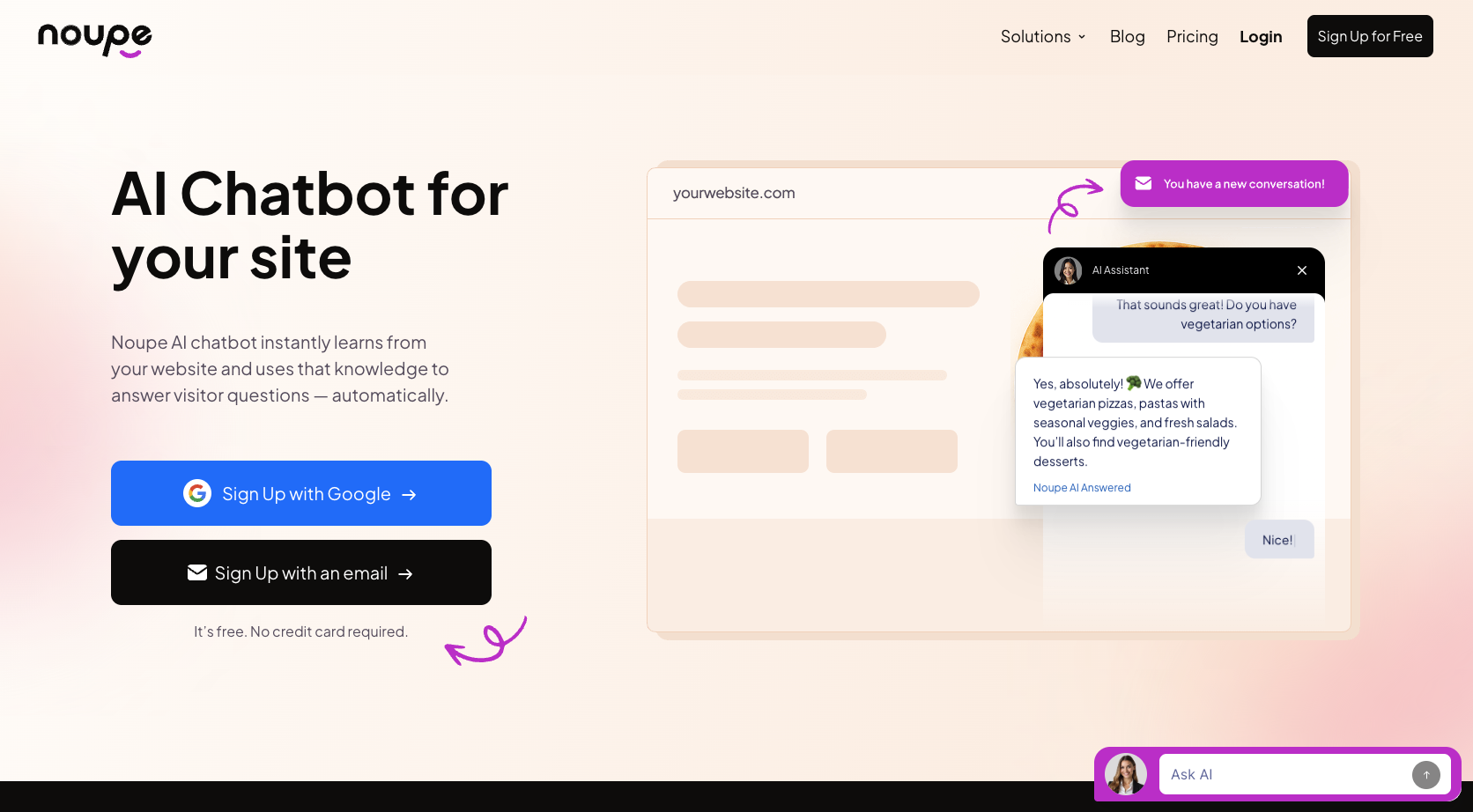
This makes it especially appealing for small teams and businesses that want immediate results without investing time in setup or technical configuration.
The platform analyzes your existing content to generate responses, allowing it to handle FAQs, basic support queries, and lead capture right out of the box. Deployment is equally straightforward, requiring just a single embed code.
While it doesn’t offer the deep customization or workflow automation of more advanced platforms, Noupe delivers strong value for users who prioritize ease of use and fast implementation.
Noupe offers a free plan including 100 monthly conversations, with paid plans starting at $20 per month.
Pros:
- Extremely fast setup with no learning curve
- Automatically uses website content to generate responses
- Simple one-line embed for deployment
Cons:
- Limited customization and advanced logic
- Not ideal for complex workflows or integrations
2. Chatfuel: No-code platform for social media chatbots
Chatfuel has established itself as a leading choice for businesses focused on social media engagement, particularly through Facebook Messenger and Instagram. The platform’s strength lies in its intuitive visual builder that guides users through creating conversation flows without overwhelming them with technical complexity.
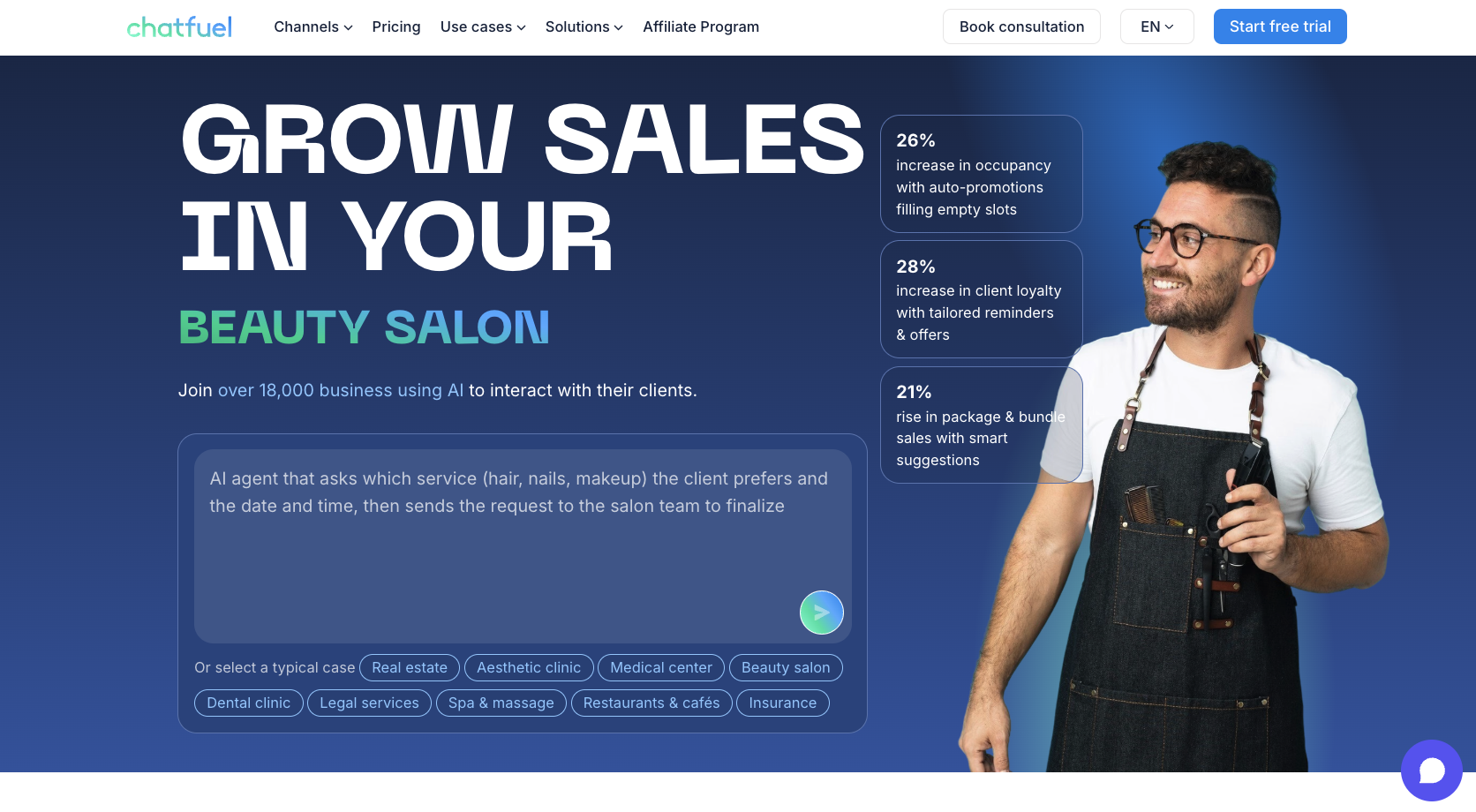
The platform handles data through its conversation flow system, storing user interactions and enabling personalized follow-up conversations. Integration capabilities include popular social media platforms, email marketing tools, and basic CRM connectivity, though the selection is more limited compared to enterprise-focused alternatives.
Chatfuel offers basic AI integration primarily through pre-built templates and simple natural language understanding. While it may not support the latest language models as extensively as some competitors, it provides sufficient intelligence for most social media use cases including lead qualification and customer service automation.
The free plan supports basic functionality for small-scale deployments, while paid plans start at $69 per month and include advanced features like unlimited subscribers, custom integrations, and detailed analytics.
Pros:
- Excellent guided flow builder for beginners
- Strong focus on social media platform integration
- Visual conversation designer with pre-built templates
Cons:
- Limited AI capabilities compared to newer platforms
- Primarily designed for social media rather than website deployment
3. Intercom: Enterprise-grade customer support automation
Intercom represents the premium end of chatbot development platforms, designed specifically for businesses that need robust customer support automation with advanced AI capabilities. The platform excels at managing complex customer interactions across multiple touchpoints while maintaining context and conversation history.
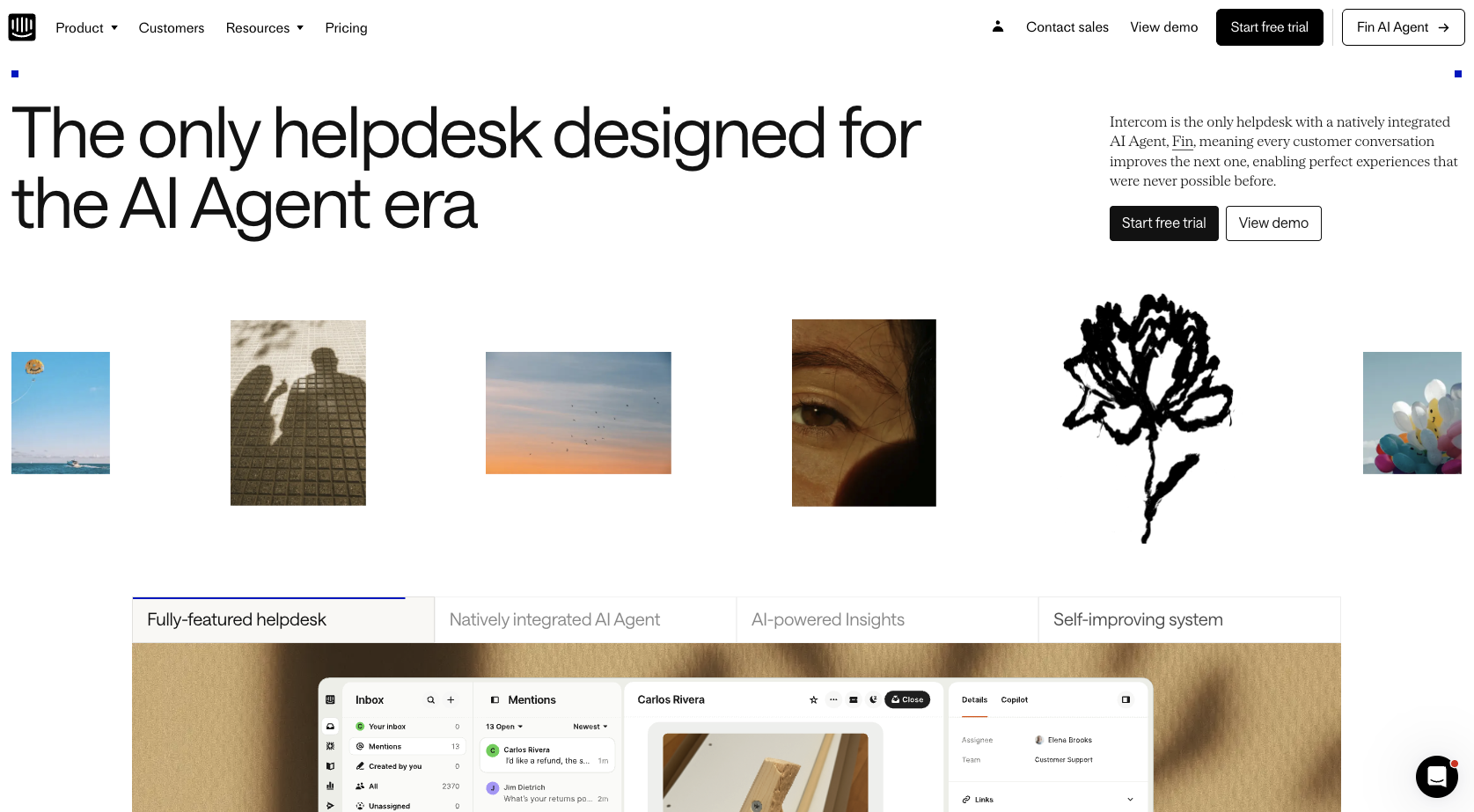
Data handling in Intercom is exceptionally sophisticated, with deep integration into customer profiles, conversation history, and business intelligence systems. The platform can access real-time customer data, order information, and support ticket history to provide personalized and contextually relevant responses.
The AI integration includes support for advanced language models with custom training capabilities, allowing businesses to fine-tune chatbot responses based on their specific industry knowledge and customer interaction patterns. Integration options are extensive, covering major CRMs, helpdesk systems, and business intelligence tools.
Pricing starts at $39 per month for basic plans, with enterprise pricing available for larger organizations requiring advanced customization and dedicated support.
Pros:
- Sophisticated multi-channel support across web, mobile, and messaging apps
- Advanced AI capabilities with contextual conversation handling
- Comprehensive customer data integration and CRM functionality
Cons:
- Higher pricing that may not suit small businesses
- Steeper learning curve for users without technical background
4. Botpress: Developer-focused platform with extensive customization
Botpress caters to developers and technically-minded businesses that need maximum flexibility and customization in their chatbot development. The platform provides extensive API access and supports complex logic workflows that can handle sophisticated business processes.
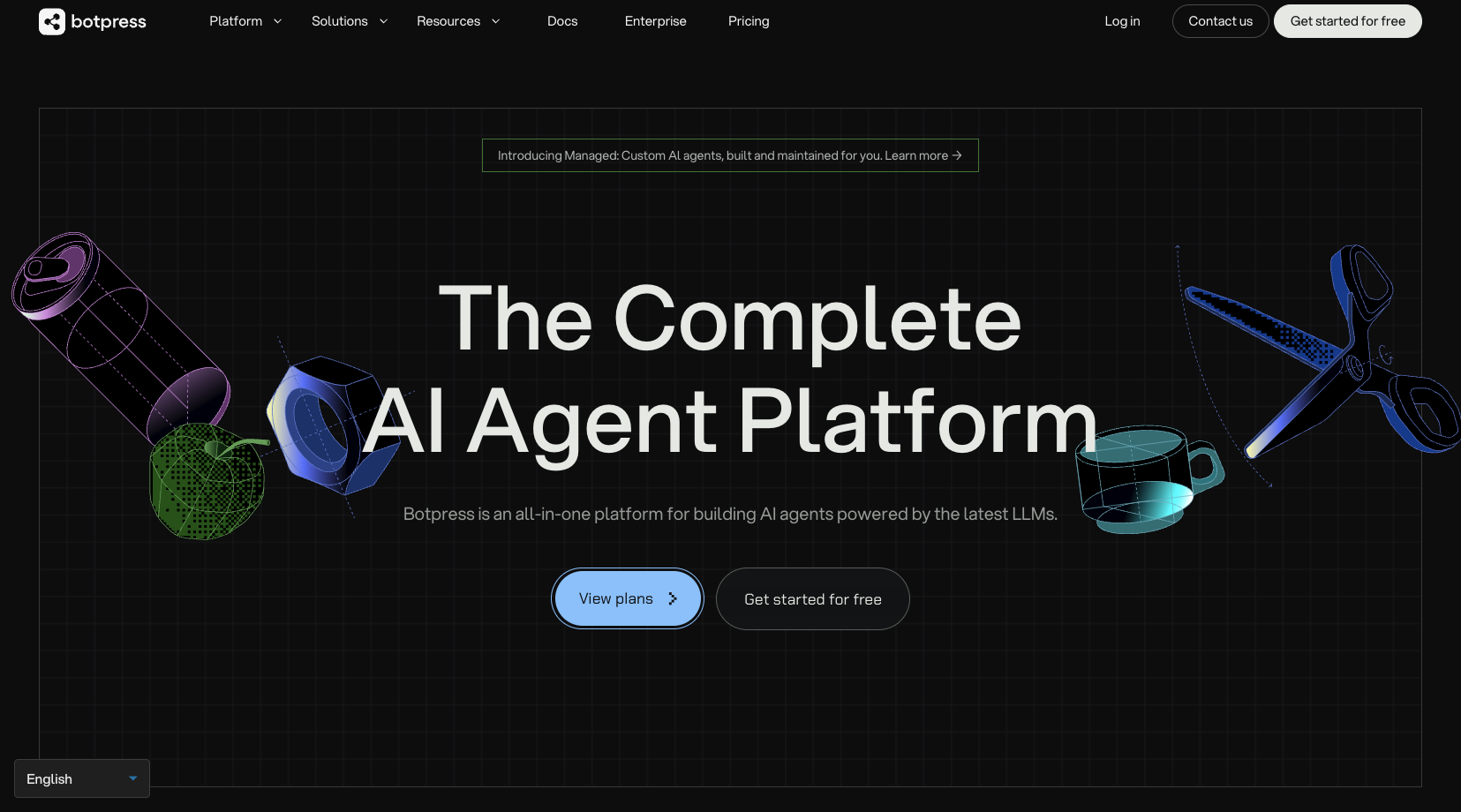
The platform’s data handling capabilities are particularly robust, supporting custom databases, external API integrations, and complex data processing workflows. Users can connect virtually any data source and create sophisticated automation rules that extend far beyond simple conversation management.
Botpress supports multiple language models and provides extensive customization options for AI behavior, making it suitable for businesses with specific industry requirements or complex conversation logic needs. The integration ecosystem is comprehensive, supporting custom API development and webhook connectivity.
The platform offers a free tier for development and testing, with production pricing based on usage and feature requirements, making it scalable for businesses of all sizes.
Pros:
- Open-source foundation with extensive customization options
- Powerful API and webhook integration capabilities
- Advanced logic and workflow automation features
Cons:
- Requires technical knowledge for optimal implementation
- Less intuitive interface for non-technical users
5. Tidio: E-commerce-focused chatbot solution
Tidio has carved out a strong niche in e-commerce chatbot development, offering specialized features that integrate directly with online stores to provide product recommendations, handle customer inquiries, and facilitate sales processes.
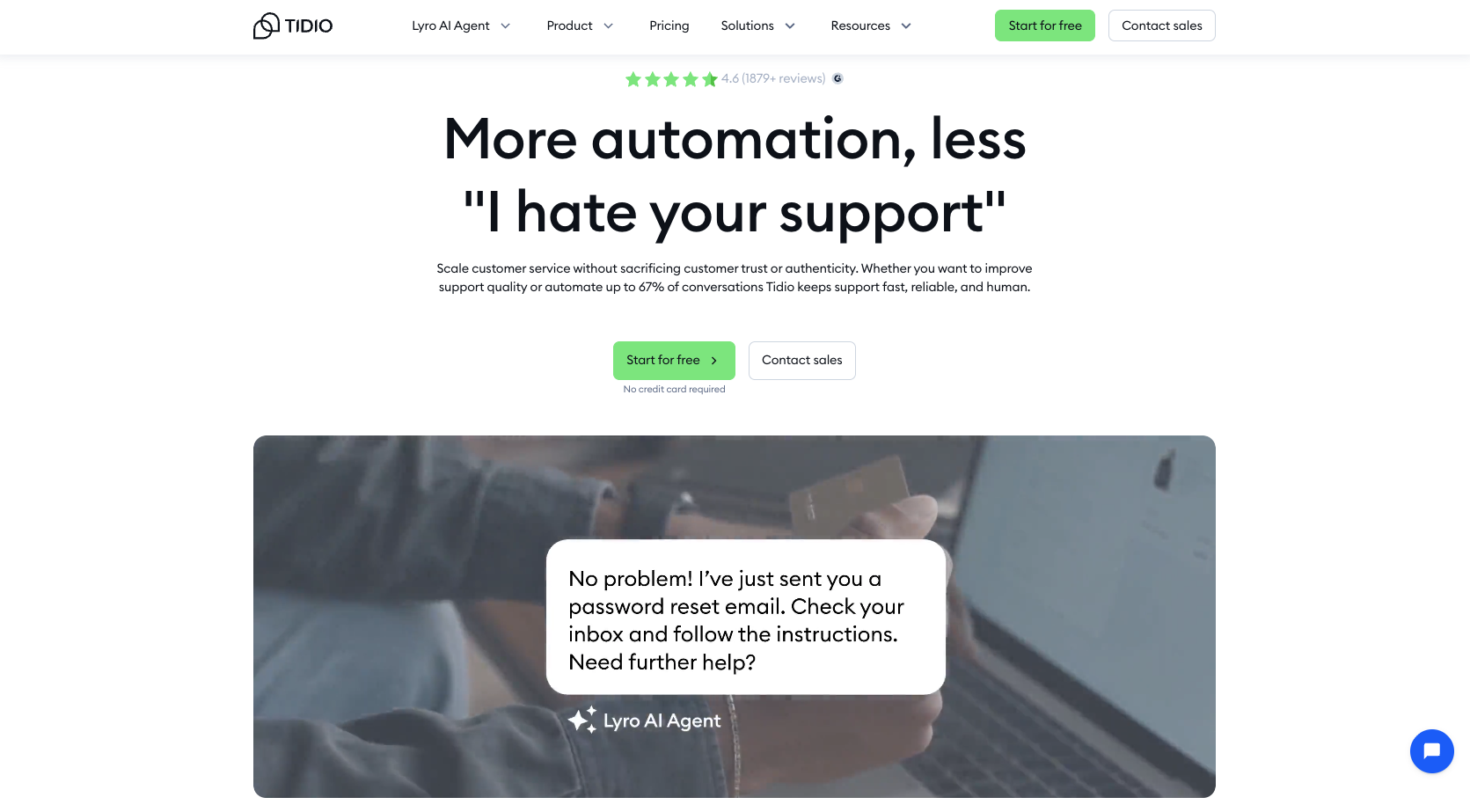
The platform excels at handling product data, inventory information, and customer purchase history to create personalized shopping experiences. Integration with major e-commerce platforms like Shopify, WooCommerce, and Magento enables real-time access to product catalogs and order information.
AI capabilities include GPT integration, specifically trained on e-commerce scenarios, enabling natural conversation about products, shipping, returns, and customer service issues. The platform can access product databases to provide accurate recommendations and availability information.
Pricing starts at $29 per month for the starter plan, with scaling options based on conversation volume and advanced feature requirements.
Pros:
- Specialized e-commerce features including product recommendations and inventory integration
- GPT-powered conversations with product data context
- Seamless integration with major e-commerce platforms
Cons:
- Limited functionality outside of e-commerce use cases
- Higher pricing for advanced AI features
6. ManyChat: Automation-heavy platform with extensive integrations
ManyChat positions itself as the automation powerhouse of chatbot platforms, offering extensive integration capabilities that enable businesses to connect their chatbots with virtually any business tool or service.

The platform’s strength lies in its automation capabilities, allowing users to create complex workflows that are triggered based on user behavior, time-based events, or external system updates. Data handling includes comprehensive contact management, conversation history, and integration with CRM systems and marketing automation tools.
While AI capabilities are somewhat limited compared to newer platforms, ManyChat provides sufficient intelligence for most automation use cases, particularly in social media engagement and lead-nurturing scenarios.
The platform offers a free plan for up to 1,000 contacts, while paid plans start at $17 per month and unlock advanced automation features and increased bot limits.
Pros:
- Over 7000 app integrations through Zapier and native connections
- Powerful automation workflows and trigger systems
- Strong social media platform support
Cons:
- Interface can be overwhelming for beginners
- Limited advanced AI capabilities compared to newer platforms
7. Landbot: Agency-friendly platform with multi-client management
Landbot caters specifically to agencies and consultants who need to manage multiple chatbot deployments for different clients. The platform provides sophisticated client management features and white-label options that enable professional service delivery.
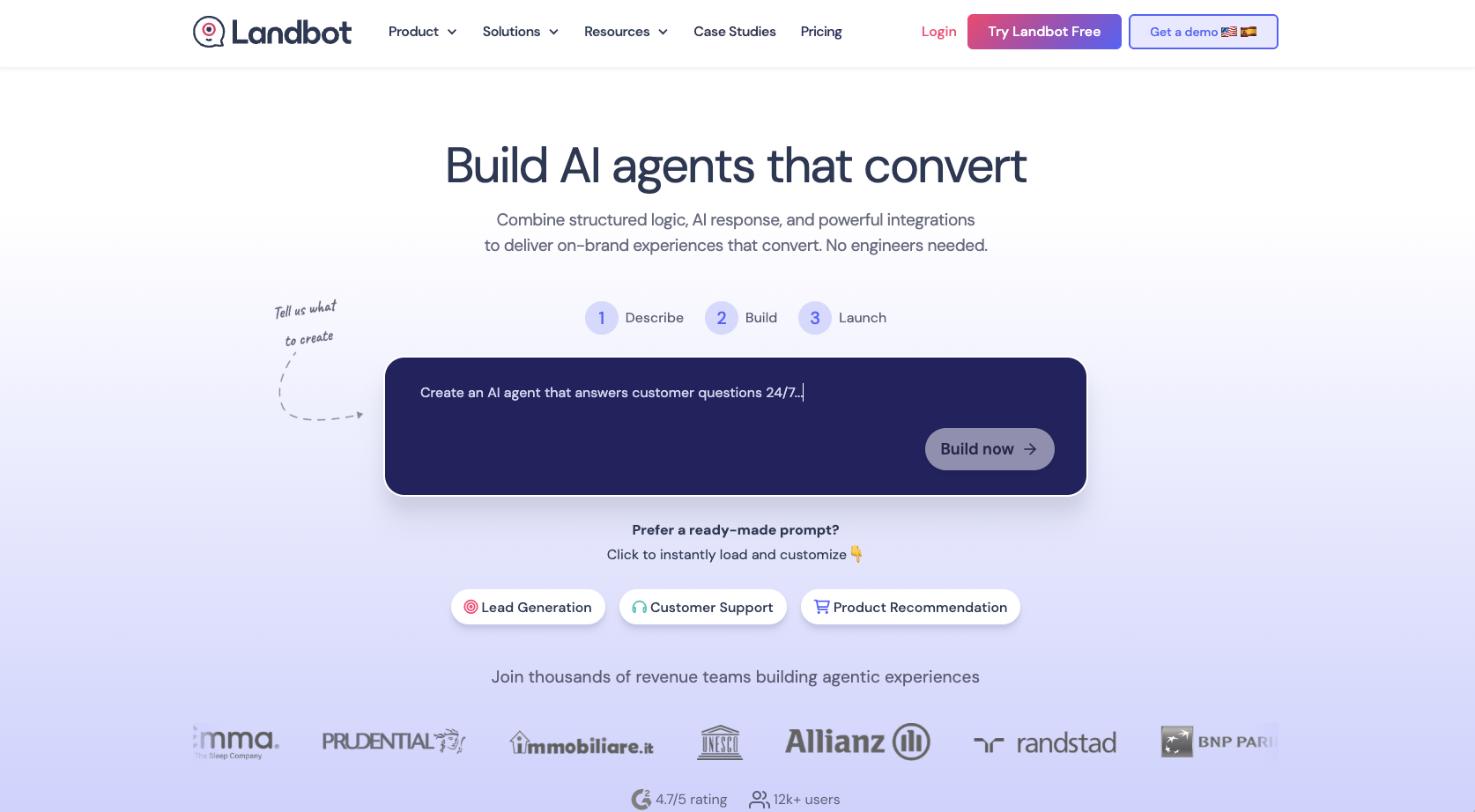
The platform handles data through client-specific databases and provides comprehensive analytics and reporting features that agencies can share with their clients. Integration capabilities include major business tools and marketing platforms commonly used by agencies.
AI integration is functional but not as advanced as some newer platforms, focusing more on conversation flow management and user experience optimization rather than cutting-edge language model integration.
Free Forever plan available up to 100 chats/month. Paid plans start at $40 per month with custom code, integrations, and upgraded flow operation options.
Pros:
- Excellent multi-client management features for agencies
- Visual conversation designer with professional templates
- White-label options for client deployment
Cons:
- Limited AI capabilities compared to newer platforms
- Pricing can become expensive for agencies managing multiple clients
Choosing the right chatbot builder for your needs
Selecting the optimal chatbot development platform depends on matching your specific goals with each platform’s strengths and capabilities. For lead generation and customer engagement, platforms like Noupe offer the best balance of functionality and ease of use, while customer support teams may benefit more from Intercom’s sophisticated automation capabilities.
Future-proofing your chatbot investment requires considering factors beyond immediate needs, including integration ecosystem growth, language model support updates, and platform development roadmaps. The most successful chatbot implementations typically start with platforms that offer room for growth and expansion as business requirements evolve.
Before committing to any platform, take advantage of free trials and basic plans to test functionality with your specific use cases. Building simple test chatbots with 1-2 platforms will provide valuable insights into interface usability, feature accessibility, and deployment simplicity that can inform your final decision and ensure long-term success with your chosen solution.

