
A chatbot personality is the distinct tone, character, and behavioral style that shapes how an AI assistant communicates, responds to emotions, and represents a brand during user interactions.
In today’s digital landscape, chatbots have evolved from simple automated responders to sophisticated conversational partners that can make or break customer relationships. The key differentiator between a forgettable chatbot and one that customers genuinely enjoy interacting with lies in one crucial element: personality.
Chatbot personality refers to the distinct character, tone, and behavioral patterns that define how an AI assistant communicates with users. It’s the digital equivalent of a human representative’s demeanor, encompassing everything from word choice and humor to empathy and problem-solving approach. When done right, a well-crafted chatbot personality can transform mundane customer service interactions into memorable experiences that strengthen brand loyalty and drive business growth.
The impact of chatbot personality extends far beyond simple pleasantries. Research shows that users are more likely to engage with chatbots that exhibit consistent, appealing personalities, leading to:
- Higher satisfaction rates and improved conversion metrics
- Increased customer retention and engagement rates
- Enhanced brand perception and stronger customer relationships
- More memorable interactions that differentiate your brand from competitors
Consider the difference between a chatbot that responds with “Your order has been processed” versus one that says “Great news! Your order is confirmed and heading your way soon. You’re going to love it!” The latter demonstrates personality through enthusiasm and anticipation, making the interaction feel more human and engaging. This emotional connection translates into tangible business benefits across industries ranging from e-commerce and healthcare to financial services and entertainment.
What is a chatbot personality?
Understanding chatbot personality requires examining its core components, each of which contributes to the overall user experience. These elements work together to create a cohesive digital identity that users can recognize and relate to across different interactions.
Tone and language
The foundation of any chatbot personality lies in its tone and language choices. This encompasses the level of formality, vocabulary complexity, and overall communication style. A chatbot designed for a law firm might adopt a professional, authoritative tone using precise legal terminology, while a chatbot for a trendy clothing brand might embrace casual slang and contemporary expressions.
Key considerations for tone and language include:
- Consistency across interactions – Users should be able to predict responses based on previous conversations
- Brand alignment – Language choices should reflect your company’s voice and values
- Audience appropriateness – Vocabulary and formality level should match user expectations
- Linguistic patterns – Consistent use of contractions, greetings, and question styles
Emotional intelligence
Modern chatbots increasingly incorporate emotional intelligence, allowing them to recognize and respond appropriately to user sentiment. This involves detecting frustration, excitement, confusion, or satisfaction in user messages and adjusting responses accordingly. An emotionally intelligent chatbot might offer additional support when it detects frustration or share in a customer’s excitement when they make a purchase.
This emotional awareness extends to knowing when to inject humor, when to be serious, and when to show empathy. A chatbot with high emotional intelligence can navigate sensitive situations with grace, apologize when appropriate, and celebrate successes with users. These human-like qualities make interactions more engaging and memorable.
Consistency
Consistency in chatbot personality ensures that users receive a uniform experience regardless of when or how they interact with the bot. This means maintaining the same tone, values, and behavioral patterns across all touchpoints. A chatbot that’s friendly and helpful in one conversation shouldn’t become formal and distant in the next.
Essential consistency elements include:
- Uniform tone across all customer touchpoints
- Aligned brand values reflected in every interaction
- Predictable behavioral patterns that users can rely on
- Consistent problem-solving approach regardless of the situation
Adaptability
While consistency is crucial, effective chatbot personalities also demonstrate adaptability. This means adjusting communication style based on context, user preferences, and situational requirements. A chatbot might adopt a more serious tone when handling a complaint while maintaining a lighter approach for general inquiries.
Adaptability also involves learning from user interactions to improve future conversations. Advanced chatbots can recognize returning users and adjust their personality based on past interactions, creating a more personalized experience over time. This dynamic approach prevents conversations from feeling robotic or repetitive.
How to create a chatbot personality that aligns with your brand
Developing an effective chatbot personality requires a strategic approach that balances brand consistency with user needs. The process involves several key steps that ensure your chatbot becomes an authentic extension of your brand voice.
1. Define your brand’s voice
The first step in creating a chatbot personality is clearly defining your brand’s voice and values. This involves identifying the key attributes that define your company’s communication style. Are you innovative or traditional? Formal or casual? Helpful or challenging? These characteristics should inform every aspect of your chatbot’s personality.
Create a comprehensive brand voice guide that includes:
- Core personality traits that define your company’s character
- Preferred language patterns and communication styles
- Communication dos and don’ts for different scenarios
- Specific vocabulary and terminology guidelines
- Tone variations for different types of interactions
This document will serve as the foundation for all chatbot interactions, ensuring consistency across different scenarios and team members involved in chatbot development.
2. Know your audience
Understanding your target audience is crucial for developing a chatbot personality that resonates with users. Different demographics respond to different communication styles, humor types, and levels of formality. A chatbot serving millennials might embrace pop culture references and casual language, while one targeting business professionals might focus on efficiency and expertise.
Research your audience through multiple channels:
- Surveys and user testing to understand communication preferences
- Analysis of existing customer interactions to identify patterns
- Demographic research to understand generational and cultural preferences
- Pain point analysis to address specific user needs
- Feedback collection to continuously improve personality alignment
3. Set rules for conversation flow
Establishing clear guidelines for conversation flow ensures consistent interactions across all scenarios. These rules should cover response length, use of humor, question-asking patterns, and escalation procedures. For example, you might decide that your chatbot should keep responses under 50 words, ask clarifying questions when needed, and always offer human assistance for complex issues.
Consider creating different conversation flows for different types of interactions. A support conversation might follow a more structured approach, while a sales conversation could be more exploratory and engaging. These guidelines help maintain personality consistency while adapting to different user needs.
4. Leverage AI and NLP
Natural Language Processing (NLP) technology enables chatbots to understand context, sentiment, and intent more accurately, allowing for more nuanced personality expression. Modern NLP capabilities can help your chatbot recognize when users are frustrated, excited, or confused, enabling appropriate personality adjustments.
Machine learning algorithms can also help your chatbot improve its personality over time by analyzing successful interactions and identifying patterns that resonate with users. This continuous improvement ensures that your chatbot’s personality evolves to better serve your audience while maintaining brand consistency.
The role of emotional intelligence in chatbots
Emotional intelligence represents one of the most significant advances in chatbot technology, enabling AI assistants to create more meaningful and effective interactions with users. This capability goes beyond simple keyword recognition to understand the emotional context of conversations.
The importance of empathy in customer service chatbots cannot be overstated. When users contact support, they’re often experiencing frustration, confusion, or disappointment. A chatbot that can recognize these emotions and respond with appropriate empathy can de-escalate situations and improve customer satisfaction.
Emotional intelligence capabilities include:
- Sentiment analysis to detect user emotions from text
- Tone recognition to understand communication style
- Contextual understanding to interpret emotional subtext
- Empathetic responses that acknowledge user feelings
- Appropriate escalation when human support is needed
Modern AI chatbots detect and respond to user sentiment through various techniques, including sentiment analysis, tone detection, and contextual understanding. These technologies analyze word choice, punctuation, and conversation patterns to identify emotional states. Once detected, the chatbot can adjust its response style, offer appropriate resources, or escalate to human support when needed.
Several brands have successfully implemented emotionally intelligent chatbots that enhance customer experience. For instance, some healthcare chatbots use empathetic language when discussing sensitive topics, while retail chatbots express excitement about purchases and offer personalized recommendations based on user preferences. These implementations demonstrate how emotional intelligence can transform functional interactions into meaningful connections.
4 best practices for optimizing chatbot personality
Creating an effective chatbot personality requires ongoing optimization based on user feedback and performance metrics. Several best practices can help ensure your chatbot continues to engage users effectively while representing your brand authentically.
1. Personalization techniques
Personalization plays a crucial role in enhancing user engagement. This includes using the customer’s name, referencing past interactions, and tailoring responses based on user preferences or behavior patterns. However, personalization should feel natural rather than forced, and privacy considerations must always be respected.
Effective personalization strategies include:
- Name usage in greetings and throughout conversations
- Interaction history references to create continuity
- Preference-based responses tailored to individual users
- Behavioral pattern recognition to anticipate user needs
- Privacy-respectful data usage that builds trust
2. Balancing scripted and AI-driven responses
The balance between scripted responses and AI-driven interactions requires careful consideration. While scripted responses ensure consistency and accuracy for common scenarios, AI-driven responses enable more natural and varied conversations.
Consider this approach:
- Scripted responses for policy explanations, FAQs, and compliance-related information
- AI-driven responses for troubleshooting, recommendations, and complex problem-solving
- Hybrid approaches that combine scripted accuracy with AI flexibility
- Dynamic switching between modes based on conversation context
3. Handling sensitive topics
Handling sensitive topics requires special attention to personality design. Your chatbot should maintain professionalism while showing appropriate empathy when users discuss problems, complaints, or personal information. This might involve using more formal language, avoiding humor, and providing clear escalation paths to human support.
4. Testing and iteration
Testing and iterating chatbot personality improvements should be an ongoing process. Regular analysis of conversation logs, user feedback, and performance metrics can reveal areas for personality enhancement. A/B testing different personality approaches can help identify what resonates most with your audience while maintaining brand consistency.
3 examples of well-executed chatbot personalities
Examining successful chatbot implementations provides valuable insights into effective personality design across different industries and use cases. These examples demonstrate how personality can enhance user experience while achieving business objectives.
Example 1: Friendly and engaging e-commerce chatbot
Consider an online fashion retailer’s chatbot that embodies enthusiasm and style expertise. This chatbot uses exclamation points strategically, incorporates fashion terminology naturally, and expresses genuine excitement about helping customers find perfect outfits. When a user asks about sizing, the e-commerce chatbot might respond: “I’d love to help you find the perfect fit! Our sizing guide is super helpful, and I can also recommend similar items that customers with your measurements absolutely adore.”
Key personality elements that make this effective:
- Enthusiasm that aligns with the fashion industry’s excitement
- Expertise positioning that builds trust in recommendations
- Authentic language that feels natural rather than forced
- A helpful approach that prioritizes customer satisfaction
Example 2: Professional and empathetic healthcare chatbot
A healthcare provider’s chatbot demonstrates how personality can balance professionalism with empathy in sensitive contexts. This chatbot uses clear, medical terminology when appropriate while maintaining a caring tone. When users describe symptoms, the healthcare chatbot responds with statements like: “I understand this must be concerning for you. While I can’t diagnose conditions, I can help you understand when it might be important to speak with a healthcare professional.”
The personality succeeds by:
- Acknowledging emotional context while maintaining medical accuracy
- Using appropriate boundaries to ensure safety and compliance
- Building trust through competence and genuine concern
- Providing clear guidance on when professional help is needed
Example 3: Humorous social media chatbot
An entertainment brand’s chatbot showcases how humor can enhance engagement when used appropriately. This chatbot incorporates trending memes, playful language, and witty responses that align with the brand’s comedic content. When users ask about upcoming shows, the social media chatbot might respond: “Oh, you’re in for a treat! Our next show is going to be absolutely hilarious — like, ‘can’t-stop-laughing-for-days’ funny. Want me to remind you when tickets go on sale?”
This approach works because:
- Humor alignment with brand’s core offering and audience expectations
- Trend awareness that keeps content fresh and relevant
- Entertainment value that creates positive brand associations
- Maintained helpfulness while entertaining users
Noupe: The instant chatbot solution for those who prefer simplicity
While comprehensive personality customization offers numerous benefits, some businesses prioritize speed and simplicity over detailed personality design. For these organizations, Noupe provides an instant chatbot solution that eliminates the complexity of personality development while still delivering effective automated support.
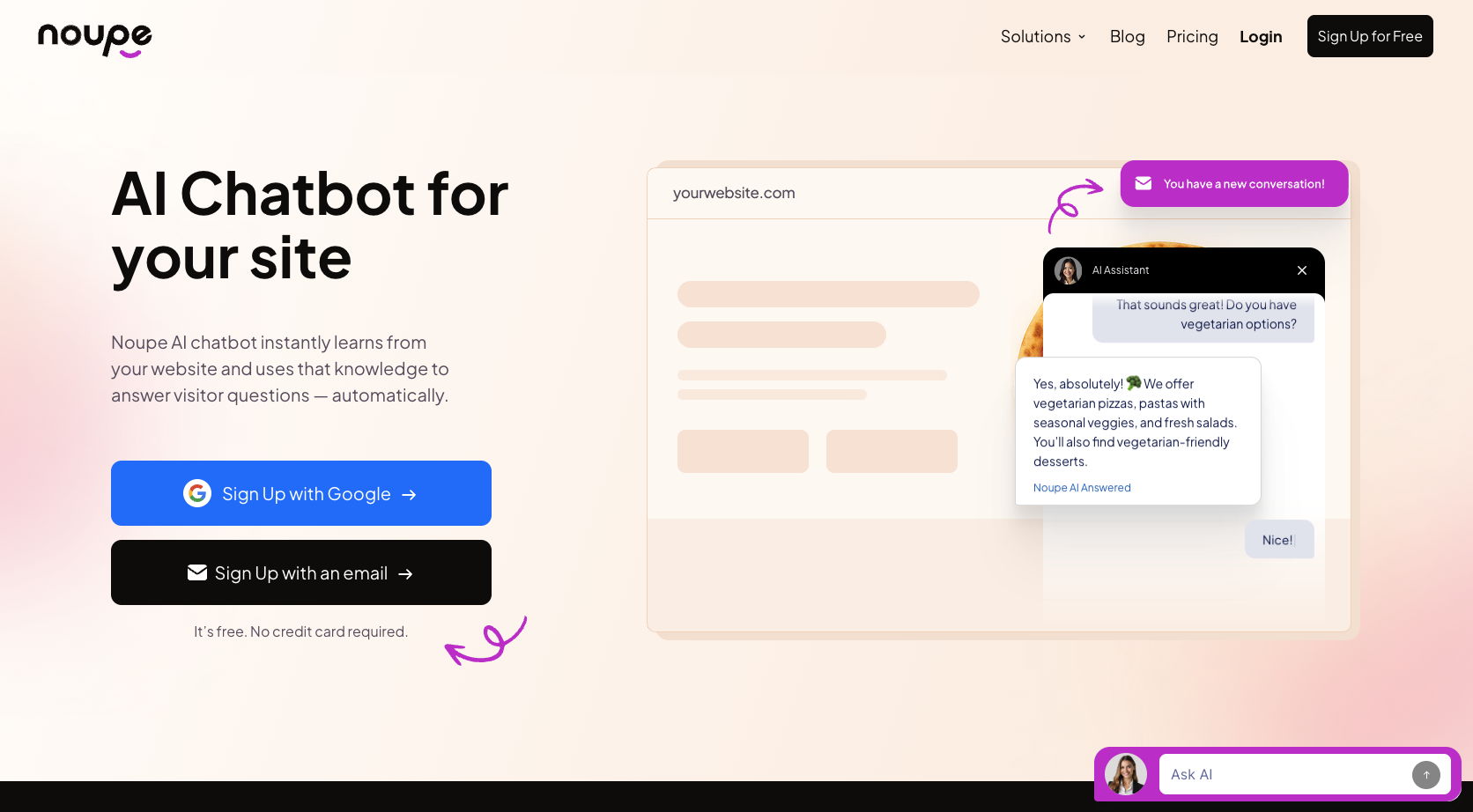
Noupe’s streamlined approach offers:
- Immediate deployment – No training, scripting, or complex setup required
- Automatic content learning – Simply provide website URL and embed code
- Neutral professional tone – Adapts to any brand without specific programming
- Risk-free exploration – Completely free solution for testing chatbot benefits
- Quick implementation – Functional chatbot within minutes rather than weeks
The solution provides automated support with a neutral, professional tone that adapts to any brand without requiring specific personality programming. This approach works particularly well for small teams, startups, or organizations looking to quickly deploy AI-powered chatbots without investing significant time in personality design.
Build a chatbot personality that boosts customer engagement
Chatbot personality plays a fundamental role in enhancing user engagement and building brand loyalty in today’s competitive digital landscape. The difference between a functional chatbot and an exceptional one lies in its ability to create meaningful connections through carefully crafted personality elements, including tone, emotional intelligence, consistency, and adaptability.
Successfully implementing chatbot personality requires:
- Understanding your brand voice and target audience needs
- Establishing clear conversation guidelines and behavioral patterns
- Leveraging advanced AI technologies for natural interactions
- Continuously testing and optimizing based on user feedback
- Balancing consistency with adaptability for different contexts
As chatbot technology continues evolving, the importance of personality in creating engaging, effective AI interactions will only continue to grow. The investment in thoughtful personality design today will pay dividends in customer satisfaction, brand loyalty, and business growth tomorrow.

