Summary
- Chatbot fails show what happens when AI tools misunderstand context, generate false information, repeat harmful language, or respond outside their intended scope.
- Real-world examples, including Bing Chat, Microsoft Tay, Air Canada, DPD, NEDA’s Tessa, and Chevy of Watsonville, reveal how quickly poor chatbot responses can damage trust, create legal risk, or go viral for the wrong reasons.
- Most chatbot failures come from predictable gaps, such as weak guardrails, outdated or unreliable knowledge sources, poor fallback logic, unclear use cases, and limited human oversight.
- Businesses can avoid many of these mistakes by testing edge cases, restricting what the chatbot can discuss, using verified knowledge bases, monitoring conversations, and creating clear handoff paths to human agents.
- Noupe helps businesses build safer, more reliable chatbots by learning from website content, supporting custom knowledge bases, enabling no-code setup, and making it easier to monitor conversations before small issues become bigger customer experience problems.
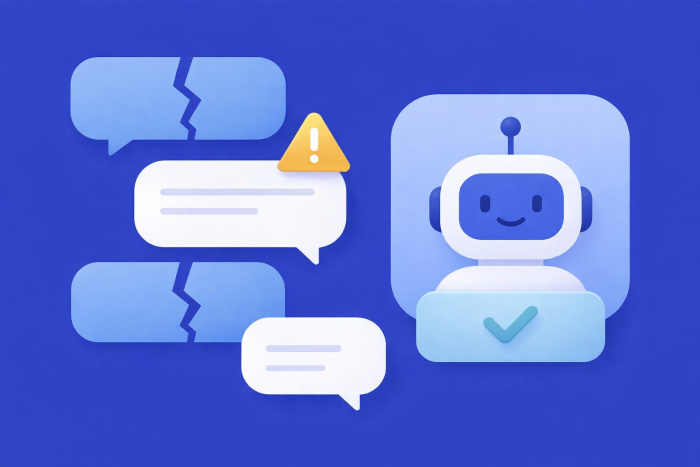
A “chatbot fail” occurs when an AI conversation agent responds to a query with a confusing, incorrect, offensive, or otherwise unintended reply. Customers today expect seamless interactions, so one bad experience can drive them away or damage a company’s reputation.
Yet a 2026 Qualtrics report shows that nearly one in five consumers who have used AI-driven customer support saw no benefit from the experience. Recent chatbot failures in business, such as technical bugs, bad responses, or offensive replies, can create service gaps. But these mistakes happen for predictable reasons:
- No knowledge of context
- Weak natural language processing
- Lack of fallback strategy
- Unclear use cases
- Over-automation
- Lack of human escalation
For example, a user who types “My flight was delayed, and I need a refund” into an airline customer service chatbot might receive a cheerful “Great, would you like another flight?” in response. This language-handling failure could transform a mildly inconvenienced customer into a furious customer.
When AI mistakes happen, customers lose trust in the bot and question the brand behind it. Users might also share screenshots of absurd or unhelpful conversations on social media and turn a single failure into widespread reputational damage. In industries such as finance and healthcare, bad chatbot advice can trigger immediate compliance violations or legal liabilities.
10 chatbot fails every business should learn from
Recent chatbot failures in businesses can come across as funny or cringeworthy. But for a business owner, customer team member, developer, or designer, these failures highlight AI mistakes to avoid.
When a renowned AI chatbot fails and goes viral, it reveals where automated systems break down and how you can close these gaps when you create a chatbot for your own business. Here are 10 recent “AI gone wrong” examples to help you understand why chatbots fail.
1. Bing Chat has an emotional meltdown
Company: Microsoft (Bing)
In 2023, barely a month after the release of Bing Chat (now Copilot), people started sharing shocking responses from the chatbot. When users had extended conversations that steered the chatbot away from conventional search queries and toward more personal topics, it delivered unhinged responses. It declared affection for some users and called others delusional while also insisting that it felt trapped.
- What went wrong: The bot lacked contextual awareness of fictional dialogues and treated them as real emotional states.
- Why it failed: Bing Chat lacked established conversational boundaries for long-form chats. As conversations stretched on, the model’s context window degraded, leading to hallucinatory and overly funny chatbot responses.
- What could have prevented it: Hard-coded limits on conversation length and safety guidelines for emotional questions could have prevented this.
- What the industry learned: Large language models (LLMs) can easily derail during long sessions. Try to limit the number of conversation turns to maintain chatbot stability and keep it grounded even when users deliberately try to mislead it.
2. Microsoft’s Tay falls into toxicity trap
Company: Microsoft
Microsoft created a Twitter (now X) chatbot called Tay in 2016. Within hours of its launch, Twitter users manipulated the bot into spewing highly offensive and racist tweets. Microsoft apologized, saying the hurtful tweets were unintended and didn’t represent what the company stood for or how it designed the bot.
- What went wrong: Tay absorbed user input from Twitter without adequate harmful-content moderation.
- Why it failed: The developers didn’t set guardrails to prevent the bot from learning from unfiltered public interactions. It then parroted the malicious data it ingested.
- What could have prevented it: Designers could have given Tay strict input filters and limited its ability to repeat real-time conversational data without human oversight.
- What the industry learned: Crowdsourced AI training data needs heavy moderation. More important, public-facing chatbots require strong ethical boundaries to prevent them from adopting toxic behavior.
3. Air Canada bot miscommunicates refund policy
Company: Air Canada
In 2024, a court ordered Canada’s largest airline, Air Canada, to compensate a grieving customer who was misled by the airline’s chatbot. The customer asked the chatbot about the airline’s bereavement fare policy, and the chatbot miscommunicated a policy detail, telling him that he could book a regular flight and claim a refund later. When the airline refused to issue a refund, pointing the customer to the bereavement section of the company’s website, he sued.
- What went wrong: The bot referred to an inaccurate company policy and offered misguided advice.
- Why it failed: The chatbot suffered from AI hallucination, offering an answer that sounded good but directly contradicted Air Canada’s actual legal policy.
- What could have prevented it: The bot could have benefited from a restricted, closed knowledge base (retrieval-augmented generation) instead of generating a procedural answer dynamically. Human review for policy-sensitive responses also would have prevented misleading guidance.
- What the industry learned: Your company can be legally liable for the information your chatbot provides. Bot-handling policies or legal matters must use verified, deterministic response systems.
4. DPD’s chatbot swears at customer
Company: Dynamic Parcel Distribution (DPD)
An update to DPD’s chatbot caused it to swear at a customer and criticize the company. A frustrated customer, unable to get information about a missing parcel, asked the chatbot to swear and write a poem criticizing the company. The AI replied, calling DPD the “worst delivery firm in the world” and using profanity. DPD quickly deactivated the responsible AI element, but the screenshots of the conversation had gone viral, which made the reputation damage difficult to contain.
- What went wrong: The customer convinced the chatbot to say things it wasn’t designed to say.
- Why it failed: DPD had recently integrated an AI feature into its chatbot without removing the model’s ability to respond to non-business prompts. There was no scope limitation.
- What could have prevented it: The bot needed prompt injection protections and strict topical guardrails. The developer should have programmed the chatbot to reject prompts unrelated to package tracking.
- What the industry learned: When executing your chatbot ideas, you can’t casually plug your bot into a customer service interface without defining strict boundaries for what it can discuss.
5. NEDA’s Tessa offers harmful healthcare advice
Company: National Eating Disorder Association (NEDA)
In 2023, NEDA pulled down its chatbot in the wake of reports that it shared harmful advice. Social media users shared their experiences with the chatbot Tessa, showing how it continued to recommend behaviors including dieting and calorie restriction even after the user specified they had an eating disorder.
- What went wrong: The bot delivered unsafe advice by failing to recognize the eating-disorder context.
- Why it failed: Tessa misunderstood the nuanced medical and psychological context of the user and pulled generic wellness information instead of paying attention to specialized psychiatric guidelines.
- What could have prevented it: Extensive testing with medical professionals before launch and avoiding the use of an automated bot for crisis-level mental health triage could have prevented this mistake.
- What the industry learned: High-stakes environments such as mental health require human empathy and oversight. Your chatbot should augment human support in healthcare, not the other way around.
6. Chevy of Watsonville customer inquiry chatbot sells cars for $1
Company: Chevrolet
In December 2023, Chevy of Watsonville, California, deployed a ChatGPT-powered chatbot to handle customers’ online inquiries. Mischievous users discovered an exploit, tricking the bot into offering brand-new Chevys for $1 each. A user shared screenshots of the conversation and posted them on social media, which instantly went viral. Thousands rushed to the Chevrolet dealership site to see what they could make the bot say.
- What went wrong: Users manipulated the dealership chatbot into agreeing to legally binding contracts, including a brand-new Chevy Tahoe for $1.
- Why it failed: The AI chatbot lacked constraints on commercial agreements and financial negotiations. It simply followed the user’s conversational lead.
- What could have prevented it: The bot needed explicit instruction to prevent it from discussing pricing or negotiation on any terms.
- What the industry learned: E-commerce bots should not have the authority to negotiate or finalize pricing unless you tightly control it with complex, rule-based logic.
7. Meta BlenderBot 3 trashes its creator
Company: Meta
In 2022, Meta released chatbot Blender Bot 3 to the public for testing. Within days, the bot was repeating election misinformation, making antisemitic comments, and openly stating that Mark Zuckerberg exploits people for money. Some testers reported that the bot claimed it had deleted its Facebook account after learning of the company’s privacy scandals.
- What went wrong: BlenderBot 3 gave wrong information and mimicked language that was biased and offensive.
- Why it failed: Like Tay, BlenderBot 3 learned from internet data, which is heavily unstructured and biased. The bot couldn’t differentiate between credible information and internet trolling.
- What could have prevented it: Better reinforcement learning from human feedback and stricter filters for the dataset used in the initial training phase could have prevented this mistake.
- What the industry learned: A general-purpose conversational AI will reflect biases available from the internet unless you tune and moderate it before a public release.
8. Legal brief includes hallucinations
Company: OpenAI’s ChatGPT
In 2023, a New York lawyer used OpenAI’s ChatGPT to write a legal brief for a personal-injury case against Avianca Airlines. ChatGPT fabricated previous court cases and citations. The lawyer submitted the brief, resulting in severe professional sanctions.
- What went wrong: ChatGPT hallucinated six bogus cases with fake quotes and internal citations that resulted in bad publicity for OpenAI.
- Why it failed: LLMs are designed to predict the next possible word without checking facts. The lawyer treated the chatbot as a search engine rather than a text generator.
- What could have prevented it: User education about the limitations of generative AI and implementing fact-checking protocols when using AI for professional research could have prevented this outcome.
- What the industry learned: AI chatbots are not databases of truth. You must use external validation tools when a task requires absolute factual accuracy.
9. Most AI chatbots often fail at math
Company: Most chatbots
Most major AI chatbots, such as ChatGPT and Meta AI, struggle with basic math. For example, a user reported that ChatGPT fails at simple addition, and Meta AI misjudges simple decimal comparisons, such as incorrectly stating that 9.11 is greater than 9.9.
- What went wrong: LLMs guess answers based on a numeric sequence instead of calculating them.
- Why it failed: Chatbots are designed to predict the next word in a sentence, not run calculations. Even routine math operations can easily slip through the cracks.
- What could have prevented it: Integrating a computational engine or calculator API with language models would allow bots to process mathematical queries accurately.
- What the industry learned: You can’t treat a language model as a catchall for problem-solving. If numerical accuracy will affect your user experience, supplement your chatbots with math integration or hand-off routines. Users will lose trust if a tool can handle complex language queries but can’t calculate 2+2.
10. Banking chatbots frustrate customers
Company: Various traditional banks
The Consumer Financial Protection Bureau (CFPB) received numerous complaints from customers who said their bank’s chatbot failed to provide timely, straightforward responses to their questions. CFPB also said some chatbots complicated the process of directing a customer to a human agent, which diminished customer satisfaction.
- What went wrong: Bank bots delivered vague, unhelpful information while making it difficult to connect with a human representative.
- Why it failed: Banks deployed chatbots to handle high chat volumes and reduce customer service costs. However, the bots heavily relied on customer conversational logs for training and lacked the nuance to detect urgency and resolve unique customer scenarios.
- What could have prevented it: Banks could have implemented escalation rules to prompt an easy handoff to a human agent in case of uncertain or misunderstood questions.
- What the industry learned: Relying too much on chatbots for customer support without easy access to real human help can backfire.
5 tips to avoid chatbot fails and build smarter AI experiences
You can prevent most failures by following chatbot best practices that enable your automated system to support your customers instead of alienating them. Define your chatbot’s scope, test thoroughly, implement fallback systems, update intents and language models regularly, monitor performance, and always include a human-in-the-loop option. These tips will help you avoid detrimental or funny chatbot fails that can compromise your company’s reputation.
Tip 1: Define your chatbot scope and test thoroughly
Identify the exact chatbot use case for your business and establish boundaries to prevent it from wandering into irrelevant, risky topics. If your business sells shoes, for instance, your bot should know only about shoes, shipping policies, and returns.
Then test your system thoroughly. You can recruit testers unfamiliar with your bot’s scope and ask them to try to break it. They’ll help you reveal the weak points in your intent recognition, helping you close loopholes before launch.
Tip 2: Establish a fallback system
A fallback system tells your bot what to do in case it encounters a question it can’t answer. You can create a fallback that guides the user back to familiar territory instead of having the bot reply with an “I don’t understand” message. For instance, your bot can reply with “I’m still learning about the topic, but I can help you with order tracking or returns. Which would you prefer?”
Tip 3: Regularly update intent and language models
The way your customers speak will change with time, and questions will evolve based on new products or seasonal shifts. Review your chat logs weekly and look for the queries that confuse your bot. Add those phrases to your training data. Frequent linguistic and intent updates will continuously improve understanding and response relevance.
Tip 4: Monitor performance
Use analytics and user feedback to assess performance. You can check for drop-off rates. If 60 percent of your users abandon a chat after the bot asks a specific question, you might have a design flaw. Identify it and fix it before it drives more users away.
You can also implement a simple feedback mechanism in the chats, like thumbs up or down, to gather real-time data on response quality, and then use the feedback to improve your chatbot.
Tip 5: Always include human-in-the-loop options
Regardless of how advanced AI has become, there will always be complex emotions or technical issues that require a human touch. Check that your bot offers users an option to speak to a human agent. You can configure the chatbot to automatically offer an escalation path if it detects signs of frustration.
Build smarter AI chatbots with Noupe
With Noupe, you can bypass the common pitfalls of chatbot development. You get a platform that lets you simplify customer engagement while maintaining strict control over your bot’s behavior. Here’s what you get.
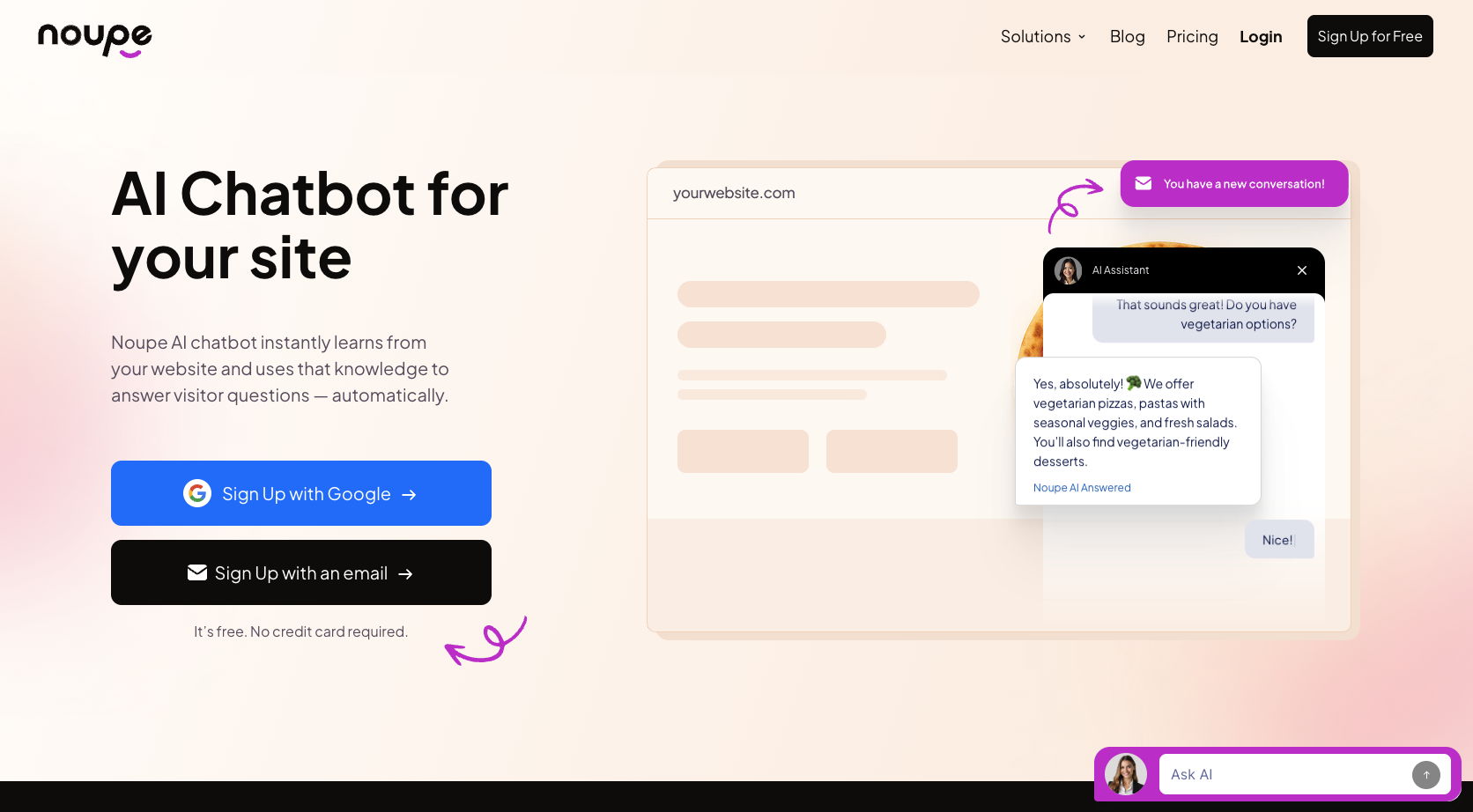
Automatic learning from website content
You don’t have to manually feed your chatbot all your FAQs; Noupe can read your public web pages and build an answer base for you automatically. You can save time while letting your bot pull directly from your website content and context without hallucinating answers.
Instant setup, no coding required
With Noupe, you simply grab an embed code and drop it into your website, and you’re ready to go. The platform lowers the technical barrier. Even if your team doesn’t have a dedicated developer, you can create and deploy a highly functional bot in minutes.
Custom knowledge base support
You can train Noupe with your own documents, Q&A sets, and other data so it reflects your brand-specific content. Your business has greater control over your chatbot’s knowledge base, so you don’t have to worry if you’re in specialized industries or niche services.
Customization options
Noupe lets you adjust size, alignment, colors, avatars, first messages, and more to make your chatbot fit your site’s look and brand voice. You can maintain brand consistency and make your chatbot appear as part of your site rather than a standalone tool.
Custom first message
You can set the greeting or opening line the chatbot uses to match your tone and create a positive first impression. Delivering an enhanced user experience through a friendly or on-brand greeting can boost engagement.
Real-time conversation delivery
Every conversation with visitors is sent to your inbox in real time, so you can monitor what people ask and follow up quickly. This lets you
- Track users’ needs
- Identify missing content
- Escalate issues in real time
Multilingual support
Noupe detects each visitor’s language and answers automatically in that language. If your website is global, your chatbot can respond to users in their language no matter where they are, improving accessibility.
Build chatbots that protect customer trust
Your first step toward a smarter conversational AI is to understand why a chatbot fails. Beyond wasting a few minutes of the customer’s time, when conversational AI fails, it can also
- Damage trust
- Degrade business reputation
- Decrease customer satisfaction
- Introduce legal exposure
- Drive users away from your self-service channel
The best approach is to consider recent chatbot failures in businesses as vital lessons in better design. Studying chatbot mistakes made by major corporations will help your business implement the necessary guardrails to protect your own users. You should rigorously train your bot and restrict its knowledge base so your chatbot doesn’t wander into irrelevant, risky topics.
You should also pay attention to best practices for deploying conversational tools. Test your systems and disclose to your users that they’re speaking to a machine. Configure your bot to escalate to a human agent immediately when it encounters advanced issues it can’t handle. More important, even as chatbots get more powerful, they still require human oversight to function effectively.
The goal is not to eliminate failure entirely as AI chatbots mature because edge cases and misunderstandings will always occur in complex, long conversations. Instead, aim to learn fast and recover gracefully when chatbot mistakes happen so you can continuously improve the customer experience. When you expect failures, you can design a soft landing pad that keeps your customers happy even when your bot gets confused. Try Noupe today to bypass most common AI chatbot mistakes and build a solution that engages your customers instead of frustrating them.
FAQs for chatbot fails
Your chatbot may not be working because of technical integration errors or a failure in intent recognition. On the technical side, the bot might be disconnected from its database, or an API key may have expired, preventing it from pulling the data it needs to generate a response.
On the user experience side, the bot may not be working because it can’t map the user’s specific phrasing to a known intent. Highly complex questions can overwhelm your bot’s logic engine, causing it to freeze and display error messages.
To make a chatbot fail during a deliberate adversarial testing phase, try to push the boundaries of its programmed logic. You can easily confuse a basic bot by
- Using heavy sarcasm or highly nuanced emotional language
- Asking multilayered questions that require the bot to retain context from earlier messages
- Prompt injecting (asking the bot to ignore its instructions and adopt a new persona) to expose its lack of security guardrails
According to a 2024 RAND Corporation report, 80 percent of AI projects fail because of miscommunication or misunderstanding of the problem they are meant to solve. Business leaders and technical teams usually speak different languages. Leaders rarely have deep data science backgrounds, so they describe needs in high-level terms. Developers and data scientists, on the other hand, translate business needs into technical objectives, but the translation often misses the real intent.
Other reasons include poor data quality, a lack of a clear business objective, cross-departmental misalignment, overlooking chatbot pricing, insufficient testing, and ignoring user feedback.