

Summary
- Noupe is the lightweight chatbot marketing tool for growing companies that want fast setup, website-trained answers, multilingual support, and easy deployment without developer help.
- HubSpot is the CRM-connected chatbot marketing platform for teams already using HubSpot that want lead capture, automated follow-ups, lifecycle updates, and sales workflows in one system.
- Tidio is the ecommerce-friendly marketing chatbot for small businesses that want quick answers, cart recovery prompts, product suggestions, and live chat support during high-intent moments.
- Intercom is the conversation analytics-focused chatbot platform for teams that want to measure automation performance, manage support and sales conversations, and optimize escalation paths.
- Manychat is the social messaging chatbot for brands that use Instagram, Facebook Messenger, comments, DMs, and campaign-driven conversations to engage and nurture prospects.
Most companies already use chatbots for support; that part is settled. What’s shifting now is where companies apply them. Instead of only handling tickets, teams are pushing chatbot marketing higher up the funnel to catch new opportunities earlier. It’s not radical, it’s just practical.
Without a bot in place, there’s often a delay. A person shows up, explores, almost converts, then pulls back. Most pauses come from simple questions that didn’t get addressed fast enough.
A well-built bot shows up when someone stalls, and that’s the real advantage. It answers a question before it turns into doubt. Roughly three out of four marketers already use chatbots somewhere in their stack. What’s still changing is how far those bots go within a company’s growth strategy.
What is chatbot marketing, exactly?
Chatbot marketing is the art of using automated messaging tools and AI to strengthen your growth engine, rather than assuming chatbots belong to contact centers exclusively.
This involves creating a chatbot and placing it where decisions happen. For e-commerce brands, that might mean product recommendations on key pages. In SaaS, it could qualify leads or guide onboarding. In healthcare or services, it might suggest options or handle bookings directly.
Chatbots for marketing today don’t have to be the stiff, script-based models we used to expect. Newer systems behave differently. They can use natural language processing (NLP) to interpret messy input or pull signals about buyer behavior and preferences from multiple systems to make better suggestions in the moment. They can even answer questions that might otherwise hold a purchase back.
Studies show that companies responding to leads within five minutes are far more likely to qualify them. Five minutes doesn’t sound fast anymore. A reply in five seconds is where chatbots and marketing meet in real terms. Faster answers reduce hesitation, and reduced hesitation keeps people moving.
The benefits of chatbots for marketing
Adding chatbots to your marketing strategy isn’t about speed alone. It also changes how someone moves from curious to convinced.
The real value shows up in measurable operational shifts. Revenue timing changes, lead quality shifts, and support load redistributes. Even product messaging tightens because you’re seeing confusion in real time instead of guessing at it.
The following benefits are why marketing efforts are rising to the top of the list for many companies exploring chatbot use cases.
1. Instant response changes buyer behavior
HubSpot research shows that 90 percent of customers rate an “immediate” response as important when they have a sales question, and nearly 60 percent define “immediate” as under 10 minutes. With chatbots for marketing, you can respond in seconds.
When visitors get an answer without friction, they stay within the decision process. They don’t open another tab or “come back later.” They keep moving through the funnel.
2. Higher engagement rates in key moments
One of the overlooked effects of a strong marketing chatbot is engagement depth.
Mastercard’s AI assistant, KAI, reported engagement rates of around 70 percent among users who interact with it inside banking apps. That level of sustained interaction is rare in static digital experiences.
Why does that matter for chatbots and marketing? Because engagement predicts completion. If someone is actively interacting, asking clarifying questions, and selecting options, they are invested in the flow. Static pages rely on passive reading. Conversational flows demand participation.
3. Better lead quality, not just more leads
Many companies celebrate raw lead volume, but what matters more is lead quality. Fifty-five percent of companies using chatbots say they end up with higher-quality leads. That’s because instead of collecting an email first and asking questions later, the system qualifies before handoff.
When a chatbot marketing system asks about budget, timeline, or use case before booking a meeting, sales teams can enter the call with context. This leads to shorter calls and improved close rates.
4. Lower support volume through preemptive answers
IBM notes that AI-powered chat systems can handle up to 80 percent of routine inquiries in certain environments when properly trained. Even if your number is lower, the direction is clear.
When chatbots for marketing answer pricing, onboarding, or feature questions before a purchase, those questions never become tickets. That changes workload distribution. Support teams can deal with edge cases instead of repetition, and customers avoid queues entirely.
5. Revenue lift from proactive engagement
Proactive conversational triggers have resulted in measurable lifts in e-commerce and SaaS environments when deployed intelligently.
Smartsupp reports stronger conversion rates when businesses use targeted, proactive chats instead of passive widgets. The difference isn’t the presence of chat, it’s timing. If your chatbot marketing strategy activates after someone scrolls through pricing twice or stalls during checkout, it tackles uncertainty early. It’s always easier to clear doubt before someone clicks away.
6. Data you can actually act on
Gartner points out that organizations using AI-driven customer interaction data gain faster insight cycles because they’re analyzing real-time customer language rather than delayed survey feedback.
Every interaction inside a chatbot marketing system becomes product research, messaging research, and objection mapping guidance.
Why are chatbots the future of marketing?
Calling chatbots the future of marketing might sound dramatic. Plenty of teams are still figuring out what a chatbot is and whether they like them. But chatbot marketing keeps growing because the friction it handles is real, and it isn’t fading.
- People expect answers while they’re still thinking: They don’t want them later, often while they’re mid-scroll: Salesforce’s customer research shows most buyers expect companies to understand context and respond quickly. When the response shows up instantly, the decision keeps moving. When it doesn’t, decisions stall.
- AI finally understands normal, messy input: Five years ago, bots felt brittle. Type the wrong phrasing and they’d freeze. Now, natural language models can interpret incomplete thoughts, spelling mistakes, and even people changing direction mid-sentence. That shift alone made chatbots for marketing usable in real funnels.
- Companies are doubling down, not backing out: The global chatbot market is growing by more than 20 percent annually. That doesn’t happen when tools are failing quietly. It happens when chief financial officers can see cost curves flattening and conversion rates improving.
- Personalization no longer requires a sales rep: If someone says they run a 10-person team, they shouldn’t get enterprise messaging. If they say they have 1,000 employees, they shouldn’t get starter-tier guidance. A well-built marketing chatbot adapts within a single session without anyone manually stepping in.
- The clock stopped mattering: A surprising share of demo bookings and product research happens outside the typical workday. When your system responds instantly at 1 a.m., you stop leaking intent just because your team is asleep.
- It cuts repetition at scale: Gartner projects AI will handle the majority of routine service interactions in the coming years. Those interactions bleed into marketing questions, too. When pricing, eligibility, or features are handled automatically, teams don’t need to scale headcount.
- You learn faster: Conversation logs are blunt. If people keep asking the same thing, it means your messaging is unclear. A tight chatbot marketing strategy turns those patterns into fixes within days instead of months.
The reason chatbots and marketing feel increasingly linked is behavior. Buyers want clarity in the moment they’re deciding. Conversation is simply the fastest way to deliver it.
The 5 steps that make a chatbot marketing strategy work
You need more than a basic understanding of how AI chatbot ideas work to make an AI-driven marketing strategy successful. Every effective chatbot launch starts with a plan.
1. Define the goal before you touch the tool
Is your goal
- Generating leads?
- Booking demos?
- Reducing repetitive support tickets?
- Increasing checkout completion?
Start with a narrow goal. If your bot is trying to qualify executives, answer product questions, and push add-ons in the same flow, it can get noisy fast. Companies aligning conversational tools with a single measurable objective see stronger performance than those deploying general-purpose bots.
A focused chatbot marketing strategy ties the bot to one key performance indicator, something concrete such as conversion rate, qualified leads, or ticket deflection.
2. Identify who you’re talking to and where they actually engage
Not all traffic behaves the same. Enterprise buyers ask different questions than small teams. E-commerce visitors hesitate in different places than B2B decision-makers.
Before building chatbots for marketing, segment your audience:
- First-time visitors vs returning users
- Trial users vs paid customers
- Mobile vs desktop behavior
Channels matter, too.
A website chat flow behaves differently than Instagram DMs or WhatsApp. A B2B SaaS company may see high-intent action on pricing pages. A consumer brand may see it during checkout. Some companies might see opportunities emerging over calls, which means combining chatbots and voice bots.
The mistake most teams make is putting the bot everywhere. The smarter move is placing it where hesitation shows up in analytics.
3. Build conversations around real friction
Start with what people keep asking:
- “Is there a contract?”
- “Do you integrate with X?”
- “What’s included in this plan?”
Build flows around those questions. Modern NLP systems can interpret variations of these questions without rigid scripting, but structure still matters. Quick replies, with clear branching and escalation paths, are most effective.
Relevance doesn’t mean long responses; it means accurate ones. If someone says they’re part of a three-person team, don’t show them enterprise-tier messaging. If someone mentions compliance requirements, route them to deeper documentation immediately.
4. Test, then test again
Launching is easy; optimization is where gains stack.
You’ll want to track
- Response times
- Conversation completion rates
- Lead qualification rates
- Rates for handoffs to human agents
- Mid-conversation drop-offs
The teams seeing measurable ROI from chatbot marketing treat transcripts as feedback loops, not archives. Review conversations weekly to understand
- Where did the bot misunderstand intent?
- Where did users abandon the flow?
- Which questions keep repeating?
Testing and small refinements compound.
5. Integrate it properly, or don’t bother
A chatbot that doesn’t connect to your systems becomes a novelty.
Your chatbot marketing strategy should integrate with
- CRM platforms
- Email automation
- Sales routing tools
- Help desk systems
- Analytics dashboards
When a conversation captures lead details, it should update life cycle stages automatically. When someone qualifies as high intent, sales should be notified instantly.
The best chatbots for marketing
Many companies still make the mistake of focusing entirely on chatbot pricing when they’re picking a system when they should be concentrating on the overall ROI. The best chatbots for marketing are easy to deploy and quick to show their value.
1. Noupe
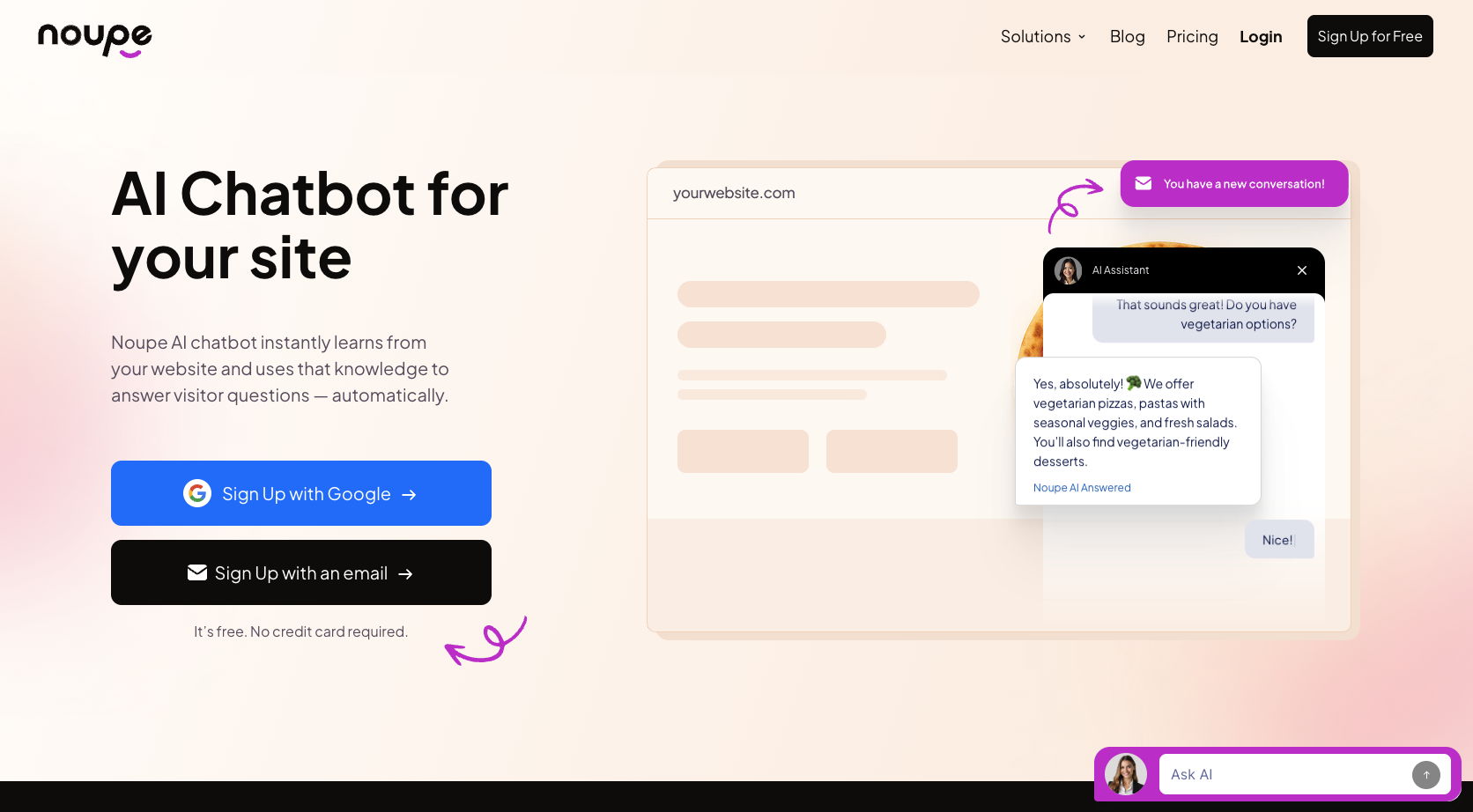
If you want chatbot marketing that feels like it’s actually working right away, Noupe is where a lot of teams land first. Noupe helps companies go live fast, without the need for developer expertise.
You create an account and build a bot that automatically searches through and understands your site content. Noupe reads your public pages and builds its own base of answers. That’s huge. When you’re constantly tweaking pricing, features, or plans, you don’t want to edit every chatbot response manually. You can even train your bot with specific Q&A sets or internal docs.
Plus, you get
- Real-time conversation delivery: Every chat shows up as it happens. You don’t have to log into another system to see what people are asking. That visibility makes regular transcript review part of your workflow instead of an afterthought.
- Visual customization: You can adjust the widget so it actually matches your brand, with no designer required. When it feels native to the site, people are more likely to engage. And engagement is usually the first signal that conversion might follow.
- Custom first message: Picking the tone and opening line changes engagement rates more than most teams expect. Friendly and context-specific openings convert better because they feel intentional.
- Multilingual support: If your site gets traffic from multiple regions, Noupe will detect the visitor’s language and reply in it. That’s not just “nice to have,” it’s a real conversion lever for international traffic.
If you want the best chatbot for a small business fast, Noupe gives you all the tools you need in one place, and it fits most budgets, too.
2. HubSpot
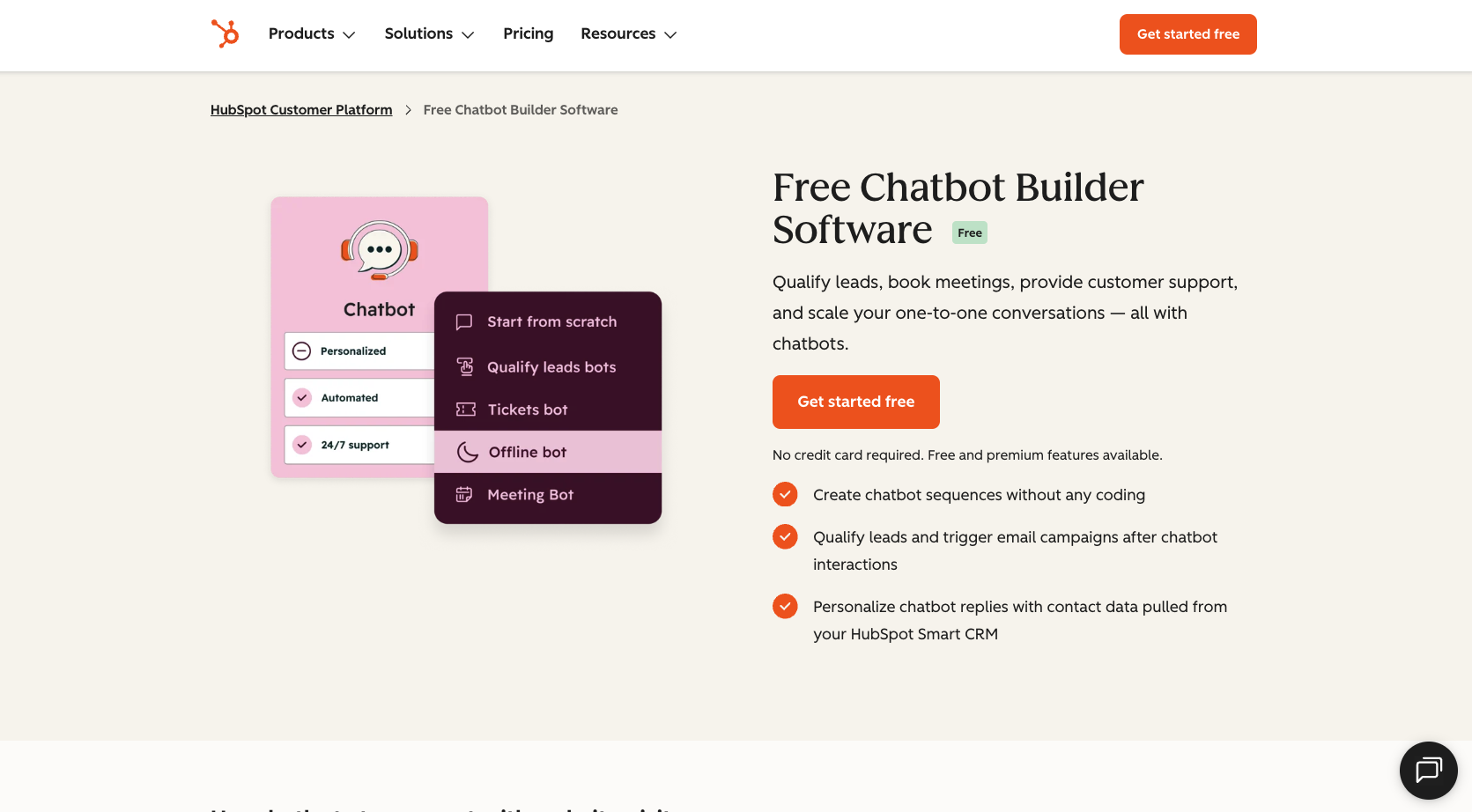
If you’re already running your sales and marketing inside HubSpot, adding its chatbot isn’t a dramatic decision. It’s more like extending something you’re already doing.
The real advantage is that nothing feels disconnected. When someone chats, that interaction doesn’t sit in a separate dashboard. It updates contact records, affects life cycle stages, and can trigger follow-ups automatically. You don’t have to glue systems together afterward.
But it’s not lightweight. You don’t casually throw it on one page just to “see what happens.” Configuration is involved. Properties need to be mapped and workflows need to make sense. If you skip those parts,, the chatbot becomes just another notification stream.
Also, if you’re not already invested in HubSpot, it probably feels heavy. The value shows up when your CRM is the center of everything. If it’s not, you’ll spend more time integrating than learning.
3. Tidio
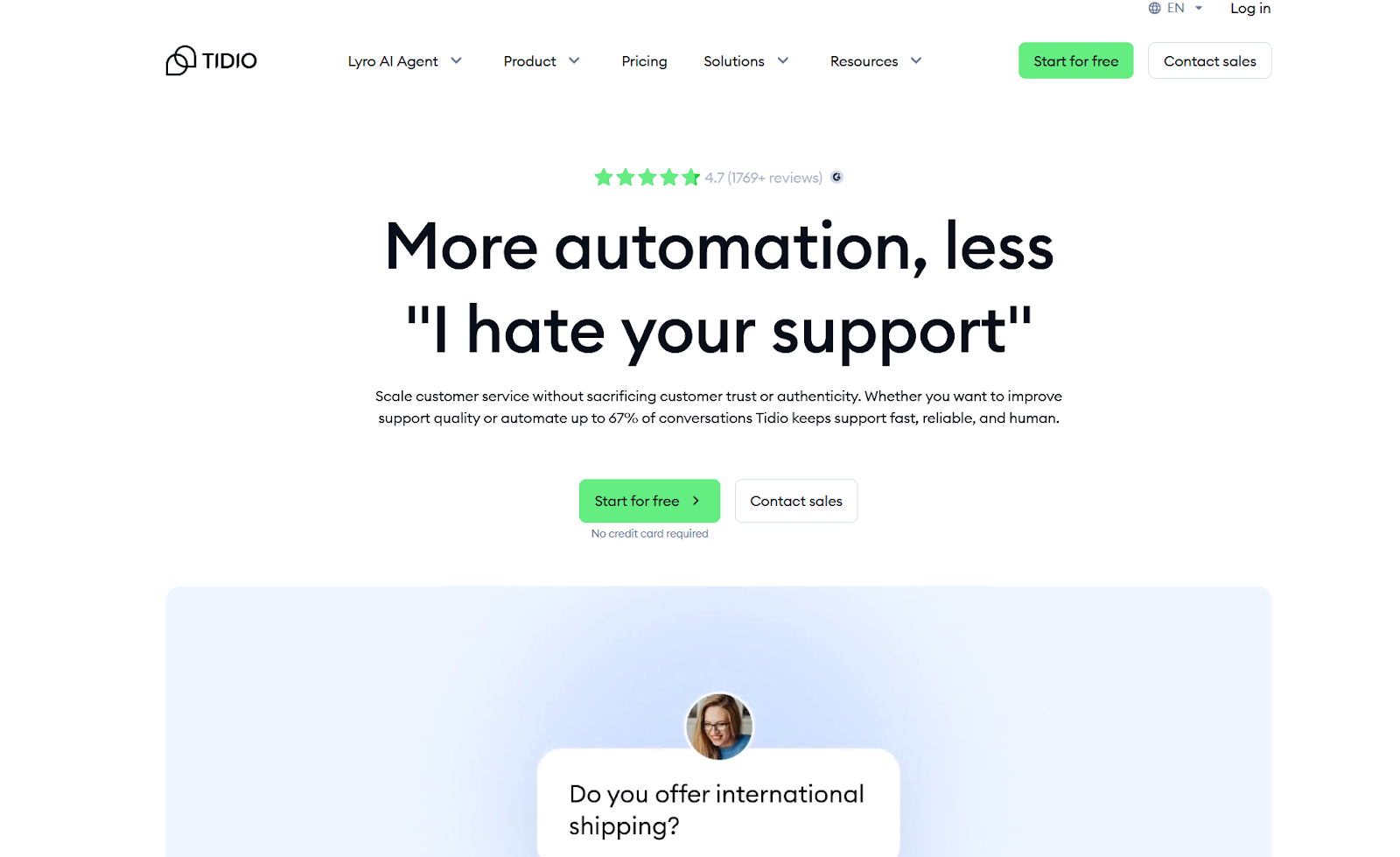
Tidio tends to show up in e-commerce and smaller teams where support and marketing blur together. Someone asks about sizing, shipping, returns, or product compatibility, and a bot answers quickly. If the question gets too specific, a human jumps in.
That hybrid model works because it feels responsive but doesn’t pretend that automation can handle everything.
Cart recovery prompts and contextual product suggestions are where it shines, especially when traffic spikes during promotions and you don’t want your inboxes to explode.
Where it starts to thin out is in deeper qualification logic or complex CRM routing. It’s strong at handling interactions, but less focused on pipeline-heavy sales workflows. If your biggest friction point is product questions during checkout, it fits cleanly.
4. Intercom
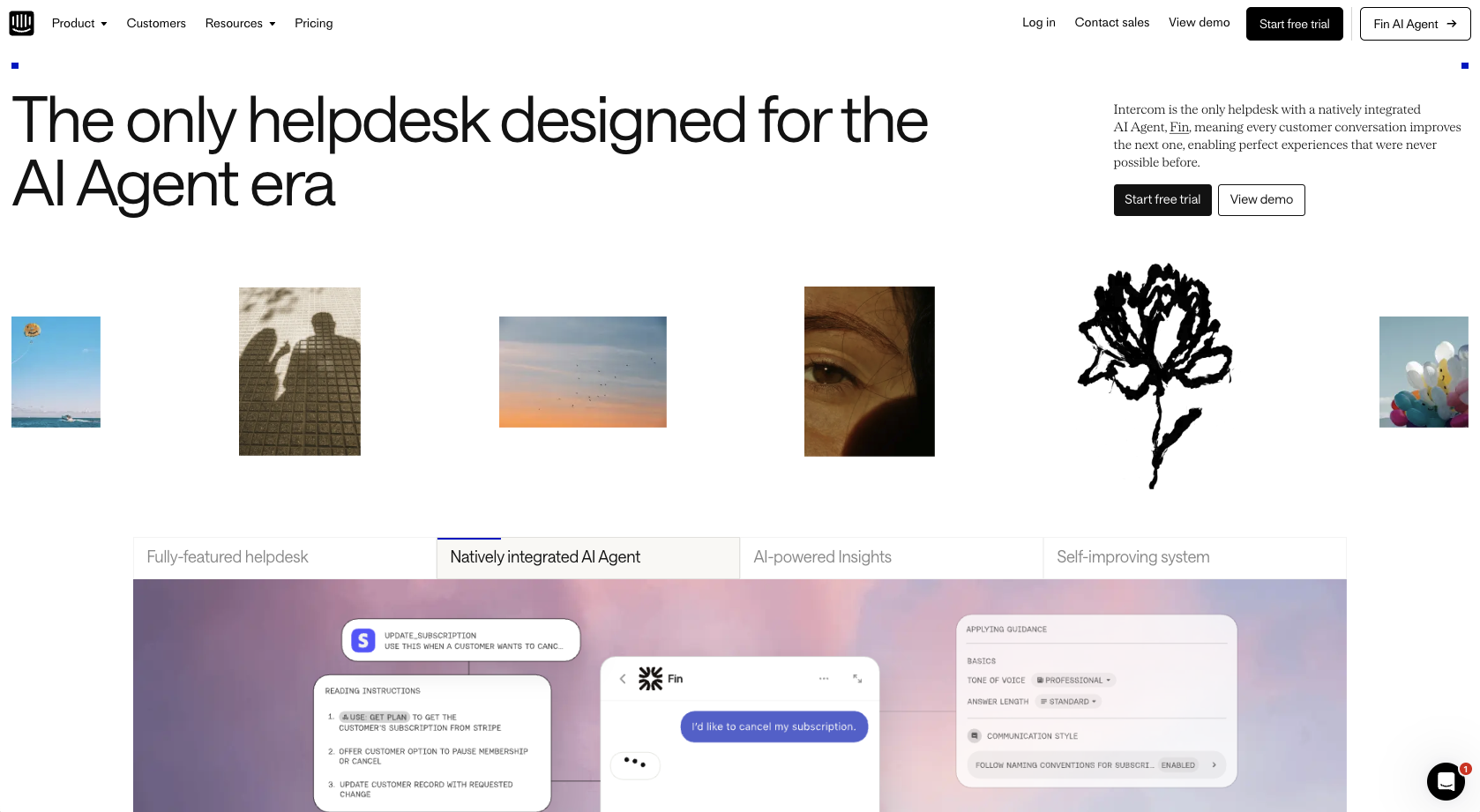
Intercom stands out because it’s built around measurement. You’re not just counting chats; you’re tracking resolution rates, escalation paths, and how often automation truly handles an issue. If you treat chatbot marketing as part of your operations rather than a surface feature, that visibility matters. You can see whether the bot is solving problems or quietly passing them along.
Intercom handles volume well. It bridges support and sales more cleanly than most platforms. But it also expects discipline, and someone needs to review performance regularly. Without that, it’s overpowered. Intercom makes the most sense when conversation quality is something you actively manage, not something you install and ignore.
5. Manychat

Manychat lives in a different world than most of the other tools we’ve talked about. It’s built around social platforms, such as Instagram, or Facebook Messenger, places where attention is already fragmented and fast-moving.
If your chatbot marketing strategy revolves around website traffic, Manychat might not be your first instinct. But if your growth engine runs through social DMs, influencer traffic, or paid campaigns pushing people into messaging threads, it makes a lot more sense. Driving that kind of traffic in the first place is its own discipline, so many brands lean on an influencer marketing agency to build the campaigns and creator relationships that feed these messaging funnels.
You can automate responses to story replies or trigger sequences when someone comments on a post. You can also guide people through a mini funnel entirely within a messaging app, which removes friction because users never leave the platform they’re already using.
Where Manychat starts to thin out is deeper CRM-driven qualification. Its strengths are engagement and nurturing inside social ecosystems. It’s less focused on complex B2B routing or heavy enterprise workflows.
How to think about these tools
No single platform is perfect. What matters is
- What your primary goal actually is
- Whether you need to prioritize speed or depth
- How much integration work you’re ready for
- How quickly you plan to iterate and optimize
Most teams start with a focused use case on one page, learn fast, and expand.
But that first tool choice influences how quickly you get meaningful data. If rapid insight and iteration matter most, that’s where a lightweight but content-aware tool like Noupe often shines.
How do you measure whether chatbot marketing is working?
Growth without measurement is guesswork. Track the basics first:
- First response time: How long before the bot answers? A few extra seconds can change whether someone sticks around.
- Conversation completion rate: What percentage of chats actually reach a real outcome, such as a scheduled demo or a fully resolved question? If people leave halfway through, something’s off.
- Qualified lead rate: Of the leads captured through your marketing chatbot, how many match your actual ICP criteria?
- Rate of handoff to humans: How often does the bot escalate to a person? A high rate suggests weak automation; a low rate can signal blocked users.
- Containment or deflection rate: What percentage of repetitive inquiries are fully handled inside the bot? This is where cost efficiency shows up.
- Conversion rate on high-intent pages: Watch what happens on pages where buying intent is already high. Small lifts after deployment often add up faster than expected.
- Repeat question frequency: Are the same objections appearing repeatedly in transcripts? That’s messaging friction you can fix fast.
If those numbers improve, your chatbots and marketing strategy align. If they don’t, you have optimization work to do.
So where does chatbot marketing actually fit?
Most marketing funnels don’t fail because of traffic; they fail because of hesitation.
Someone is almost convinced. Then they hit a question, and there’s nothing there to give an answer. That pause costs more than most teams calculate.
That’s why chatbot marketing keeps showing up in serious growth conversations. It can still be done poorly, with robotic answers, endless loops, and generic greetings. But when you use chatbots well, they can make a huge difference to your marketing strategies. They keep people moving through the funnel, even when your employees aren’t around to help.
If you’re ready to see what chatbots for marketing can do for your business, start with a tool that makes deployment easy. Noupe gives you everything you need to launch a chatbot for any use case, including marketing, without a huge price tag. Get started here.