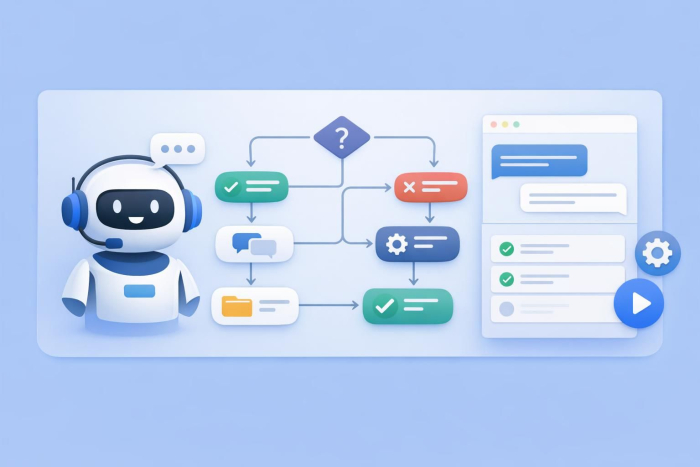
Rule-based chatbots are software programs that guide conversations using predefined rules, decision trees, and scripted responses to answer common questions or complete simple tasks.
Every business gets the same dozen or so questions on repeat. Your support team can probably recite your return policy by heart, and it seems like they spend half their day checking shipping statuses. A rule-based chatbot can take over these routine tasks, using predefined paths to respond to common inquiries.
This kind of software uses decision trees and scripts to interact with users. If a customer asks when a store opens, the chatbot shares the operating hours. That’s much faster than a human can type it out or explain over the phone. Automating these questions also frees up your team to deal with more complex issues.
Rule-based chatbots are already common in customer support, e-commerce, finance, and healthcare. These industries deal with a constant stream of routine questions that don’t need a human response. With chatbots, customers get instant answers, and your team saves time.
What are rule-based chatbots?
What is a chatbot? It’s a computer program that understands human communication and responds with relevant responses as though you’re having a conversation.
A rule-based chatbot follows structured workflows to guide conversations. Like a train on tracks, it can follow only the paths you’ve built for it. That predictability means you don’t have to worry about the chatbot going rogue and giving incorrect or random responses.
Businesses often use these tools for frontline customer support. Huntington Bank, for instance, uses a rule-based chatbot to handle basic requests. It can help clients open a new account or enroll in online banking. It also answers common questions, such as, “What is Zelle?”
This scripted assistance means customers don’t need to wait to chat with a human to get things done. Plus, it reduces wait times for people with more complicated issues that chatbots can’t resolve. However, the Huntington Bank chatbot can’t have random conversations about, say, penguins or the stock market. That’s because these topics aren’t part of its script.
The logic behind rule-based chatbot conversations
This type of chatbot uses a simple trigger-response system. It scans each query for specific words and phrases, then responds with preset answers. If a patient types “refill prescription,” the chatbot may ask them for their prescription number.
Of course, people don’t always use identical phrasing. The chatbot uses pattern recognition to understand variations. If the patient says, “I need to get more heart meds,” it will trigger the same response.
Every conversation follows a decision tree with branching paths. The chatbot uses if-then logic to guide the user down the right path. For instance, if the patient has their prescription number, it looks up the next refill date. If they don’t, it routes them to a nurse.
Unlike AI chatbots, a rule-based chatbot can’t spontaneously generate responses. If a customer asks it about their favorite TV show, it can’t answer unless you’ve already programmed it to do so. Instead, it will usually reply with a fallback such as, “I’m not sure what you mean. Can I connect you with a representative?”
5 benefits of rule-based chatbots
What makes rule-based chatbots useful? Here are a few benefits of adding this software to your toolkit:
- More predictability and control over interactions: When chatbots provide preset responses, every customer has the same experience. Plus, you don’t have to worry about a human accidentally giving inaccurate information.
- Easy to implement: A rule-based chatbot is the definition of “set it and forget it.” Once you build it, you don’t need to keep training and tweaking it; you can just update or add responses as needed.
- Affordability: Unlike AI chatbots, rule-based chatbots don’t rely on huge datasets or complex programming, which saves money.
- Faster responses with less manual work: Rule-based chatbots give quick and consistent answers without human oversight.
- High accuracy in handling repetitive inquiries: This kind of software is perfect for routine queries that don’t require much nuance. For example, a chatbot can provide order updates and handle FAQs.
Additionally, rule-based works better than AI for many chatbot use cases. You might consider this option if you have straightforward queries that don’t need intelligent responses. These chatbots also work best in situations in which accuracy and consistency matter more than flexibility. For example, you may prefer a rule-based chatbot for scheduling appointments or processing refunds.
Where rule-based chatbots fall short
While rule-based chatbots offer predictability, they come with a few potential pitfalls:
- Lack of flexibility: A rule-based chatbot always gives the same responses. That can be off-putting for customers who expect a more personalized experience or have questions the chatbot can’t answer.
- Inability to handle unstructured conversations: Rule-based chatbots rely on patterns to give relevant answers. If a customer uses unusual phrasing or asks for something unexpected, the chatbot can’t respond. This weakness can frustrate people who are looking for quick fixes.
- Challenging to scale for more complex interactions: Decision trees can quickly turn into a sprawling mess if you give customers too many options. You’ll need to create a new branch for every decision, making it time-consuming to expand your chatbot.
- Reliance on manual updates: Unlike AI chatbots, rule-based chatbots can’t learn from their interactions. You must add new scripts every time you want to expand its library of responses. That can be time-consuming, especially if you have a large business or customers with complicated needs.
- Limited adaptability: A human or AI chatbot can empathize with people and respond creatively to multiple scenarios. By contrast, a rule-based chatbot can follow only its preset “train tracks.”
You can prevent some of these issues by treating your chatbot as an extension of your other resources, rather than a replacement. For example, if a customer gets frustrated by the chatbot’s rigid conversations, you can set up a fallback to route them to a human.
Are rule-based chatbots right for your business?
Rule-based chatbots can save time and give customers a faster experience. However, they’re not ideal for every situation.
These tools work best in industries that deal with a lot of transactions and straightforward queries, including
- Banking
- Customer service
- Healthcare
- Insurance
- Marketing
- Retail
In the insurance sector, Progressive uses a rule-based chatbot named Flo to supplement frontline support workers. Clients can chat with Flo through the Facebook Messenger app. It offers insurance quotes and answers simple questions about policies. Flo is a practical resource for people who want a fast quote or who would rather not speak to an agent.
However, AI-powered chatbots are a better option for nuanced or sensitive queries. A healthcare bot can’t triage patients safely if it doesn’t understand the context of their question or their need. With AI, the software can interpret symptoms and decide whether the user should visit the emergency room. It may also handle thorny insurance issues that a rule-based chatbot couldn’t address. Likewise, a law firm may prefer an AI chatbot if clients often ask open-ended legal questions.
Consider your target audience’s expectations, too. A shopper who’s browsing cocktail dresses might only need to know if their order will arrive before their best friend’s wedding. A rule-based chatbot can share that information in seconds. Similarly, someone scheduling a dentist appointment may need to get only essential information from the chatbot, such as available time slots and whether the office accepts their insurance.
By contrast, customers shopping for services or luxury items often expect more bespoke responses. An AI chatbot can meet these needs by asking about their preferences and offering personal recommendations.
Chatbot pricing is another big consideration. Setting up a simple rule-based or AI-driven chatbot usually costs between $0 and $10,000. For mid-market chatbots with AI features, expect an up-front investment of $10,000 to $50,000.
Build your first rule-based chatbot with Noupe
You don’t need a computer science degree to create a chatbot. Noupe’s AI chatbot doesn’t require coding or extensive training, so you could set it up in only a few minutes.
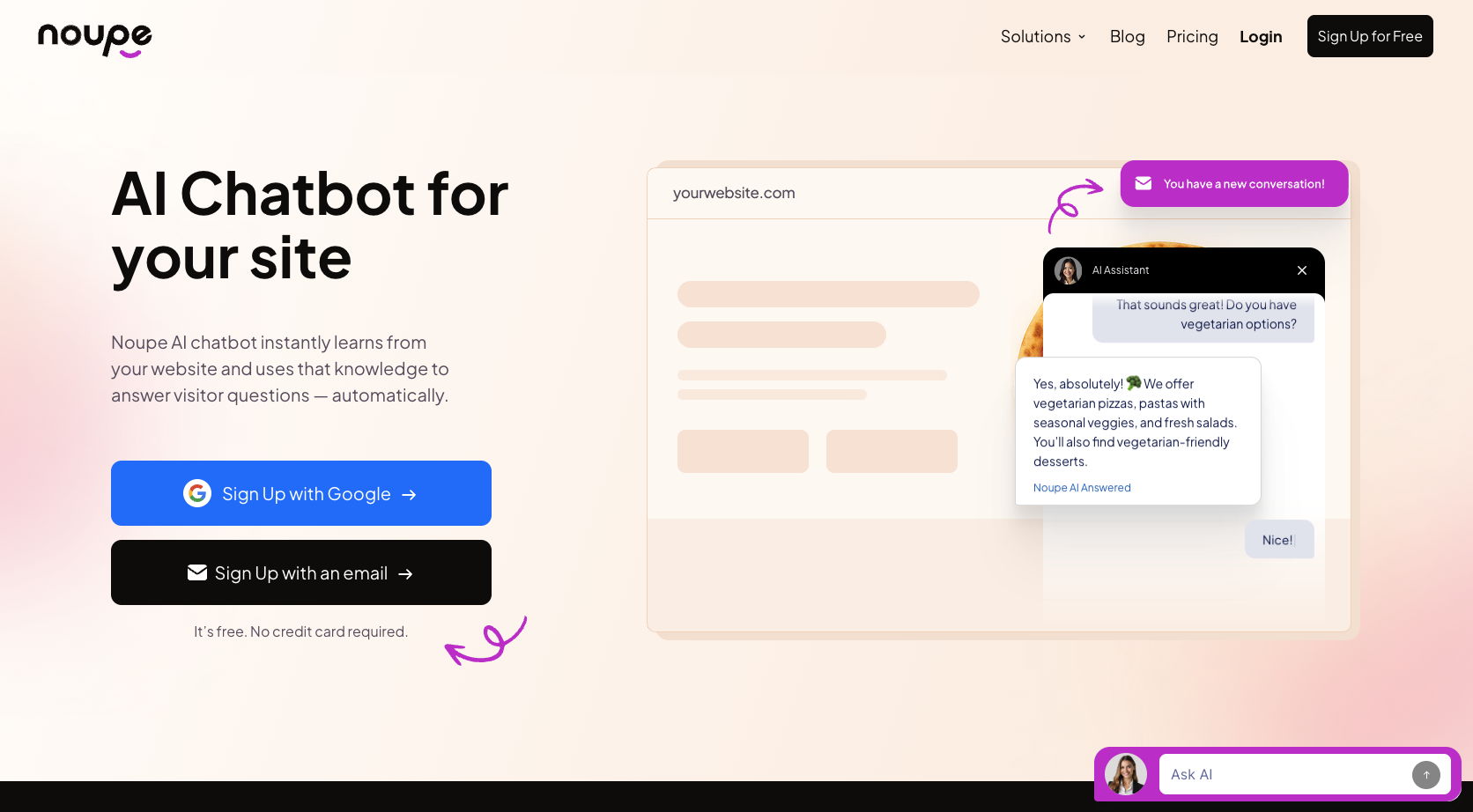
All you need to do is paste an embed code into your website. The chatbot will read your public web pages and automatically build a knowledge base. You can also upload documents, such as product manuals or sizing guidelines.
This saves time because you don’t need to manually type in your FAQs. It also gives you more control over your chatbot. Every answer it gives draws directly from your brand’s content, so it always sounds like you. Plus, you can trust that it will share specialized or niche information accurately.
Customization is another major perk. You can adjust your chatbot’s colors, size, alignment, avatar, and other visual details. That way, it will fit right into your site instead of clashing with your design. You can also customize the first message to fit your brand voice. A software firm may prefer something professional, such as, “Hello! How can I help you with your tech needs today?” But a retailer who markets to Gen Z might start with, “Hey girl! What’s up?” These friendly messages help engage visitors and create a strong first impression.
Once your chatbot is live, it sends a copy of every conversation to your inbox. That makes it easy to follow up if your visitors need more support. It also helps you spot missing content and common customer needs. If people keep asking about your return policy, you may want to move it to a more obvious location on your site.
Also, Noupe automatically detects and responds in each user’s language. That’s perfect for businesses with global audiences.
Check out our chatbot ideas for more inspiration, or sign up for free to start building your rule-based chatbot.