
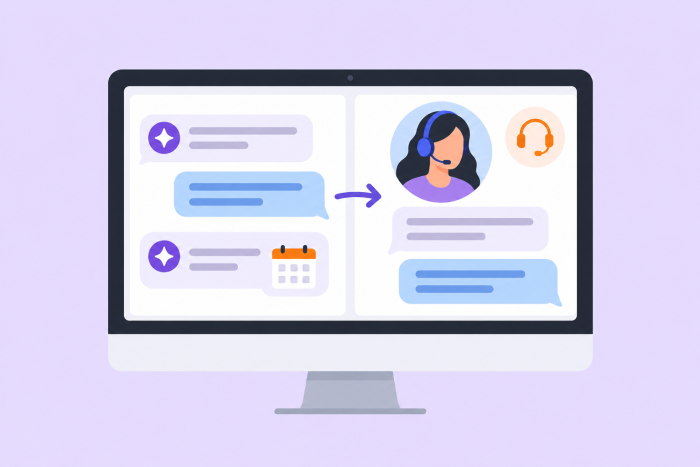
When deciding to use chatbots or live chat systems for customer support, businesses must evaluate how each option enhances customer support. Chatbots eliminate wait times and reduce costs by turning customer queries over to AI-powered, automated systems. Meanwhile, live chat systems offer human operators who can handle complex problems and build more personal connections.
The good news is you don’t have to choose one solution over another. By evaluating your business goals, you can create a hybrid model that provides clients and staff with the support they need.
What is the difference between live chat & chatbots?
Chatbots are computer programs designed to process human conversation and respond as if they were real people, creating automated conversations. Because chatbots don’t require sleep, they can provide instant, accessible customer service 24/7. Modern chatbots can even remember past conversations, learn from past encounters, and understand context. This lets them answer frequently asked questions, process orders, or even make recommendations.
However, chatbots still struggle to comprehend complex questions and can provide incorrect information when provided with limited data or poor prompting. The 2025 Stanford HAI AI Index Report found AI models still struggle with complex logic tasks, limiting how well they can be used in high-stakes situations that require precision.
As chatbots grow more sophisticated, they come with higher setup costs and maintenance requirements. Businesses also need to consider data security to safeguard customer privacy when using chatbots.
On the other hand, live chat systems provide real-time, personalized human support which increases customer loyalty and satisfaction. Live chat operators can deal with complex or emotional customer issues which can lead to better sales conversions as they guide clients through complex purchases. However, this expertise comes with training costs, while their availability is limited to business hours.
| Feature | Chatbots | Live Chat |
|---|---|---|
| Response Time | Instant | Variable |
| Cost | Low (long-term) | High (salaries, training) |
| Availability | 24/7 | Business hours |
| Empathy | Low (simulated) | High (can handle emotional issues) |
Which conversations should a chatbot handle, and which need a human?
Matching chatbots and live chat operators to different customer queries helps optimize chatbot benefits and live chat advantages while managing their shortcomings.
For instance, chatbots excel at answering frequently asked questions (FAQs) about return policies, shipping times, or business hours. They can also offer instant, real-time status updates on shipping and are available 24/7 to schedule appointments and manage bookings. This makes them ideal for addressing repetitive questions and offering zero wait time for appointment scheduling.
Meanwhile, live chat is better reserved for high-urgency queries that require complex troubleshooting. Explaining product features, resolving login problems, or clarifying billing questions are all issues best left to human operators. Well-trained agents can acknowledge client frustrations while offering high-value customer service that quickly resolves any problems, improving customer appreciation.
| Scenario | Chatbot | Live Chat |
|---|---|---|
| FAQ | Can provide reliable answers to repetitive questions without burning out | Answering the same questions can lead to exhaustion and inaccuracies |
| Complex issues | May struggle to comprehend customer issues | Can acknowledge customer difficulties with empathy and provide personalized solutions |
| Scheduling queries/requests | Available 24/7 to manage bookings | Only available during business hours |
Hybrid customer service models: The best of both worlds
Understanding the strengths and limitations of chatbots and live chat allows businesses to combine the two into a hybrid customer service model that allows you to enjoy the benefits of both worlds.
By assigning routine, high-volume tasks, including fielding frequently asked questions, providing delivery updates, and managing appointments, to chatbots, you reduce both costs and employee burnout. One IBM report states that chatbots can handle 80% of routine tasks and customer questions. This also lets you offer customers immediate answers 24/7, enhancing the customer experience.
At the same time, a hybrid customer service model seamlessly hands over customer calls to human agents if complexity increases or the system’s sentiment analysis detects customer frustration. This allows customers to receive support from the best resource, whether that be human or AI.
Hybrid models leverage customer service strengths in other ways. For instance, your AI system can provide human agents with a customer’s call history, offering context for the current inquiry and helping to speed up the resolution. Seeing each customer’s history with the company also lets human agents personalize the call by showing they understand the customer’s needs, improving their experience.
This increased efficiency also results in lower customer wait times. One report published by career resource platform gradsingapore indicated that in 2023, the average wait time for live chat in finance decreased by 23%, averaging just 23 seconds, thanks in part to chatbots that took over duties like basic troubleshooting and opening new accounts.
While using live chat agents costs more than only using chatbots, the overall operational costs of a hybrid customer service model are offset by reducing the need for human operators on simple, repetitive tasks. Instead, live chat agents are reserved for calls that require high-level thinking, allowing you to get more value out of your staff.
Implementing hybrid models effectively requires you to develop protocols and workflows that allow your staff to work seamlessly with your AI-powered resources. Build your protocols by:
- Identifying the type of high-volume, repetitive customer inquiries (FAQs, tracking, basic troubleshooting) that AI automation can handle.
- Investing in a platform that can track customer tone, pitch, and word choice in real-time, allowing your AI system to detect when it needs to send a call to a human agent.
- Ensuring your system provides live chat agents with a full transcript and AI-generated summary of the interaction to provide full context of the interaction to make the handoff seamless.
- Integrating your AI platform with existing CRMs that allow agents to have instant access to a customer’s full history when receiving a transfer.
- Training staff in AI-assisted customer service. This can mean using AI to find information or handle background tasks during a live chat, reducing work for the human agent.
- Improving staff skills by training them how to handle more complex customer issues with empathy and efficiency.
- Monitoring chatbot interactions with clients to update your knowledge base with new customer information and improve chatbot responses based on customer feedback.
- Measuring key performance indicator (KPI) metrics like average handling time, escalation rate, chatbot resolution rate etc.
The future trends of AI chat support
AI-powered tools are constantly advancing, enabling chatbots to handle more complex tasks and interact with customers with more human-like behavior.
Simultaneously, new communication tools are being developed to help live chat operators handle calls more efficiently. Keep an eye on the following emerging technologies and their impact on customer support:
NLP and machine learning
Machine learning (ML) is a branch of AI where computers learn from data, identify patterns, and make decisions or predictions without having to be programmed for every task. Natural Language Processing (NLP) is a subset of this branch that focuses on helping computers understand, interpret, and generate human language.
By using ML algorithms to learn language rules, NLP improves semantic accuracy in chatbots. This allows chatbots to go beyond scripted rules and comprehend user intent. Not only does this let chatbots engage in more human-like conversations, it also evolves them into AI Agents that can perform more tasks autonomously, including customer service tasks like resolving account issues or offering product advice.
Video chat and co-browsing
Modern live chat agents don’t just talk to customers over the phone. Now, they can see clients in real-time and navigate websites with them to help resolve customer issues.
Video chat is a browser-based communication tool often included in a company website or app. Not only does this let agents see customers, it allows customers to use cameras to show agents physical problems with products, helping agents come up with solutions.
Meanwhile, co-browsing, or collaborative browsing, lets agents view a customer’s web browser in real-time to help guide them through complex workflows or fill out forms. Co-browsing protects sensitive customer data by masking areas like credit card fields, letting customers feel more secure as they receive outside help.
Both these technologies enhance live chat by turning support sessions into interactive encounters where agents can more quickly diagnose problems, find solutions, and lead customers to more satisfying resolutions. This reduces customer frustration while enhancing personalization and maintaining trust.
How Noupe improves customer support with AI chatbots
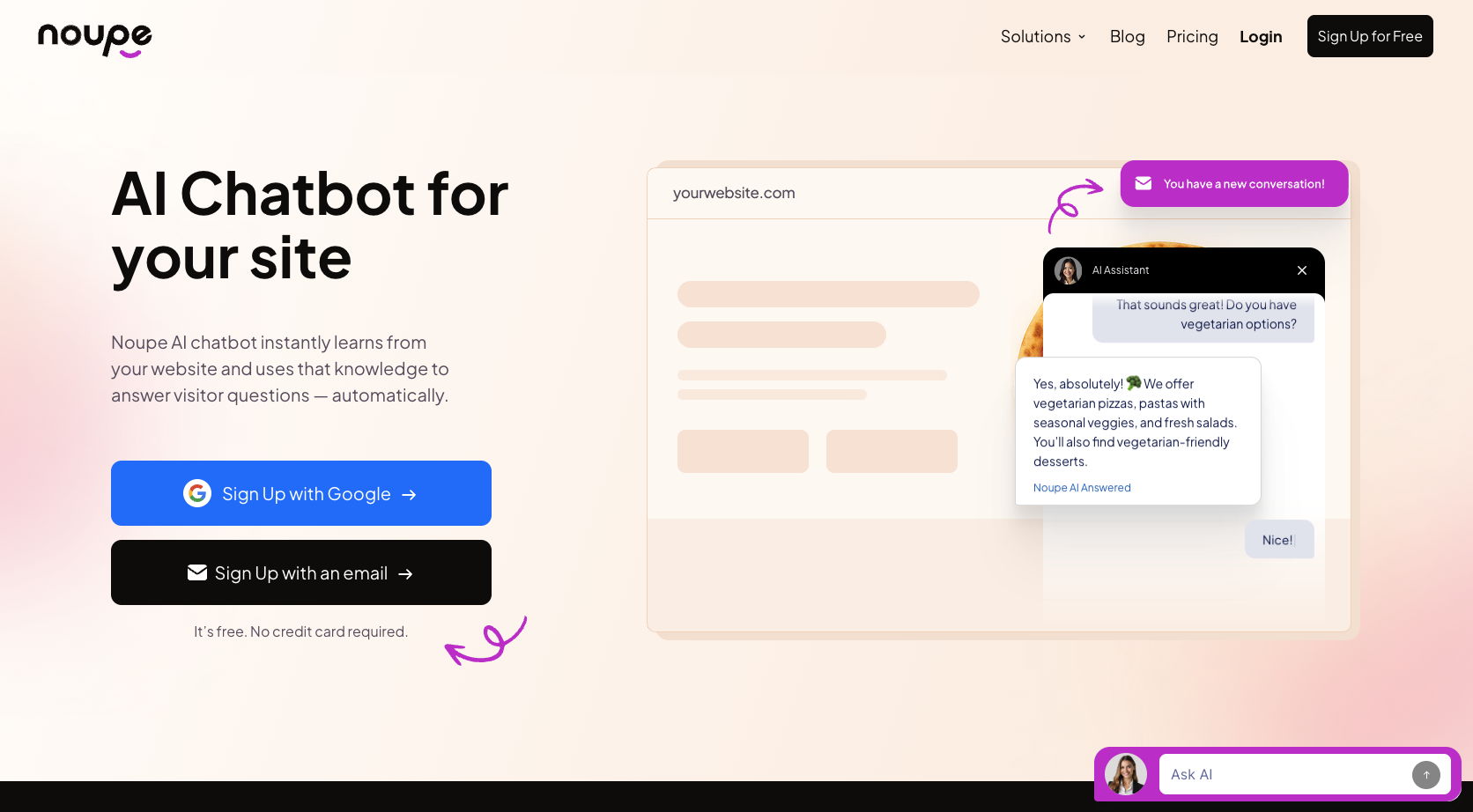
Noupe is an AI chatbot builder that helps you deliver automated AI-powered customer support. It offers no-code software solutions for businesses that want to use chatbots in their customer support systems or build hybrid customer service models.
Businesses benefit from the following standout features:
Turn your website content into instant chatbot answers
Instead of manually training chatbots through document uploads or scripting, Noupe can read your public website content to automatically build its knowledge base. This means Noupe can instantly ingest data from your FAQ pages, product descriptions, and company policy pages, then use this information to answer related customer queries.
Not only does this save time when building your customer service chatbots, it also means when you create a chatbot, it will have access to up-to-date information whenever your pricing or policies change and you need to update your website content.
Launch a customer support chatbot without coding
Traditionally, companies have needed to hire experienced coders and developers to build their chatbots from the ground up. This increased operating expenses, making using chatbots less feasible for small businesses.
However, once Noupe’s AI system finishes learning from your website content and building its knowledge base, it provides you with a one-line embed code (in JavaScript) that connects your website to the AI model trained on your content.
This eliminates the need to code your own chatbot and lets you integrate chatbots into your customer service workflows much faster. Just paste the embed code into the HTML of your website or use a CMS plugin, and your chatbot can engage with visitors to answer questions, perform tasks, and capture leads. Not only does this save time and money, it lowers technical barriers for your team, letting you use high-tech solutions.
Give your chatbot deeper, more accurate knowledge
While Noupe can help train chatbots by crawling your website and building a knowledge base from site content, you can add to your knowledge base by feeding Noupe your own documents, Q&A sets, manuals, and more.
This comes in handy if you want a chatbot with deeper domain knowledge that isn’t limited to your website. For instance, you can upload internal data, like product manuals, and provide chatbots with precise, on-brand data. This is very helpful for companies in specialized industries or businesses that offer niche services.
Now, chatbots don’t have to guess when answering customer queries. Instead, they can provide faster, more accurate answers to repetitive questions, eliminating inconsistencies. Training chatbots on specific business contexts also helps AI understand visitor intent, letting chatbots offer personalized conversations and improve customer satisfaction and conversion rates.
Give your chatbot deeper, more accurate knowledge
Noupe’s user-friendly dashboard lets you customize the look of your chatbot to match your website’s look and your company’s brand. Adjust your colors, fonts, shapes, and other design elements so your chatbot looks like an integrated part of your website. Upload a custom avatar icon or select from available sample icons that match your brand. You can also adjust your chatbot’s placement and size so visitors easily gravitate toward it.
Since Noupe’s AI learns from your existing website content, it can use the wording of your FAQs and product descriptions to answer customer questions in a tone and style that reflects your brand voice.
Guide visitors with personalized chatbot messages
Business owners and marketing teams that use a more “hands-on” approach can customize the “first message” your chatbot uses to greet visitors. This grants your team more control while also making sure your on-brand message offers a positive first impression that improves engagement.
Rather than greeting customers with a generic, “How can I help?” message, this option lets your chatbots offer more specific and personalized help options. For instance, a chatbot greeting a customer on a pricing page may offer to help the customer choose the right plan. Meanwhile, another message could use existing data to greet the customer by name, establishing immediate rapport.
Use real customer conversations to improve support
Creating effective chatbots is an ongoing process that requires you to know what questions customers need answered.
Noupe provides these insights by sending every conversation your chatbot has directly to your inbox in real time. This allows you to monitor what people ask and make any necessary adjustments to your customer service model.
For example, if the conversation logs show customers getting frustrated with your chatbots vague answers to “Does this plan include API access?” you could include this question (and a detailed answer) on your website’s FAQ page. Noupe would then update your chatbot’s knowledge base with the response, allowing the chatbot to provide on-brand responses to future queries.
This lets you build a better customer support model in real-time while also refining your website content to meet customer needs.
Support customers in their preferred language
Businesses that deal with global clients need to offer customer support services that can handle queries relayed in multiple languages. Noupe allows you to accommodate them by detecting each visitor’s language and automatically replying in that preferred language.
This makes Noupe ideal for tourism, e-commerce, and education platforms that need to service multiple populations that do not use English as their main or preferred language. Chatbots produced using Noupe can also be used by local businesses targeting non-English speakers, enabling them to connect with an entirely new customer base.
Make the right choice for your business
Small businesses, educational institutes, nonprofits, healthcare providers, enterprises and more can now significantly upgrade their customer service models to improve customer experiences without straining their budgets. By turning to advances in AI chatbots and live chat communication tools, companies now have the resources to provide personalized service to large customer bases while avoiding staff burnout.
Leveraging no-code AI chatbot builders like Noupe lets marketing teams create on-brand AI systems that learn your business model directly from your website. These chatbots can offer immediate service to customers, automatically update themselves, and do not require expensive coders and chatbot developers.
Meanwhile, new developments in video chat and co-browsing enhance the personalized service your human live chat operators provide. By giving human agents the ability to talk face-to-face with clients or walk them through complex issues by viewing and moving through a customer’s web browser in real-time. These communication tools help agents solve difficult problems for clients faster, improving your brand reputation and increasing conversions.
When deciding which solution is best for your company, it’s important to conduct a thorough audit of your needs and goals. Automating customer support with AI offers faster response times and 24/7 availability. On the other hand, well-trained live chat agents are better equipped at solving complex problems for customers and can offer more empathetic support than chatbots.
For companies that deal with both issues, a hybrid approach offers a happy medium. Repetitive tasks and scheduling can be handled by chatbots while human agents can reserve their time and energy for resolving complex issues. Effective hybrid systems also let chatbots handover calls that get too complex to human agents and supply them with detailed summaries of the customer’s problem, allowing the agent to resolve the issue sooner.
Understanding the optimal blend of these resources for your business lets you build a hybrid system that improves your customer service model and remains cost-effective. If you’re ready to look into these resources, start by learning about the customer support options offered by Noupe and discover why support teams love Noupe.