
Chatbot platforms have come a long way in a short time (and the market is expected to reach $41.2 billion by 2033). These days, they’re better at understanding context, their conversations feel reasonably human, and managing the backend tech is a lot easier.
Still, every platform has its audience. That’s why we compare tools. Chatfuel and Manychat are both easy to use and ideal for automating conversations across many channels, but which is fit for your workflow?
Chatfuel is the better option if you want a straightforward setup and are invested in WhatsApp messaging. Manychat, a broader tool, can handle a large volume of social media interactions and fast-paced communications. The following table gives an overview of how they stack up against each other.
ManyChat vs Chatfuel: Quick comparison
| Question | Chatfuel | Manychat |
|---|---|---|
| Who is this tool for? | Companies that want an affordable bot with built-in ChatGPT AI | Teams growing their sales and building social media funnels with multichannel messaging |
| What industry is it best suited for? | Enterprise, tech-focused brands and customer support | E-commerce, social media, creators, and marketers |
| How does it scale? | Good scalability for built-in AI, WhatsApp, and Facebook Messenger | Wider omnichannel support for Instagram, SMS messaging, email, WhatsApp; plenty of integrations |
| What is its core functionality? | WhatsApp, Messenger, and Instagram customer service; simple sequence builder; and growth tools | No-code visual builder, omnichannel messaging, rule-based flows, and automatic response triggers |
| Does it come with AI & automation features? | Comprehensive ChatGPT integrations; great for open-ended questions | AI assistant, AI Flow Builder assistant, and AI Text Improver |
What is Chatfuel?
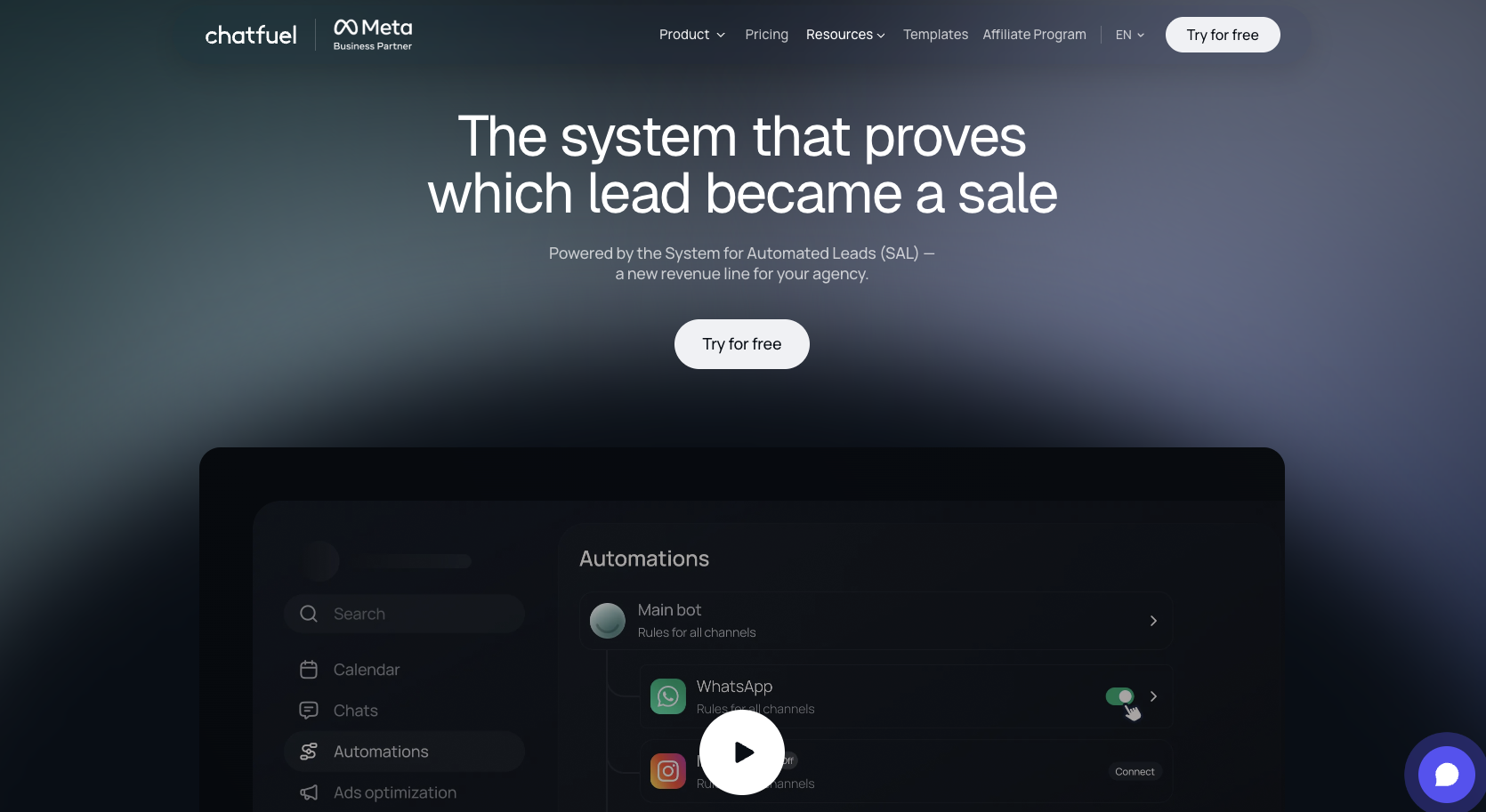
Chatfuel is a popular no-code AI chatbot and messaging automation tool. Though it started as a basic Facebook Messenger automation tool, it now has an AI coworker, new templates, and lead qualification tools.
It’s made for businesses that need to quickly respond to customer messages across channels such as Instagram, Facebook, WhatsApp, TikTok, and web chat.
The visual builder is easy to use, and the platform’s native integrations have advanced AI models, including OpenAI’s ChatGPT. Its bots can help with answering FAQs, capturing leads, recommending products, processing bookings, and following up with customers.
There’s even a lightweight CRM to help you collect customer information and segment your users.
If you need a chatbot for a small business, choose Chatfuel to answer repetitive questions and work efficiently in Meta apps.
What is Manychat?

You might assume that you’re getting about the same thing from Chatfuel and Manychat. To a degree, that’s true: Manychat is also a chatbot creation and automation platform, but its focus is marketing instead of customer service.
You still get customer support basics, such as always-on FAQ response. But you also get bots that can handle tricky calls just as well as your salespeople and bots that can qualify leads without human intervention.
Manychat supports all major communication channels, as well as a few extras, such as email, Telegram, and SMS messaging. Like Chatfuel, it has a no-code visual builder and useful automation features, such as the Comment-to-DM (direct message) feature and automatic contact capture.
The company has added new features (such as Follow-to-DM, WhatsApp broadcasts, inbox labels, and reminders) and offers active contact-based pricing. It’s an appealing option if you’re using generative AI chatbots to build an audience, rather than just serve one.
Chatfuel vs Manychat: Which platform is right for you?
Manychat works better for creators and e-commerce brands, particularly if you’re going big on social media growth. Chatfuel is the option businesses tend to pick when they want a simple AI-powered bot and website chat and don’t want to build everything themselves.
These are the best audiences for Manychat:
- Companies focused on Instagram and Facebook marketing
- E-commerce brands and creators who need omnichannel reach
- Service businesses with complicated sales funnels
Depending on the plan, Manychat covers a much larger range of channels than Chatfuel, and its pricing runs on active contacts, which helps with cutting costs. In addition, the integrated sales tools, such as Follow-to-DM, are great for generating new leads.
Chatfuel, on the other hand, works well for
- Companies looking for a simple solution that has built-in AI
- E-commerce companies interested in a simple, built-in website chat
- Creators and service providers in the Meta ecosystem
Chatfuel’s setup is easier for most brands, and the company is an official Meta partner and WhatsApp Business Solution Provider, which works to the advantage of businesses using Meta tools.
Chatfuel key features
Chatfuel’s best features save your staff time they would spend answering the same FAQs every day, moving people along the customer journey more efficiently. You get
- AI agents trained on the business: Chatfuel can use your FAQs, knowledge base data, product information, rules, and other business context to answer questions.
- Instagram, WhatsApp, Facebook Messenger, and web chat: Chatfuel covers the channels many smaller service and e-commerce businesses use most.
- Visual flow builder: The platform is simple, requires no coding, and is ideal for building reply paths, autoresponders, booking flows, and triggers.
- Lead capture and contact management: It can collect details from customers, from names to booking details, and store and segment customers.
- Drip campaigns and reengagement: Your salespeople can use its automated follow-ups, broadcasts, recurring messages, and targeted sequences for leads.
Manychat key features
Manychat’s feature set is built for people who sell from noise: comments, DMs, follows, launches, freebies, creator posts, and product drops. It works well for campaigns, which is why it’s popular with marketers. You get
- Broad channel coverage: Your team can work across Instagram, TikTok, Facebook Messenger, WhatsApp, email, SMS messages, and Telegram.
- DM flows: Comment-to-DM and Follow-to-DM features help convert customer actions on social media to immediate follow-ups. There are broadcasts for follow-ups too.
- Data collection and management: In addition to inbox labels, rules, and team assignments, you get segmentation for customer details, with tags, fields, behavior tracking, and contact history.
- A simple flow builder: As with Chatfuel, you don’t need coding to build flows for replies, questions, follow-ups, and lead qualification.
- Friendly AI assistance: The platform’s natural language processing chatbots can use your company data to respond naturally to various customer questions.
Chatfuel and Manychat: Similar features
Chatfuel and Manychat overlap in some areas:
- No-code building tools: You can build automated conversation paths without bringing in engineering or development help.
- Automated replies: Both tools can easily and quickly respond to repeat questions across several social media and messaging channels.
- Lead capture and segmentation: These platforms help you with lead generation, capture, and segmentation, collecting customer details so you can reach out when the time is right.
- Human handoff: Both offer teams an easy way to jump into live conversations when the automation hits its limit.
- Broadcasts and follow-up: Both can help reengage your audience, although Manychat is more focused on marketing campaigns, while Chatfuel will work better for service follow-ups.
Chatfuel vs Manychat: Key differences
Since Chatfuel is mostly for simple customer service automation, it has a lot of features that make life easier for service teams:
- AI Coworker: This assistant can help with everything: replies, bookings, reminders, and leads.
- Voice support: Although Chatfuel isn’t a voice bot, you can give it instructions in natural language, because it uses built-in ChatGPT models.
- WhatsApp sales assistant: This native AI sales manager helps your team execute customer service tasks using AI.
Manychat’s distinctive features concentrate on channel coverage, follow-up, and your sales funnel. You’ve got
- Broader channel support: Manychat supports TikTok, SMS messages, and email, while Chatfuel mostly focuses on Instagram, Messenger, and web chat.
- Unique DM features: These include Comment-to-DM, Follow-to-DM, and even the ability for bots to send PDFs in direct messages.
- Stronger integrations: Useful integrations such as Shopify help you combine your messaging strategy with your website.
Quick comparison: Manychat vs Chatfuel
At this point, you’re probably starting to get a good idea of which system might offer the best chatbot software for you. It usually depends on your use cases. But if you’re still struggling, here’s a closer look at some of the main considerations for choosing the best live chat software.
| Consideration | Chatfuel | Manychat |
|---|---|---|
| Pricing | Light (free); AI Pro ($69/month and adds AI sales, knowledge base, broadcasts, reengagement, and lead qualification) | Free (25 active contacts), Essential (starts at $17/month for 250), Pro ($39/month for 2,500), Business ($99/month for 7,500), and Advanced ($199/month for 25,000). |
| Features | More front desk than funnel lab: replies, flows, shared inbox, contacts, templates, broadcasts, lead qualification | Built for social media sales: comment replies, Follow-to-DM, DM links, broadcasts, labels, reminders, TikTok automation, PDF delivery |
| Integrations | Google Sheets, Zapier, Stripe, Chatfuel API | Broader campaign stack, with more channels, inbox seats, broadcasts, AI, routing, and higher-plan API access |
| AI | AI sales manager, AI knowledge base, AI-powered automations, and lead qualification | Manychat AI on Pro and above can learn business tone, answer DMs and FAQs, reply to comments, and guide campaign chats |
| Security | Data Processing Agreement terms; GDPR, UK GDPR, CCPA/CPRA, and other privacy laws compliance | Cloud Security Alliance Security, Trust, Assurance, and Risk Registry; International Organization for Standardization (ISO) 27001:2022, ISO 42001:2023, GDPR, and CCPA compliance; SOC 2 Type II certification; and encryption in transit |
1. AI and automation
Chatfuel’s AI is very beginner friendly. ChatGPT is built into the system. However, if you want to train chatbots and customize them with Chatfuel, you’ll need to invest a little more time.
Chatfuel’s AI agent, Fuely, helps service businesses instantly reply to questions, book appointments, qualify leads, and route handoffs. You can set it up pretty quickly after giving it basic information about your business, and you can add connectors that trigger automations when certain topics are mentioned or when the customer needs to speak to a human.
You can also adjust how the bot answers based on intent and select preconfigured AI agents based on function, such as customer support or sales.
Manychat’s AI has a few more extras. You can configure AI agents by telling them your goal (for example, to generate leads) and can even assign tasks to the AI. You can provide specific information you want it to refer to when answering questions and set keyword triggers that prompt certain actions.
Manychat also offers AI tools for capturing intent (and adjusting responses accordingly). There’s AI Step, to which you can give step-by-step instructions on tasks such as collecting and storing information.
There’s also the AI Flow Builder assistant. After answering a few questions, Manychat will create a flow for you. And with the AI Text Improver, you can translate text, change the tone, or rewrite content for a different goal.
2. Channels and integrations
You probably already know who wins this round: Chatfuel focuses on three areas: web chat, Meta social media platforms (Facebook Messenger and Instagram), and WhatsApp, though it has started introducing integrations for TikTok.
Manychat is the more comprehensive omnichannel chatbot platform, built for Instagram, Facebook Messenger, WhatsApp, Telegram, SMS messages, TikTok, and email. Your plan determines your coverage.
Both platforms offer Stripe integration for online payments, and Manychat offers PayPal. In addition, they both integrate with a few other tools. You can connect Manychat to Google Sheets, Klaviyo, and over 60 other tools. Chatfuel integrates with Shopify, Google Sheets, and tools such as Komo.
3. E-commerce and lead generation
Although Chatfuel tools are customer support bots, both tools give you helpful tools for sales.
Manychat has the bigger lead magnet toolkit, with features such as PDF-in-DM, Comment-to-DM, and Follow-to-DM. With the PDF feature, you can send guides, menus, and freebies inside the conversation with your customer.
Manychat also has native integrations with platforms such as Shopify and a handy Story Mention Triggers option, which enables you to jump in when a customer mentions you.
Chatfuel lets you build agents specifically for lead generation, and they can handle complicated open-ended questions. You can also create broadcasts and sequences to nurture leads. For personalized offers, you can use the platform’s lightweight contact segmentation.
Both tools integrate with Stripe, as mentioned above.
4. Ease of use
Manychat is a bit easier to use than Chatfuel. The initial setup feels more straightforward, and the visual drag-and-drop flow builder is convenient. There’s even an AI tool that can create your flows for you. The onboarding seems clearly made for beginners.
Chatfuel is simple, but it takes a little more work to get everything running perfectly. The platform offers more granular control over chat functionality, which usually means more effort. It provides many templates to help you, although sometimes you have to hunt for them.
Chatfuel’s onboarding is great, and it shows you exactly how to get the basics done, from designing a welcome sequence to handling reply-to-comments automations.
5. Analytics and reporting
Manychat has better reporting for marketing campaigns. If your team spends a lot of time tracking how DMs become clicks and then how clicks become purchases, Manychat’s growth analytics can tell you exactly which posts or ads give you the most leads.
The platform’s audience segmentation helps you sort through tags and user states, and you can add custom user fields.
Chatfuel’s reporting is a lot more operational. It can help you figure out what your bots are missing. The Analyze tab shows you user queries that your AI can’t answer. That’s very helpful for the early stages of chatbot testing.
You can also use the tools to collect user feedback and leverage AI intent analytics to learn how often users rely on your bots.
How much do Chatfuel and Manychat cost?
Chatbot pricing is a huge consideration for most companies. The trouble is, there are many ways to price a bot platform, and no platform seems to agree which is best.
Chatfuel has two tiers:
- Chatfuel Light: The free plan includes Instagram, Facebook, and WhatsApp automation; a shared inbox; automated replies; the flow builder; contact management and segmentation; and templates.
- AI Pro: At $69 per month, this plan gives you everything in the free plan, plus the AI knowledge base, AI-powered automations, an AI sales manager, broadcasts and reengagement, funnels for lead qualification, and more advanced contact tools.
Manychat is a bit more complicated. Everything is based on the number of active contacts you have per month. The free plan gives you basic automation for 25 contacts per month, for one user, and two channels. You can create basic automations and get a unified inbox, but you have to use Manychat’s branding. After that, there’s
- Essential: This plan is $17 per month for 250 contacts. It offers all the features of the free plan, unlimited custom automations, two users, inbox organization and reminders, email support, and custom branding.
- Pro: At $39 per month, this plan offers 2,500 contacts, the option to connect three channels, advanced automation and AI-powered conversations, three users, custom inbox rules and labels, and all the features of the Essential plan.
- Business: The $99 per month Business plan has 7,500 contacts, unlimited channel connections, five users, priority support, shared team assignments, and all the features of the Pro plan.
- Advanced: This plan is $199 per month for 25,000 contacts, all the features of the Business plan, and 10 users.
Noupe: A better chatbot alternative for customer engagement
If neither option seems right for you, there is an alternative: Noupe is one of the best Chatfuel and Manychat alternatives for brands that want to improve the customer experience before they send a message.
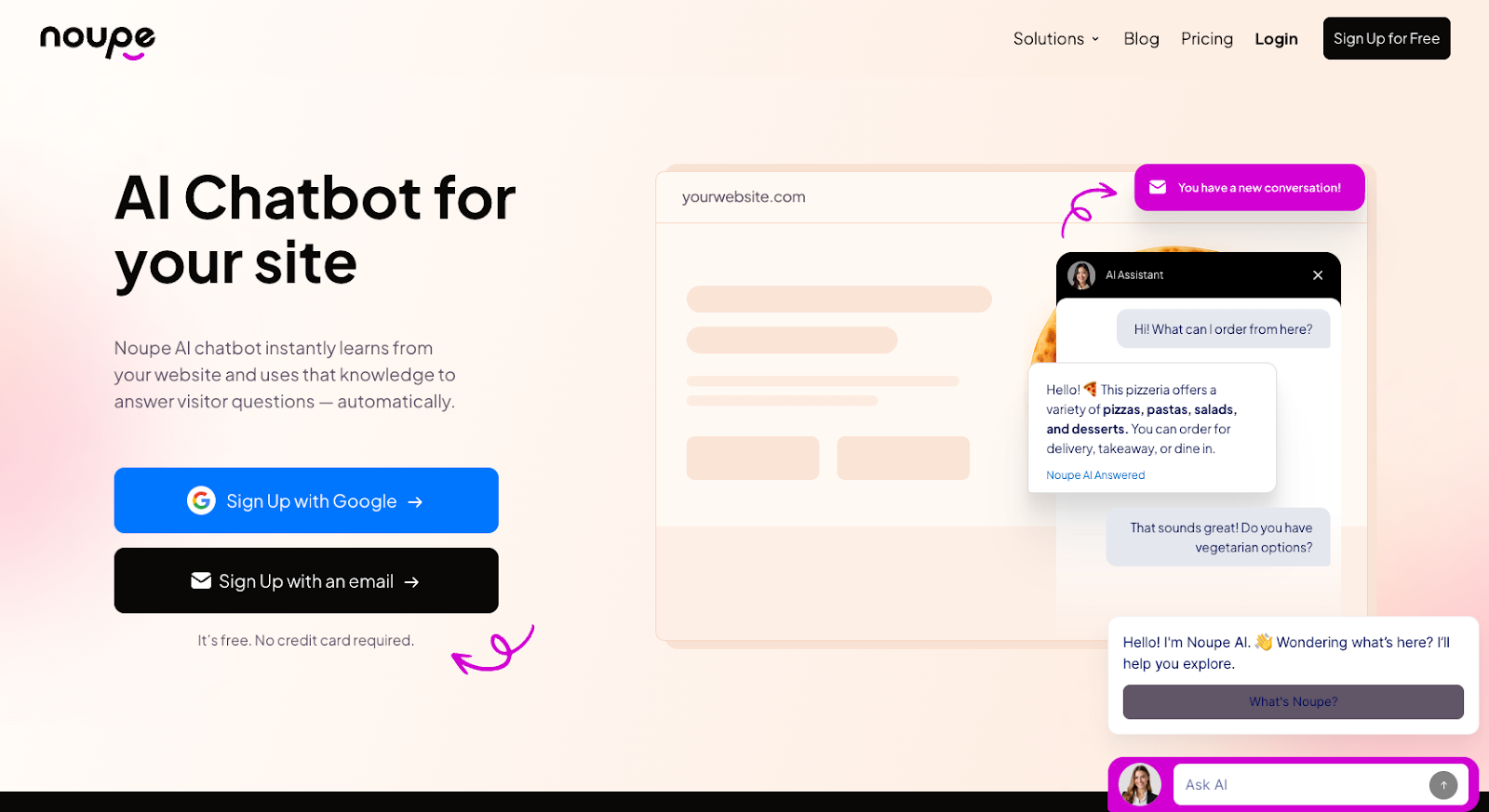
That’s a different job. For example, when a visitor asks, “Do you support annual billing?,” that shouldn’t always become a DM. Neither should “Will this work in French?” or “Which plan fits a two-person team?” If the answer already exists on your site, Noupe helps turn it into a conversation.
Noupe is ideal for
- Website learning: It reads your public site content automatically and builds answers from it. It also updates automatically, so it never gives stale answers.
- Custom knowledge: You can add documents, Q&A sets, policies, service notes, product details, or anything you think your public pages might not explain perfectly.
- Fast setup: It takes seconds to get started with Noupe. Add the embed code, customize the widget, and go live in less than an hour.
- Inbox delivery: Conversations always land in a shared inbox, so no context is missed when a human picks up the thread.
- Multilingual replies: Noupe detects the visitor’s language and answers in it. That’s useful if you have an international audience.
- Brand controls: You can change widget colors, avatars, the box’s location, its size, and the first message it sends.
The free plan is generous, too. It comes with all features and up to 100 monthly conversations. That’s more than you get from Manychat.
Find the right chatbot platform for your business
Manychat is probably the better choice if you’re focused on social media sales, marketing, and growth. It has better omnichannel coverage, and it’s packed with useful features, such as the AI Flow Builder and AI Text Improver, to help with your campaigns.
Chatfuel is a good option if you want a simple way to improve customer conversations, handle bookings and reminders, and deal with price checks. Its capabilities are a little narrower than Manychat’s, but that can be a good thing for some companies.
However, if your visitors keep asking questions your pages should answer already, Noupe is the best choice. It’s the best tool if you want something that learns from your website content, supports custom knowledge, replies in multiple languages, and sends conversations to your inbox so you can see what people couldn’t find.
To see how Noupe can fit into your chatbot and automation workflows, start with a free plan today.