
Many claim to show the benefits of chatbots in neat numbers: One report might say chatbots pay back $8 for every $1 spent, or a company might claim it reached an ROI of over 500 percent.
Despite these assertions, most company leaders don’t approach chatbot conversations wide eyed and optimistic. They come in cautious, usually because they’ve already seen one chatbot perform well and another go off the rails, sometimes inside the same company. That inconsistent experience causes leaders to question the advantages of chatbots, even as more teams keep launching them. Eventually, usually in a budget review or retrospective meeting, a higher-up will ask, “So what did this actually change for us?”
That’s a fair question. This guide will answer it in plain terms, outlining the benefits of building chatbots that have clear limits, good information, and someone paying attention to how they’re used.
20 benefits of chatbots, from faster help to better service
For customers, the benefits of chatbots are usually simple and immediate: they get answers faster, find what they need with less effort, and avoid the frustration of waiting for basic help. When a chatbot is set up well, it improves the customer experience by making support feel more available, more consistent, and easier to use.
1. Get customers answers faster
People don’t separate the questions, “How fast did I get an answer?” and “Did I get an answer at all?”
They ask, “Did this help me right now or not?”
One of the most concrete benefits of chatbots is that they reply immediately and they reply to everyone. No queues. No missed messages. No “We’ll follow up.”
Klarna’s chatbot is a good example. Its AI assistant covered roughly two-thirds of all customer chats and reduced average resolution time from 11 minutes to under two. In addition, repeat inquiries fell by about 25 percent.
That last number matters. When people get a clear answer the first time, they don’t return to ask the same thing three different ways.
Note that your response rate quietly matters as much as your response time. Bots in a call center don’t prioritize unless you tell them to. They don’t forget. They don’t leave messages unread because volume spiked. Every question gets acknowledged, even if it later needs to be escalated to staff.
The real operational win shows up downstream. Your staff will see fewer duplicate tickets, fewer “just checking back” emails, and fewer customers opening a second communication channel because they felt ignored in the first one.
2. Lower support costs
One of the biggest advantages of chatbots is their ability to absorb repetitive work without adding to your payroll. The tech experts at Gartner predict that by 2029, agentic AI will solve about 80 percent of customer service problems without human assistance, leading to a 30 percent reduction in costs.
Klarna, again, provides real-life proof to this claim: The company reports that its AI assistant did the work of 700 full-time representatives in its initial rollout window.
When you use chatbots efficiently, you can scale without needing to hire more employees, have fewer temp-worker spikes, and reduce the need to schedule overtime.
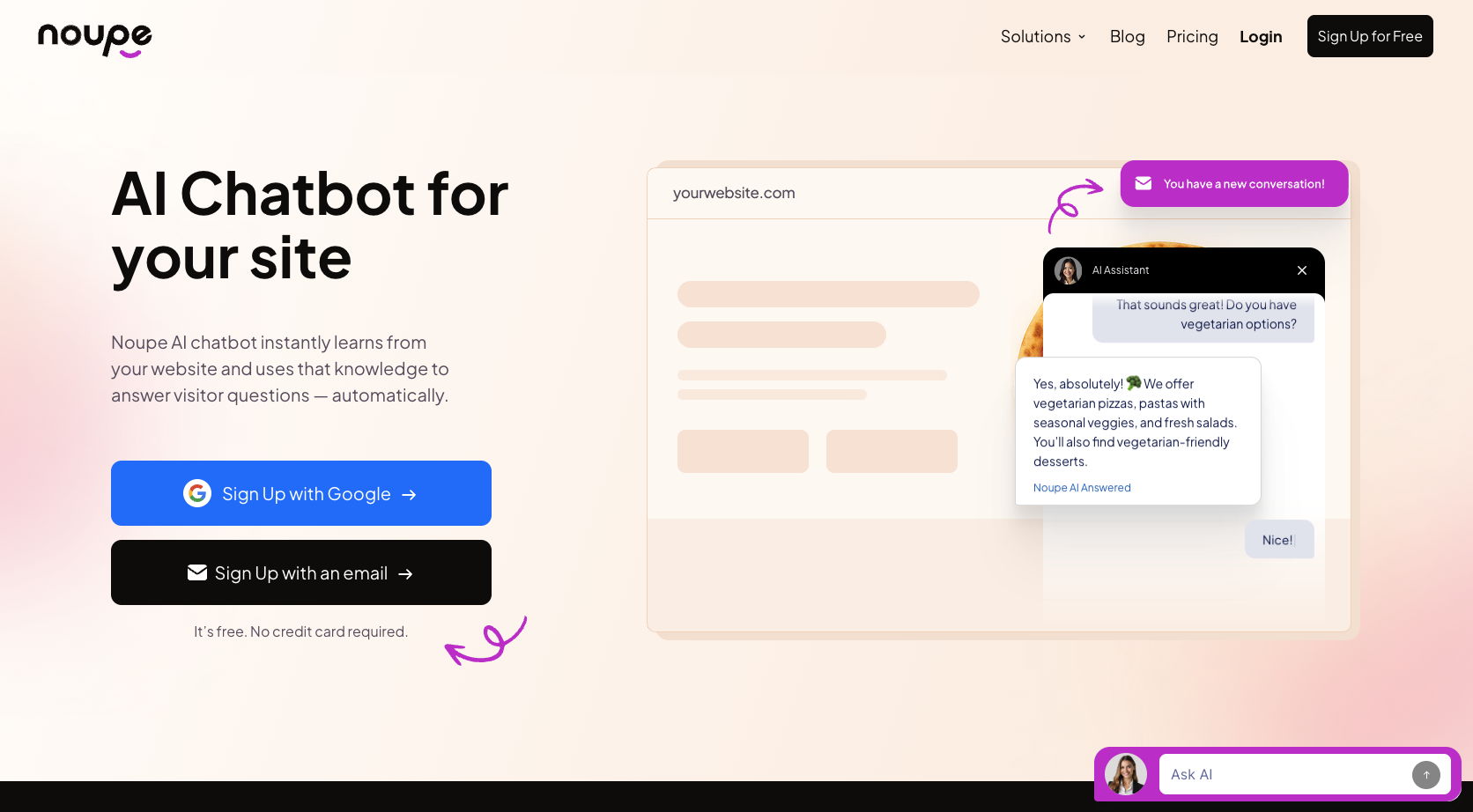
And when you use a system like Noupe, which can assist you with creating a bot quickly and keep the bot’s knowledge synced to your website, you avoid the expensive part of launching a chatbot: maintenance chaos.
3. Personalized customer interactions
Chatbots can give customers help that fits their moment: They know what website page a customer is on, what they already asked, and what language they’re using. Chatbots don’t make them work hard to be understood.
For questioning company leaders, you can show personalization through business outcomes. Take Mastercard’s KAI: The company reported 70 percent engagement rates and a 12-point lift in its brand reputation score. KAI is making it easier for Mastercard’s customers to stick with the experience long enough to finish what they came to do.
To replicate this model, your bot needs to understand messy, human input, for example, fragments, typos, and “Wait, no, actually …” moments. This is a setting where AI natural language processing chatbot systems earn their keep: Instead of guessing at an answer, they recognize a customer’s intent and find answers in the approved sources you upload.
You don’t have to track customers across the internet to reflect their taste. To offer a personalized experience, you could do something as basic as use the content you already have and match the tone and language to what that potential customer is looking at on your website.
4. Capture more leads
When a chatbot handles lead generation and nurturing, you stop losing good leads because your team needs 24–48 hours to respond. Working outside business hours, a chatbot can book meetings anytime.
That’s the strongest argument for using bots. Customers don’t browse your website only during office hours. They click around when they finally have time. Having a chatbot that qualifies leads and books meetings while your team sleeps is an advantage that feels unfair until you’re the one using it.
Keep in mind that lead capture improves when the bot can answer product questions confidently (using your web pages and documentation), before it asks for a potential customer’s email. People give contact info only after a company has proven to be trustworthy.
5. Keep answers consistent
Inconsistency makes customers nervous.
One representative offers an answer. Another says something slightly different. The website provides a third version. All of that inconsistency chips away at trust.
A chatbot can pull answers from a single, approved source of truth, so consistency is no longer a problem. The tone stays familiar, and the answers sound like they came from the same place, because they did.
Consistency matters more than most teams realize. Customers relax when information feels stable. They stop double-checking. They stop asking the same question in different ways. They stop assuming someone is wrong.
Creating a chatbot also takes away the worry when you change your policies. You update your chatbot’s source once, and every answer shifts with it.
6. Support more languages
If your site gets visitors from more than one country, you may have experienced the following situation: The answer to the visitor’s question exists. It’s correct. But it’s written in only one language.
Teaching a human, or even an AI bot, a new language takes time and effort. Even basic chatbots can easily translate information into multiple languages, with virtually no work. On a platform like Noupe, you can build a bot that recognizes the customer’s language automatically and responds in-kind.
A multilingual chatbot doesn’t just make the experience better for your customers. It also expands your scope. You can start serving customers all over the world, because you can actually communicate with them.
7. Gain better customer insights
Chatbots answer customer questions and reveal problems you didn’t know you had.
Every conversation your chatbot has is raw data. You get feedback from real people: what they couldn’t find, what they misunderstood, and what made them hesitate. In your chat transcripts are patterns you can act on instead of guessing what your strategy should be.
It can also be helpful to include one or two feedback prompts at the end of a chat, while the experience is still fresh. Such questions help you learn whether the answer actually helped or the visitor just ended the conversation.
The value here is speed: If you can diagnose problems faster, you can fix them faster and avoid vulnerabilities that cost you money.
8. Scale without extra stress
Customer conversations don’t scale politely. They spike and arrive all at once. Usually, this is the worst possible time.
Chatbots can help in such scenarios. For example Klarna’s AI assistant handled 2.3 million conversations in its first month. That’s super-optimization. Chatbots absorb this predictable work, so your team can focus on more complex issues.
9. Engage customers proactively
Most people don’t hate proactive chats. They hate bad proactive chats. The popup that interrupts. The “Can I help you?” bot that clearly can’t.
Proactive engagement works when it shows up with the right assumptions at the right moment, for example, when someone hesitates because of a price tag, gets stuck completing a form, or scrolls the same website section twice.
This kind of outreach is another bottom-line-related benefit. Proactive chats can increase conversion rates by 10–30 percent when chatbots are triggered based on behavior instead of timers.
Proactive bots can also help your team, reducing the number of inbound tickets by answering questions before frustration sets in.
10. Boost employee productivity
Chatbots assist with internal sanity as much as they help customers.
Support teams often lose time context switching and field the same questions over and over each shift. Productivity slows during those moments.
AI can help upgrade your team’s performance. Representatives using AI assistance handle around 13–14 percent more inquiries per hour, on average. It’s not because they work harder. It’s because they’re not writing the same response all day.
Chatbots also help your team with ticket quality. When bots handle the repetitive stuff, human representatives are clearer about the conversations that reach them. They don’t need to ask, “What do you mean?” and there is less emotional residue, because customers aren’t angry after waiting too long.
11. Improve support accessibility
Accessibility usually gets framed as 24-7 support, but that framing undersells it. The real gain is from removing the friction of asking for help.
Some people won’t call. Some won’t fill out forms. Some won’t wait. A chatbot lowers the barrier to entry. Type a sentence, and get an answer.
User data shows this is true. Studies consistently find that users are more likely to ask “small” or “embarrassing” questions through chat instead of in an email or on the phone. Knowing how people will interact with them matters when you’re using chatbots for onboarding, billing, and account issues: In these situations, people may hesitate to raise their hands.
Of course, it does matter that chatbots are available around-the-clock. Bots don’t sleep, don’t need queues, and don’t make customers wait for office hours. For businesses with an international audience, availability is one of the clearest advantages of chatbots.
12. Connect with your business tools
A chatbot that can give general responses is fine. A chatbot that can tap into your data to respond using customer specifics is truly useful.
When a bot can connect to order data, account status, or a help desk, it stops answering in abstracts. It gives answers for this order, this account, and this issue. That shift immediately reduces the back-and-forth a customer has to endure.
In workflows with tight integrations, support teams report faster resolution times and fewer follow-ups. Escalations also improve. When a human steps in and the full conversation and relevant data are already there, everyone’s tone changes, because there is less frustration.
Here’s the trade-off. Integrations magnify whatever base you start with. If the cross-platform information you give the chatbot is scattered or outdated, plugging it into more systems just spreads the problem faster. When the data is accurate and the bot’s scope is clear, those integrations turn a chatbot into something your team will actually rely on every day.
13. Improve the customer experience
Customer experience is usually measured when something goes wrong. Chatbots improve it by making fewer things go wrong in the first place.
They deliver fast answers, follow policies consistently, and respond 24-7. So customers use less effort interacting with your business, and their relief turns into loyalty.
This benefit is visible at scale. Bank of America’s virtual assistant has handled billions of interactions, with millions of customers using it daily.
People don’t come back to tools that slow them down. They come back to tools that eliminate friction.
14. Reduce human error
People can be good at using judgment. They’re bad at recall. Policies shift, prices change, and features get updated. Your staff may not be able to keep tabs on all of those changes. In such instances, inconsistencies start to creep in.
That’s why companies turn to chatbots. A bot pulls answers from your single approved source, so it always “remembers” the policy. That ability alone reduces the small errors that erode trust over time.
This is not to say that bots are always right, but with chatbots, errors become easier to spot and fix. You update one source one time, and your change is reflected everywhere. Compare that with having to correct 10 agents across three shifts, and you’ll appreciate the difference.
15. Increase sales opportunities
If you catch a potential customer at the right time, you can prevent a sale from falling apart. For example, if someone pauses on a web page because they have a question but don’t know where to get the answer, a chatbot can help keep things moving.
This benefit isn’t limited to direct-to-consumer e-commerce. The same chatbot applications can be used inside your business with internal questions about pricing, features, and onboarding, for example.
With customers, tone is the important element. Avoid a pushy tone and ensure your bot clarifies in a helpful way. The good chatbots don’t sell; they just explain, remove friction, and step aside.
16. Handle crises more effectively
During outages, delays, and even policy changes that land badly, chatbots earn their keep, absorbing predictable questions so your staff can handle any extreme cases. Bots relay consistent information when volume explodes. Everyone gets the same update, and nobody waits in a queue just to hear “We’re aware of the issue.”
This benefit shows up only in stressful situations. The challenge here is obvious: updating your messaging. A bot that repeats yesterday’s update during an outage makes things worse.
17. Support sustainable operations
The environmental benefits of chatbots are easy to overlook but are important considering the sustainability focus in the debate about chatbot pricing. Some advanced AI systems do have negative impacts on the planet. Most simple chatbots actually reduce your business’s footprint.
Every question resolved in chat removes a little pressure elsewhere. Across thousands or millions of interactions, that relief compounds. Call centers don’t run as hot. Teams don’t need to backfill as aggressively. Fewer tasks get done twice, because the first answer was sufficient.
Automation doesn’t magically save the planet, but it does remove waste from processes that were already inefficient.
18. Speed up onboarding
Most customer drop-offs don’t happen because someone decided a product wasn’t for them. They happen because the next step wasn’t obvious and asking for help felt like work.
Chatbots help after the sale. They don’t need to give onboarding tours or walk-throughs. They can help subtly when someone asks, “What do I do now?” or “Where is that thing I just saw?” or “Why isn’t this product behaving the way I expected?”
When those questions get answered immediately, people keep moving through your website. They aren’t confused or forced to open “help” documents they don’t want to read. They don’t decide to come back to your site later (they never do).
Teams usually notice this benefit indirectly, through a reduced number of onboarding tickets, half-setup accounts, and users who disappear before interacting meaningfully with your brand.
19. Keep visitors on your site
There’s a moment that kills a customer’s progress on your site, and odds are, you’re not tracking it: A visitor has a question about something, leaves your website to open a new tab and find the answer, but never returns to your web page.
If you have a chatbot, when a visitor has a question, the answer appears on the same page as the user. And when it doesn’t have an answer, a well-built bot passes along the visitor’s context, so the staff representative doesn’t have to start the whole conversation over.
That changes how people use your site’s support features. Over time, your customers and team feel that difference.
20. Catch issues earlier
Most customer issues start tiny, and chatbots can discover those issues early, for example, when someone types exactly where they got stuck, right when they get stuck.
Having real-time data helps your team react quickly. Instead of waiting for patterns to show up in analytics or surveys, if you review chatbot conversations regularly, you can see customers’ issues as they unfold. If you catch an issue early, the fix is usually simple.
By revealing ongoing issues, chatbots stop being a support tool and become a maintenance tool.
Why investing in the right chatbot pays off
The difference between a useful chatbot and one people avoid is rarely the tool itself. It usually comes down to attention. Someone has to review the questions customers ask most, spot where answers feel weak, and fix the parts of the experience that create hesitation instead of clarity. When a chatbot is monitored and improved over time, it becomes a practical part of the customer journey. When it is ignored, it quickly turns into another point of friction.
If you’re improving an existing chatbot, start small. Focus on the repetitive questions your team already answers every day, make sure the responses are accurate, and keep refining the experience based on real conversations. If you’re building a chatbot for the first time, Noupe gives you a simpler way to get started. You can launch a chatbot using your existing website content, keep answers aligned with your business information, and create a support experience that feels fast, helpful, and easy to manage.
The real value of chatbots is not just that they save time or reduce workload, although they often do both. It is that they help businesses create smoother, more consistent experiences for the people they serve. Customers get answers faster, teams spend less time on repetitive work, and small points of confusion are easier to catch before they grow into larger problems. Over time, those improvements shape how people experience your brand. A well-built chatbot does not need to do everything at once. It just needs to solve the right problems clearly and reliably. That is usually where the biggest gains begin.