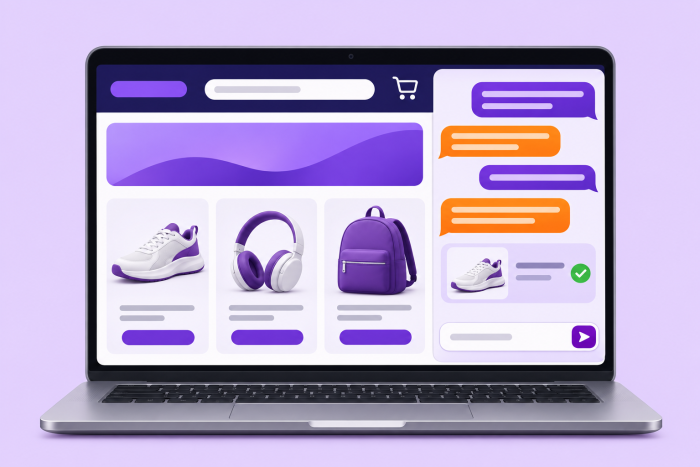
An AI chatbot for ecommerce can either be the thing that makes online shopping feel truly intuitive for customers, or the thing that ends up driving people away from your store.
For all the tools that genuinely answer questions well, resolve problems with deliveries, or guide buyers towards the right product, there are plenty that still struggle with clunky or clunky responses and problematic hand-offs.
Now that 42% of customers are already using AI for shopping tasks, and 5% are even handing purchases over to autonomous tools, online retailers are under increasing pressure to find a system that truly does something useful for the customer experience.
Here’s how to find an ecommerce chatbot that does more than chase conversions and actually makes shopping easier for your customers.
What is an ecommerce chatbot, and what can it actually do?
You probably don’t need another definition of a chatbot in 2026. What matters is how much the technology has changed.
The older generation followed rules. A company would define possible questions and approved answers, and the chatbot would respond when the customer used certain terms. For an online store, that often meant basic help with shipping times or return policies.
An AI chatbot can do quite a bit more than wait for someone to type the exact right phrase. It can make sense of intent, find products, recommend something suitable, and, depending on the setup, carry out simple order tasks. You might not need a particularly clever bot. You just need one that makes life easier for shoppers and leaves your agents with fewer repetitive questions.
How can companies use ecommerce chatbots?
There are endless chatbot use cases, but in ecommerce, companies tend to use these bots for a handful of practical jobs.
1. Answering customer questions
The most obvious ecommerce use case is still an always-available website assistant that answers questions while people shop. Even a basic menu-based bot can handle common queries about sizing, shipping, returns, materials, compatibility, or product differences.
Burker offers a good example. The company already had a strong FAQ page, but customers kept asking support many of the same questions. After adding a chatbot, Burker reported an 80% resolution rate and around 10,000 conversations per month that might otherwise have ended up in the support queue.
2. Reducing Purchase Hesitation and Cart Abandonment
An AI chatbot for ecommerce probably won’t completely eliminate the problem of cart abandonment, but it can make it much more likely that customers will feel confident completing a purchase.
You don’t have to wait until a shopper asks for help. A bot can recommend relevant products while they browse, then handle the doubts that tend to appear just before payment, from delivery dates to return policies. It can also put the right promotion in front of someone who hasn’t quite committed. Caitlyn Minimalist reported a 20% conversion lift and an 11.3% increase in average order value after using Gorgias Shopping Assistant to cover questions about customization, metals, and allergy safety.
3. Handling post-sale support
Issues can still pop up for a customer after they’ve bought something. Customers might have concerns about late deliveries, or want advice on how to use the new product they bought. They might even want to ask about complementary products that they could buy in the future.
An AI chatbot for ecommerce can help with all of that. One company, UKLASH, for instance, uses its AI chatbot to handle subscription management, address changes, refunds, and shipping problems. It said around 12% of subscriptions are now paused rather than canceled thanks to its AI tool.
4. Finding issues within the customer journey
Repetitive questions are usually a sign that something in the customer journey needs fixing, but analyzing every conversation manually would be an expensive and time-consuming process for an ecommerce team.
Chatbot data can tell you something about the product itself too. Stoov used customer contact data to spot repeated complaints about battery life, which prompted its product team to introduce a larger battery option. The company said 50% of customers chose the more expensive battery, helping increase average order value by 10%.
Mybacs took a different approach. It used recurring support questions to shape A/B tests and improve product pages, reducing how often customers needed to contact support in the first place.
5. Capturing useful customer intent
People can tell chatbots a surprisingly large amount when they’re trying to make the right choice. They can ask about fit, style differences, colors, product features, or even upcoming launches. That tells a company a lot about what their target audience really cares about.
That data is useful when you’re personalizing product recommendations, but it can tell you far more than what somebody might want to buy next. You can use it to spot product features customers keep asking for, see where demand is coming from, and rethink parts of your sales or marketing strategy around what people are actually telling you.
Where can you use ecommerce chatbots?
Your website is the obvious starting point for an ecommerce AI chatbot. Platforms like Noupe make this incredibly simple. You give the bot access to all of your public website information, as well as any additional details it might need to support customers, customize the widget to feature your brand’s aesthetic and voice, and then embed it into your website with a single line of code.
The bot can automatically identify a customer’s language to respond accordingly (ideal for global companies), and it routinely updates its own knowledge base whenever you make changes to your site, so you don’t have to keep manually uploading information.
You can take the same kind of assistance into other channels too:
- Social media channels: Plenty of shopping conversations now start on Instagram, Facebook, or TikTok. A chatbot can pick up direct messages straight away and even help somebody explore products without sending them back to your website first.
- Messaging apps: WhatsApp and similar tools are fantastic for stores with international audiences, or customers that already tend to use messaging for delivery updates and support. The same bot that responds to questions on your site can interact with customers on those messaging channels, and hand customers over to humans when needed.
- Mobile apps: Online sellers with their own apps can put conversational support inside of the mobile shopping experience, rather than sending customers elsewhere. Platforms like Fin already have mobile SDKs to help businesses on that front.
- SMS and text support: When somebody only wants to know where an order is or when it’ll arrive, text can be a much faster channel. AI chatbots can connect with supported carrier or messaging solutions and take care of many of those exchanges without an agent stepping in.
Top 5 AI chatbots to boost online shopping sales
There’s no point paying for the “best” chatbot if half of what it does won’t help your customers. Work backward from the problems you see in your store. Cost obviously comes into it, but so does whether the tool can keep up when your needs change.
| AI chatbot tool | Best for | What stands out |
|---|---|---|
| Noupe | Website-first stores | Multilingual support, automatically learns from website content |
| Gorgias | Shopify stores | Excellent store and order context |
| Intercom | Revenue-focused teams | AI shopping and revenue attribution |
| Tidio | Smaller stores mixing live chat and AI | Shopping recommendations and human support |
| HubSpot chatbot builder | CRM-connected ecommerce | Free bot builder and CRM context |
1. Noupe: Best for website-first ecommerce chat
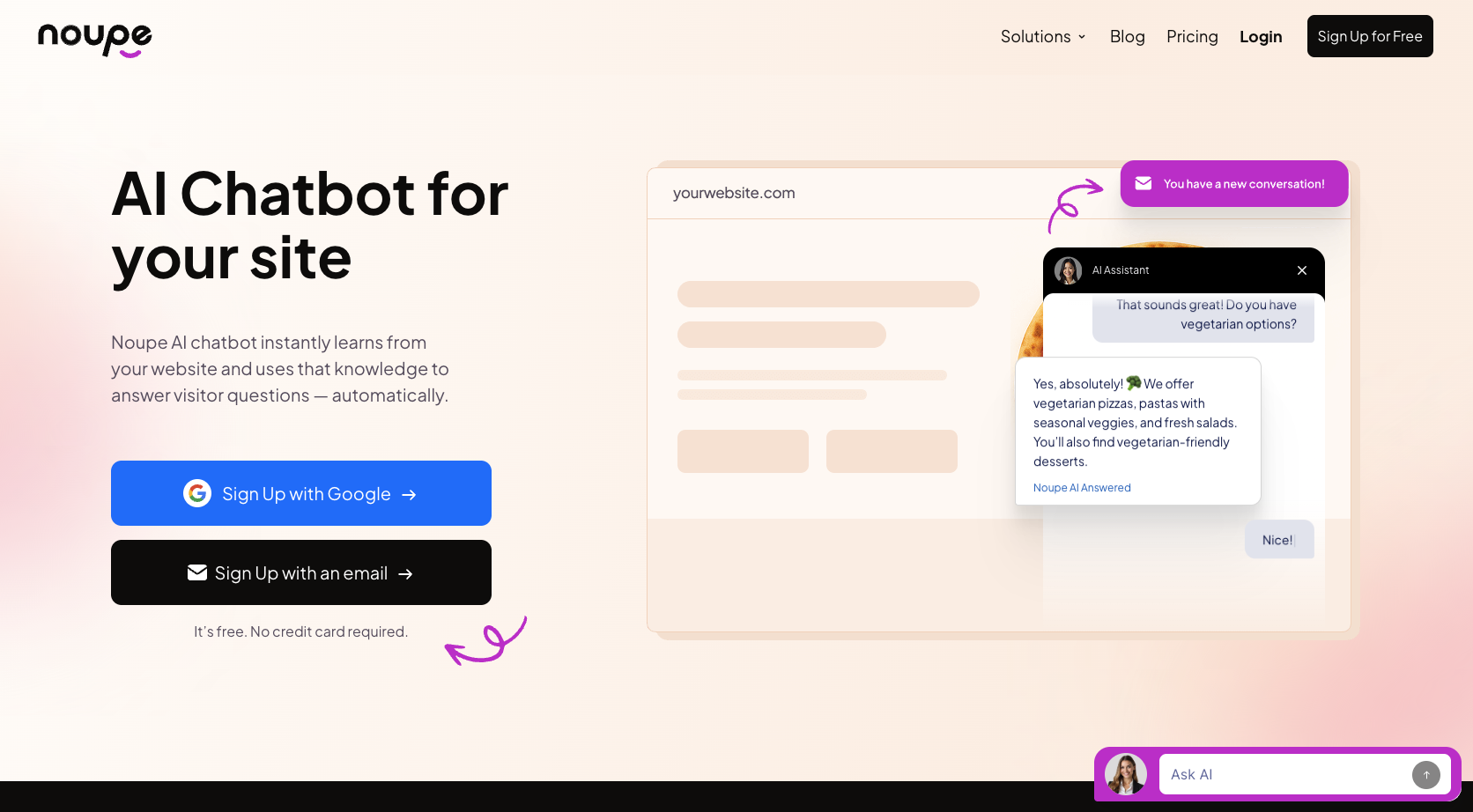
Developer: Noupe
Key Features: No-code setup, automatic website learning, multiple language support, shared inbox and custom branding.
Pricing: Free for 100 conversations per month, Basic plans start at $20 monthly.
Noupe is a strong option if you want an ecommerce chatbot you can get onto your website without turning the setup into a technical project. Give it your site, and it reads the public pages to build its knowledge base automatically. You can add extra material, including product or supplier documents, whenever you need to expand what it knows.
The widget is easy to customize, including your welcome message and branding. It can also detect the customer’s language automatically and respond in that language.
It also sends contextual information from each chat to a shared inbox, so if your human team members have to follow up or take over later, they’ve got the details they need. Noupe gives companies a quick way to discover the benefits of chatbots for themselves, without forcing them to worry about things like complicated coding or endless maintenance.
There are some limitations; for instance, Noupe isn’t designed for deep integrations with things like help desks and inventory software, but it gives ecommerce retailers an excellent starting point for reliable, website-based support. The bot can easily make product recommendations, answer questions with approved content, and even help you identify recurring customer queries.
Pros:
- Fast and easy to set up
- Learns from your approved website content
- Fully customizable, right down to the welcome message
- Automatic multi-language support
- Shared inbox for human review and follow-up
Cons:
- Fewer integration options than some alternatives
- Basic analytics
2. Gorgias: Best for Shopify-centric ecommerce
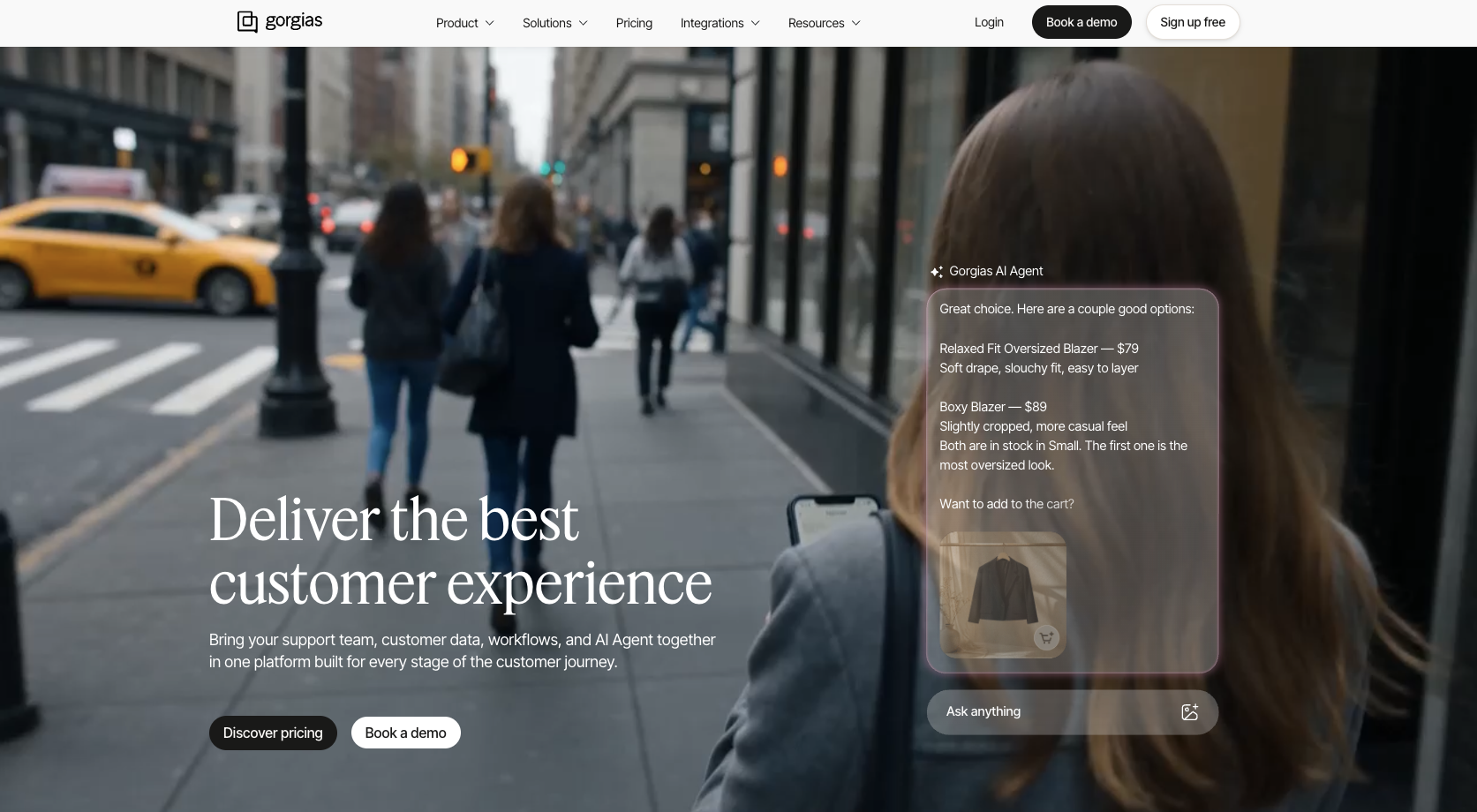
Developer: Gorgias
Key Features: Ecommerce integrations, unlimited seats, omnichannel support, advanced automation.
Pricing: Starting at $10 per month for the Help Desk (50 tickets).
Gorgias is another brilliant omnichannel AI chatbot solution for ecommerce, particularly if you’re using Shopify as your ecommerce platform. The AI agent can learn from your Shopify data, website content, custom guidance, and documents, and teams can use Actions to let the bot handle jobs related to things like returns, cancellations, or subscription changes.
The tool works across email, chat, and SMS, and most of the paid plans even let you set up hundreds of seats without having to worry about an extra charge. Probably the best thing is how easily the bots can view and manage orders directly from support tickets. Plus, you get a central record of all customer conversations in a shared inbox, which is great for maintaining context when a human has to take over the chat.
This platform is a little trickier to master than some other tools for AI chatbots, since you’ll need to put some time and effort into setting up workflows and rules. Plus, the reporting capabilities are a bit limited. Still, it’s a great choice if Shopify is your home base for online selling.
Pros:
- Deep integrations with ecommerce platforms like Shopify
- AI tools can take actions, like adjusting an account subscription
- Works with social media channels and SMS
- Unlimited seats on some paid plans
- Useful insights into shopper intent
Cons:
- Slight learning curve for complete beginners
- Mostly focused on Shopify
3. Intercom Fin: Best for connecting AI conversations to revenue
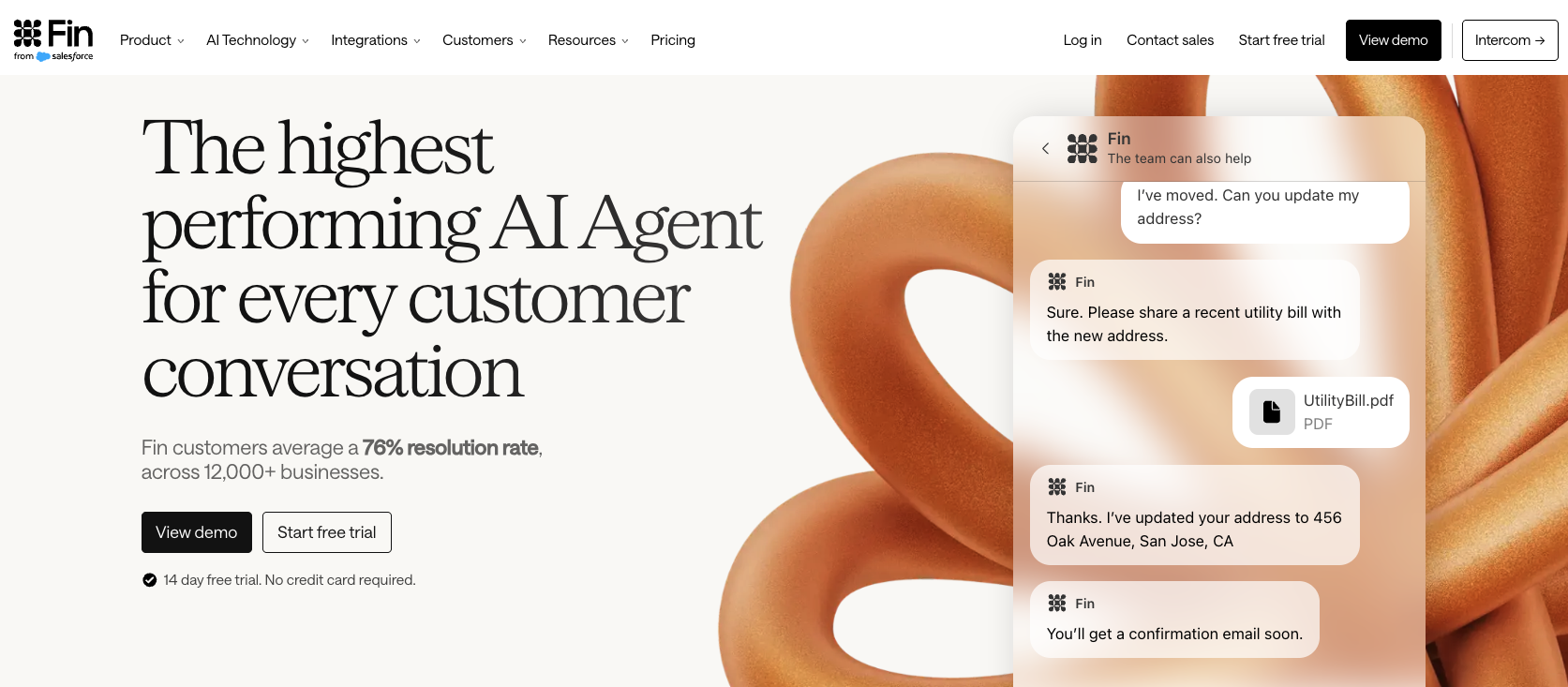
Developer: Intercom
Key Features: Support across channels and languages, built-in actions, external data connections, performance reporting, and revenue attribution insights.
Pricing: From $0.99 per resolution.
Intercom’s Fin could be an ideal option for companies starting to think beyond chatbots, into the realm of AI agents that can support customers and team members at the same time. The Fin for Ecommerce solution connects directly with platforms like Shopify, keeps catalog information synced, and uses that data to recommend products, help customers compare options, and increase sales.
You can design bots that work across social media and messaging channels, as well as your website, and the outcome-based pricing means you’re only paying for conversations where something actually gets resolved. There’s also a really exciting new feature in the form of Revenue Attribution reports, so you can see exactly how your AI tools are improving financial performance.
The slightly less attractive parts are the overall cost and the initial setup. It takes quite a bit of work to get an Intercom bot ready for your site, compared to using something like Noupe. Plus, you’ll be paying for Intercom subscriptions alongside the per-resolution price for bots.
Pros:
- Supports multiple channels and languages
- Excellent deflection rates and outcome-based pricing
- Great integrations with tools like Shopify
- Works with existing help desks and CRMs
- Revenue attribution insights
Cons:
- Complicated initial setup and maintenance
- Costs can stack up quickly
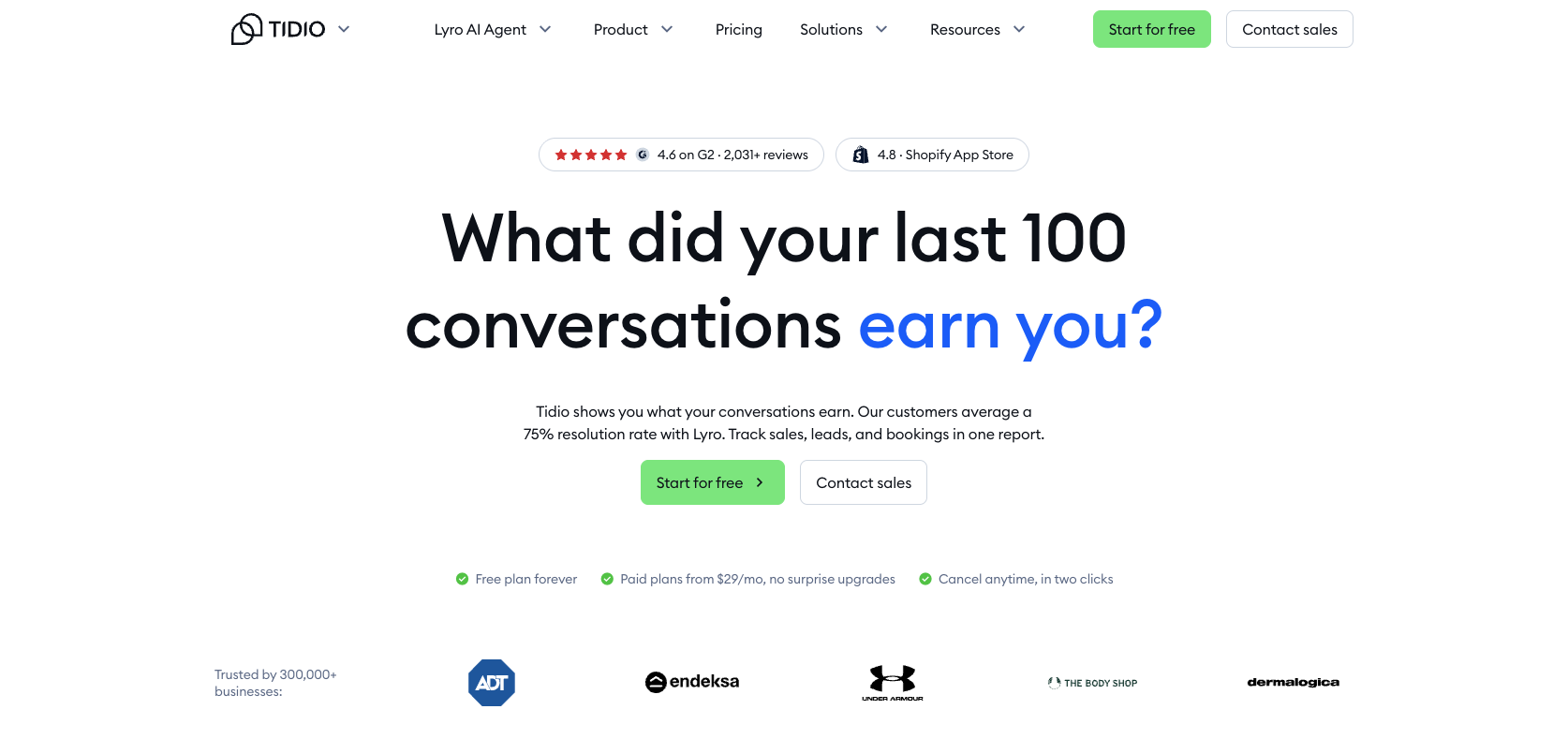
4. Tidio: Best for smaller stores mixing AI and human chat
Developer: Tidio
Key Features: Human and AI chat, template-based automation flows, one help desk for conversations, ecommerce order tools, Copilot, and reply assistance.
Pricing: From $24.17 per month.
Tidio makes particular sense when you want AI handling part of the ecommerce support workload without taking human agents out of the equation. You get the live chat widget (which includes live typing previews and canned responses), alongside the Lyro AI agent that learns from your website and product information to automatically answer customer questions.
Lyro can recommend products based on what the shopper asks, compare different options, and even send conversation context to a centralized inbox, combining insights from live chat, emails, social channels, and more. There are also tools here to help your team out, too, such as the AI reply assistant and copilot.
The platform also integrates natively with systems like Shopify, so agents can preview carts, process refunds, and check order status. Still, compared to some of the other options here, Tidio does have some limitations when it comes to things like analytics and branding options. The pricing can be a little complicated too, because the base plan, flows, and Lyro AI conversations are charged separately.
Pros:
- Works with platforms like Shopify and WordPress
- Easy-to-use automation builder and shared inbox
- Templates for things like abandoned cart recovery
- Combines AI and live human chat
- Useful tools for human agent support (like Copilot)
Cons:
- Can be expensive when you’re using multiple features
- Rigid workflows and branding options
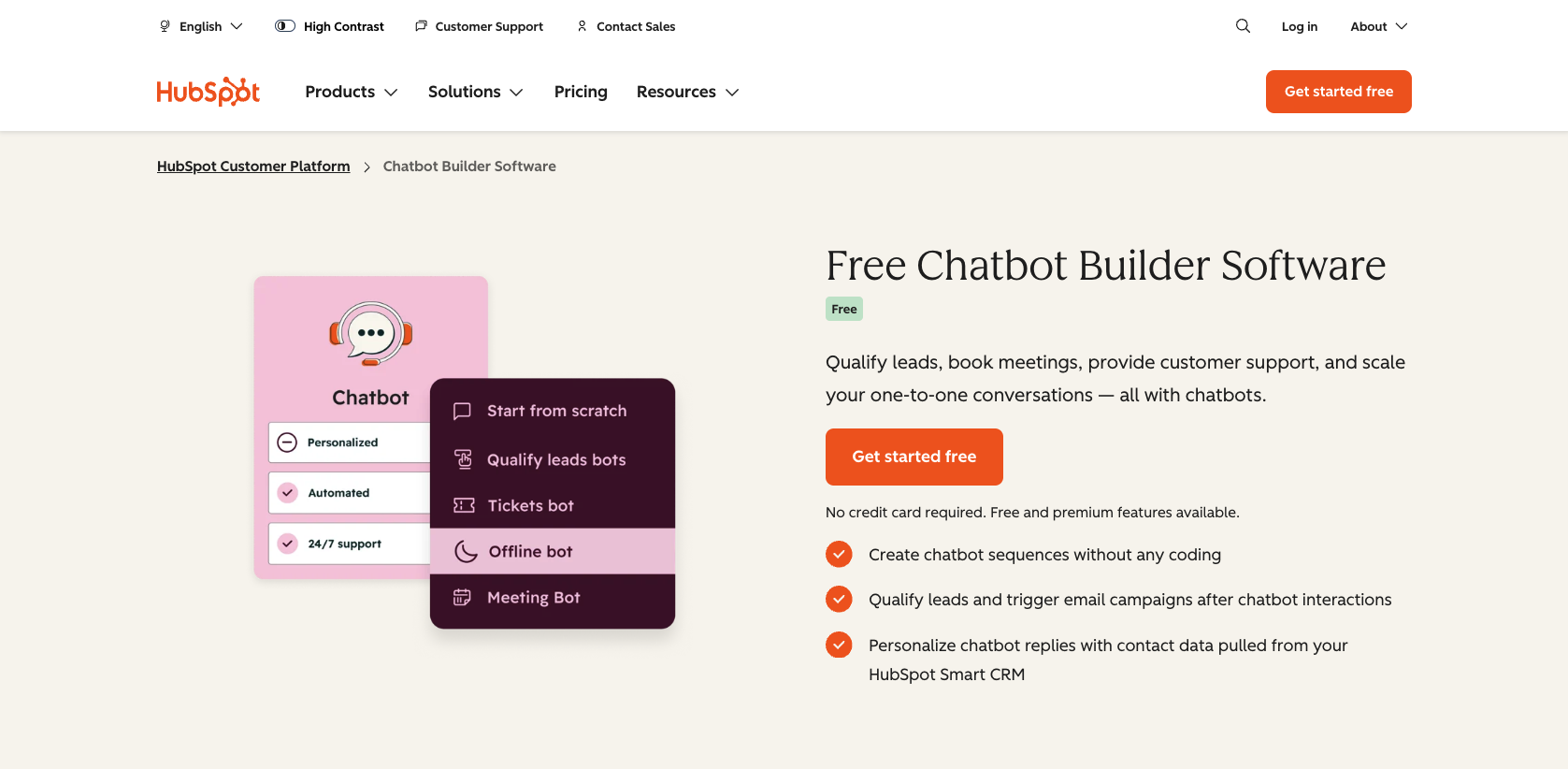
5. HubSpot Chatbot Builder: Best for CRM-connected ecommerce conversations
Developer: HubSpot
Key Features: Visual no-code building, native CRM data, automated lead qualification and routing, agent handoffs, workflow automation, and flexible chatbot customization.
Pricing: Free to start.
You won’t get the same ecommerce focus here that you’d find with Gorgias, but HubSpot has a different advantage: your chatbot already lives alongside the CRM data your team uses.
Without touching code, you can create conversations that qualify leads, schedule meetings, raise tickets, or tailor recommendations using information you already know about the customer. The bot can update those records after a chat too. If the conversation needs a person, it can hand things over to an agent and trigger the relevant HubSpot workflows.
There’s also an upgrade path available when you’re ready to experiment with more advanced features, with solutions like the HubSpot Breeze Customer Agent. The downside is that although the basic chatbot builder is free, you’ll probably have to upgrade quickly for advanced features like complex automation branches or advanced knowledge base syncs.
Pros:
- Free no-code builder for simple chatbots
- Bots can pull context from your CRM
- Supports lead qualification, meeting bookings, and ticket creation
- Can hand conversations to other AI or human agents
- Easy to use for beginners
Cons:
- Limited free functionality
- Works best if you’re already using HubSpot CRM
Which AI chatbot for ecommerce should You choose?
All of the chatbot options for ecommerce companies we’ve mentioned here are valuable in their own way; your choice really depends on what kind of issues you’re trying to solve with the online shopping experience.
HubSpot suits stores that want chatbot conversations feeding directly into CRM records. SnatchBot is geared more toward broad omnichannel coverage. Tidio keeps AI and human service closely connected, while Gorgias has a much stronger Shopify angle. If you want to understand how AI support contributes to revenue, Intercom Fin brings that measurement into the discussion too.
Noupe is the much better option all around if shoppers struggle to find the answers to their questions sitting in your product and policy pages. It makes it easy to create a reliable bot that can guide consumers through the shopping journey, without the typical setup and maintenance headaches associated with most AI platforms.
If you want to see for yourself if Noupe could give you the fastest, simplest way to simplify online shopping for your audience, you can start with a free demo today.