Chatbots come in a lot more shapes than most companies realize, from the basic options built around a specific menu to the more complex systems built to solve multi-stage problems. It’s easy to overlook that when your team’s under pressure to “implement AI,” as 91% of customer service teams are right now, according to Gartner.
The trouble is, if you don’t understand the different types of chatbots before you start shopping, you can end up either with a system that’s too basic to get the right job done, or a solution that’s far too complex and expensive for what you really need.
The best way to compare chatbots is always by understanding the job you need them to do first. Once you’ve got your chatbot use cases ironed out, it’s much easier to match the different types of chatbots available to the project at hand.
What are the different types of chatbots?
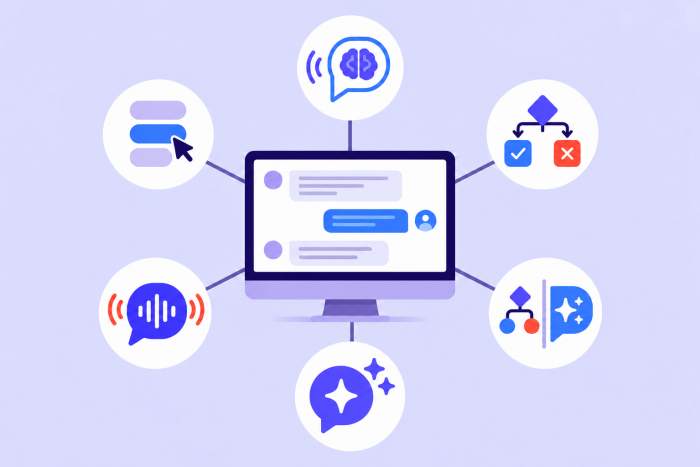
There are six main types of chatbots, and the categories tend to overlap quite a bit; for instance, both menu and rule-based chatbots give you more control over the conversations. AI-powered and generative AI chatbots interpret language and take action in various ways.
Voice chatbots give users another way to interact with the software beyond typing a question into a widget; they can run on rigid rules or use generative models. They can also fall into the same category as an “omnichannel chatbot” if they’re capable of handling multiple types of input.
Every type of chatbot has different benefits, because they’re targeted at different tasks and requirements.
| Type | Best fit | Main strength | Main problem |
|---|---|---|---|
| Menu-based | Simple journeys | Predictable | Limited choices |
| Rule-based | Structured processes | Control | Unexpected wording |
| AI-powered | Natural language conversations | Intent recognition | Knowledge quality |
| Voice | Spoken interactions | Easier access for some | Speech errors |
| Generative AI | Conversations with open-ended questions | Flexible replies | Wrong answers |
1. Menu-based chatbots
Menu-based chatbots give people a specific set of buttons and choices to guide them through a pre-defined path. They might help someone track an order, start a return, change a delivery, or address a billing issue. These tools rely on decision trees and work similarly to old-fashioned automated phone trees; each click or choice opens the next step in the path until the user reaches a solution.
The big benefit of these chatbots is that they’re extremely simple, easy to implement, and ideal for simple tasks like booking an appointment or finding an answer to a common question. The downside is that if a customer’s need isn’t included in the menu, they could be left with nowhere useful to go.
Menu-based bots made the most sense for surveys, quizzes, FAQ handling, lead qualification, or basic information discovery.
Pros:
- Usually simple and affordable for businesses to create
- Very easy to control how the conversation moves forward
- Simple to test before launch and quick to deploy
- Works for users who don’t want to type long questions
- Low risk of unexpected answers
Cons:
- Users might get stuck if they can’t see a button for their issue
- Not suitable for complicated questions
2. Rule-based chatbots
A rule-based chatbot, sometimes called a trigger-based bot, is similar to a menu-based chatbot. It’s built around specific conditions, so a certain word, answer, or phrase sends the conversation along a route defined by the company beforehand.
For instance, if a customer types in a message that includes the word “refund” or “return”, then the bot can identify that and determine the right next stage to send them to. While menu-based chatbots rely on decision trees, rule-based bots can respond to triggers that include everything from keywords to phrases, or a user’s location.
They’re great for technical troubleshooting and fixing predictable issues; they’re a little more problematic from a maintenance perspective, because customers don’t always use the same language or follow the same routes that designers would expect. One person might type the word “billing” because they want to change their card details, and end up being sent to a refund page.
Pros:
- Usually deliver consistent answers and the behavior is predictable
- They’re easy to audit and review
- Great for recognizing various different types of triggers
- Ideal for conversations with pre-designed rules
Cons:
- Users can get stuck if their language doesn’t match the triggers
- Large rule libraries can require a lot of maintenance
3. AI-powered chatbots
When most people ask, “what is a chatbot?” they’re usually thinking of AI-powered bots first, even though quite a few chatbots don’t use any artificial intelligence at all. AI-powered chatbots are different from the two options we just covered, because rather than relying on decision trees or triggers, they can use machine learning and natural language processing to understand and respond to more complex human language.
For instance, Heathrow’s Halli chatbot can resolve 90% of chats without a live-agent transfer, because it can infer intent from ambiguous user input and draw information from the company’s larger knowledge base.
AI chatbots can be a lot better at handling complicated customer service requests than rule- or menu-based chatbots, and they’re even used to personalize shopping experiences. The important thing is making sure the knowledge behind the chatbot is accurate, and that it stays up to date.
Pros:
- Better at understanding and responding to natural human language
- Can handle more variable customer behavior
- Recognizes intent across different kinds of phrasing
- Works well with large knowledge and databases
- Can ask clarifying questions and enable ongoing conversations
Cons:
- Knowledge quality is very important
- Often requires more testing than other chatbots
4. Voice chatbots
Voice chatbots or voicebots are tools that allow a user to speak directly to them, rather than typing out a question. They use speech recognition and language processing capabilities to understand what was said, then return an answer. Plenty of people are familiar with the idea thanks to tools like Google Assistant or Amazon Alexa.
Some of these tools can be rule- or menu-based, while others rely a lot more on AI; the best use cases for voicebots tend to revolve around accessibility. If someone’s driving or calling from a phone, typing their question isn’t very convenient; it’s much easier to speak.
Still, compared to text-focused chatbots, voicebots can be more complicated. To create a chatbot that handles voice, you need to train it extensively on language and accents, and you’ll need to make sure you’re accounting for background noise and issues that can harm the interaction.
Pros:
- Ideal when typing throughout a conversation would be inconvenient
- Helpful addition to a phone-based contact center
- Works well for people with specific accessibility needs
- Can allow for quicker interactions in some cases
- Might help with branding if you can create a specific, memorable voice
Cons:
- May struggle with accents or background noise
- Requires extensive training, especially for nuanced speech patterns
5. Generative AI chatbots
Generative AI chatbots are a type of AI-powered bot that use large language models to create fresh and unique responses to questions or comments throughout a conversation. They’re far more capable than most bots at following up with customers, summarizing what was said before, explaining complicated topics, and working through complicated questions. They can also create new content that’s more personalized and relevant to the user, rather than just pulling something from a script.
These bots are getting more powerful all the time, and some are even capable of completing multi-stage tasks, working as digital agents within a contact center or sales team. The challenge is that they take a lot more work to implement and maintain.
A business chatbot still needs somewhere reliable to source facts, which often means using RAG (Retrieval Augmented Generation) techniques; otherwise, it can end up hallucinating and making up nonsense. There’s also more effort involved in chatbot design and testing. You need to create conversation flows, regularly check for drift, and watch for signs of bias.
Pros:
- Can easily handle open-ended questions and multi-stage conversations
- Produces fresh and relevant responses rather than pulling from a menu
- Can summarize and explain existing information in easier terms
- Feels more natural and conversational than interacting with other bots
- Often solves a wider range of problems than menu-based bots
Cons:
- Can hallucinate or produce incorrect responses
- Requires significant design, maintenance, and testing effort
6. Hybrid chatbots
Hybrid chatbots are the most flexible types of chatbots, because they mix AI capabilities with fixed workflows, so you can decide exactly how much control you need.
For example, a company could create a chatbot that can recognize specific keywords like “billing” or “charged”, while still using natural language understanding and generative AI capabilities.
So if someone messages a bot saying they think the company charged them more than once, the AI could recognize the topic, check the payment record, respond with a potential solution, or send the person to a human to solve the problem. Intelligent handoffs are particularly valuable with hybrid bots, since Gartner found 87% of customers think human access is essential when they’re using AI tools for customer service.
These kinds of bots give you a lot more control with your chatbot ideas, but they also take more effort to build, and, like generative AI chatbots, they need regular testing.
Pros:
- Access to rules and AI features in one bot
- Support human escalation strategies with context in handoffs
- Work across various different journey types
- Give teams more ways to govern higher-stakes conversations
Cons:
- More complicated to build and maintain than most bots
- Maintenance and upgrades can be expensive
How do you choose the right chatbot for your business?
The best way to decide which types of chatbots are right for your company is to figure out the jobs you need help with. Companies won’t always need to build an AI chatbot if all they need is a simpler way to give customers answers to common questions.
Ask:
- How predictable will the conversations be? If customers can easily choose from a handful of options, rule-based or menu-based chatbots should be fine. If they’re going to word things differently, or ask follow-up questions, then you might need AI.
- Does the bot need to answer or act? Menu- and rule-based chatbots generally just answer questions; AI-powered bots are more likely to do things like booking appointments or placing orders on behalf of a customer.
- How much effort can you put in? Do you have someone on your team capable of training, testing, and maintaining an AI-powered bot? Can you afford to hire a specialist to make sure nothing goes wrong?
- What will it really cost? Chatbot pricing can vary widely, but simpler menu- and rule-based bots are often cheaper and easier to scale than AI-powered alternatives. That might be worth it if you save time and money on customer service or sales tasks, but you’ll need to know in advance whether the cost matches the return on investment.
Also, remember to check the rules around your industry; different regulations and guidelines can influence the types of chatbots that are actually safe for your business to implement.
A simple option to get started: Noupe
Many smaller teams won’t need complicated chatbots straight away; they’ll just be looking for a tool that can quickly and reliably answer the customer questions that employees tend to hear the most. A solution like Noupe could be perfect for that.
Noupe’s ideal for chatbot use cases linked to customer service and lead generation, particularly when a company has limited technical and financial resources. All you need to do is give the system a website URL, let it read your public pages, and input any additional information it might need, then add an embed URL to your website.
There’s still AI underneath to help the system understand intent and customer queries, but you don’t need to go through a comprehensive training setup because Noupe works from the content you already have, whether that’s product pages, FAQs, service details, policies, or specific knowledge.
Additionally, Noupe’s bot automatically updates when you add fresh information to your website, and it can detect a customer’s language and respond in kind, making it ideal for global teams.
You can try Noupe for free without even entering your credit card details here.
Which chatbot type should you pick?
Chatbots in all of their forms can be incredibly useful, but not every company needs every type. Some types of chatbots, like menu-based and rule-based bots, are brilliant when people need a quick answer to a question, and they’re likely to follow a predictable route. AI-powered bots are far more appealing when the conversations your bot will have with customers are likely to be more complicated.
Then, hybrid bots, which can use a combination of AI and specific rules, are ideal when you need absolute control. You don’t have to stick to one type; plenty of companies mix and match different types of chatbots for different tasks. The main thing is making sure you understand the strengths and limitations of each option before you start paying for something you don’t need.
Start with the job, the level of freedom customers need, and the repercussions of a bad answer. If website-based support or lead generation are priorities, and you don’t want to spend a lot of time or money setting up your new system, Noupe gives you a great starting point.