- Noupe is the website-first AI support tool for small teams that want a simple, multilingual chatbot trained on their own content, with a shared inbox for human handoffs.
- Talkdesk is the enterprise contact center platform for larger teams that need visual workflows, omnichannel routing, AI assistance, and workforce management.
- NiCE CXone is the contact center platform for regulated and global teams that need compliance controls, workforce planning, detailed analytics, and AI-powered support.
- Five9 is the contact center platform for larger teams that need inbound and outbound calling, predictive dialing, AI agents, and supervisor tools.
- Amazon Connect Customer is the customizable cloud contact center for AWS-experienced teams that want usage-based pricing, flexible routing, AI agents, and workforce tools.
- Nextiva is the unified communications platform for small to mid-sized businesses that want business phones, team collaboration, customer support, and AI automation in one place.
- CloudTalk is the voice-first support platform for growing sales and service teams that need visual call flows, outbound dialers, AI voice agents, and CRM integrations.
- Dialpad is the AI-powered contact center platform for teams that want real-time coaching, live transcription, automatic summaries, and customizable AI agents.
- RingCentral RingCX is the omnichannel contact center platform for companies that want connected business communications, digital support channels, AI assistance, and workforce tools.
- Zendesk is the ticket-first support platform for teams that need omnichannel ticketing, integrated calling, AI agents, and knowledge-based assistance in one workspace.
There’s no arguing with the value of Genesys Cloud CX if what your team really needs is a comprehensive toolkit for managing end-to-end customer service. It’s a powerful, cloud-native contact center platform, with omnichannel routing, inbuilt workforce engagement tools, and some brilliant AI features. It’s also a bit too much for certain companies.
If you’re looking for a Genesys competitor, you might want something with a smaller learning curve, better reports, or even just cheaper monthly chatbot pricing.
Fortunately, there are a lot of great Genesys alternatives out there, the one you choose will likely depend on whether you need full cloud call center solutions, or just a more convenient route into AI-powered customer support.
What to look for in a Genesys competitor?
When you’re comparing Genesys competitors, the first question to ask is what is a chatbot or platform actually going to do for your business? Are you looking for the best contact center software with built-in AI features? Or do you just want to create a chatbot that can handle some of the extra questions that come in through your website each day? A few things worth thinking about:
- The job you need done: Replacing a 500-seat contact center means routing, recording, forecasting, QA, and compliance. Supporting agents that keep answering the same repetitive questions with information you can already find in your knowledge base is different.
- Pricing needs: You’ll need to account for seat costs, telephony, AI usage credits, WFM, support, and overages. A cheap basic plan can quickly become expensive when you add in extra channels, analytics, or capabilities.
- Automation capabilities: Look at your chatbot use cases, do you need the bot to update tickets, book appointments, check orders, or collect details for the next agent? Should the system be able to integrate with various tools you’re already using, like the CRM?
- Governance and control: How much control do you need over your approved knowledge sources, guardrails for AI agents, and AI to human hand-offs? Those hand-offs need to maintain context two, since one in three agents say they lack the information they need after a bot transfer to offer the ideal experience.
- Scalability: How easy is it going to be to add additional customer support channels, new features for AI agents and human staff members, or integrations with additional tools? Genesys is naturally scalable as a cloud-based tool, but other systems are more restrictive.
It’s also worth thinking about what your biggest problem with Genesys already is. The best Genesys competitor should be able to fix pricing issues, limited AI capabilities, problems with real-time analytics, or unnecessarily steep learning curves.
Quick comparison: Best Genesys alternatives at a glance
We’ve chosen these ten options to suit different companies looking for various levels of AI, automation, and contact center features. Some are better for companies looking for a direct replacement for Genesys’ full contact center suite, others, like Noupe might make more sense if you want a quick and easy way to discover the benefits of chatbots for your website.
| Tool | Best for | Features that matter | Published pricing |
|---|---|---|---|
| Noupe | Website-led service teams | Automatically learns from your website pages and custom knowledge. Multilingual support, unified inbox | Free for 100 conversations; Paid plans start at $20 per month |
| Talkdesk | Larger CCaaS teams looking for simple admin | Visual routing, comprehensive omnichannel coverage, copilot, and workforce management | Digital Essentials starts at $85 per month |
| NiCE CXone | Regulated and global contact centers | Comprehensive omnichannel routing, compliance controls, and recording with built-in WFM | Starts at $110 to $249 per agent/month |
| Five9 | Combined inbound and outbound service | Predictive dialing, blended queues, Agent Assist, Voice AI Agents, WEM and CRM integrations | Digital starts at $119; Core $159 per user/month |
| Amazon Connect Customer | AWS teams comfortable with enterprise scale | Voice, chat and email, AI agents, workforce scheduling, evaluations, simulation plus AI metrics | Voice $0.038/minute, chat $0.01/message and email $0.08 |
| Nextiva | Companies combining business phones and customer service | Voice, web chat, skills-based routing, transcription, blended calling and higher-tier digital channels plus conversational automation | Essential starts at $75 per agent/month |
| CloudTalk | Growing sales and support teams focused on voice | IVR, visual call flows, dialers, call monitoring, CRM connections, Conversation Intelligence and AI Voice Agents | Starter prices begin at $25 peer user per month |
| Dialpad | Teams looking for AI-powered live-coaching and automatic Q&A | Real-time transcription, coaching prompts, AI summaries, contextual scorecards and no-code agents | Support Essentials starts at $80 per user per month |
| RingCentral RingCX | Companies consolidating internal and customer conversations | Voice, more than 20 digital channels, outbound campaigns, AI assistance, plus workforce tools | Starts at $65 per user/month |
| Zendesk Contact Center | Ticket-led support teams | Amazon Connect-powered calling inside Agent Workspace, live knowledge suggestions, AI agents, WFM | $83 per agent/month annually, on top of a qualifying Suite plan. |
1. Noupe: Best for simple website-based chat
Best for: Companies trying to simplify website-based chat experiences, with multilingual support, and automatic knowledge base updates.
Noupe is a straightforward Genesys alternative if what you really need is an accurate, reliable chatbot that can answer customer questions quickly, using pre-approved knowledge. It’s a multilingual tool that automatically recognizes a customer’s language and responds accordingly, plus it gives you complete control over branding and messaging tone.
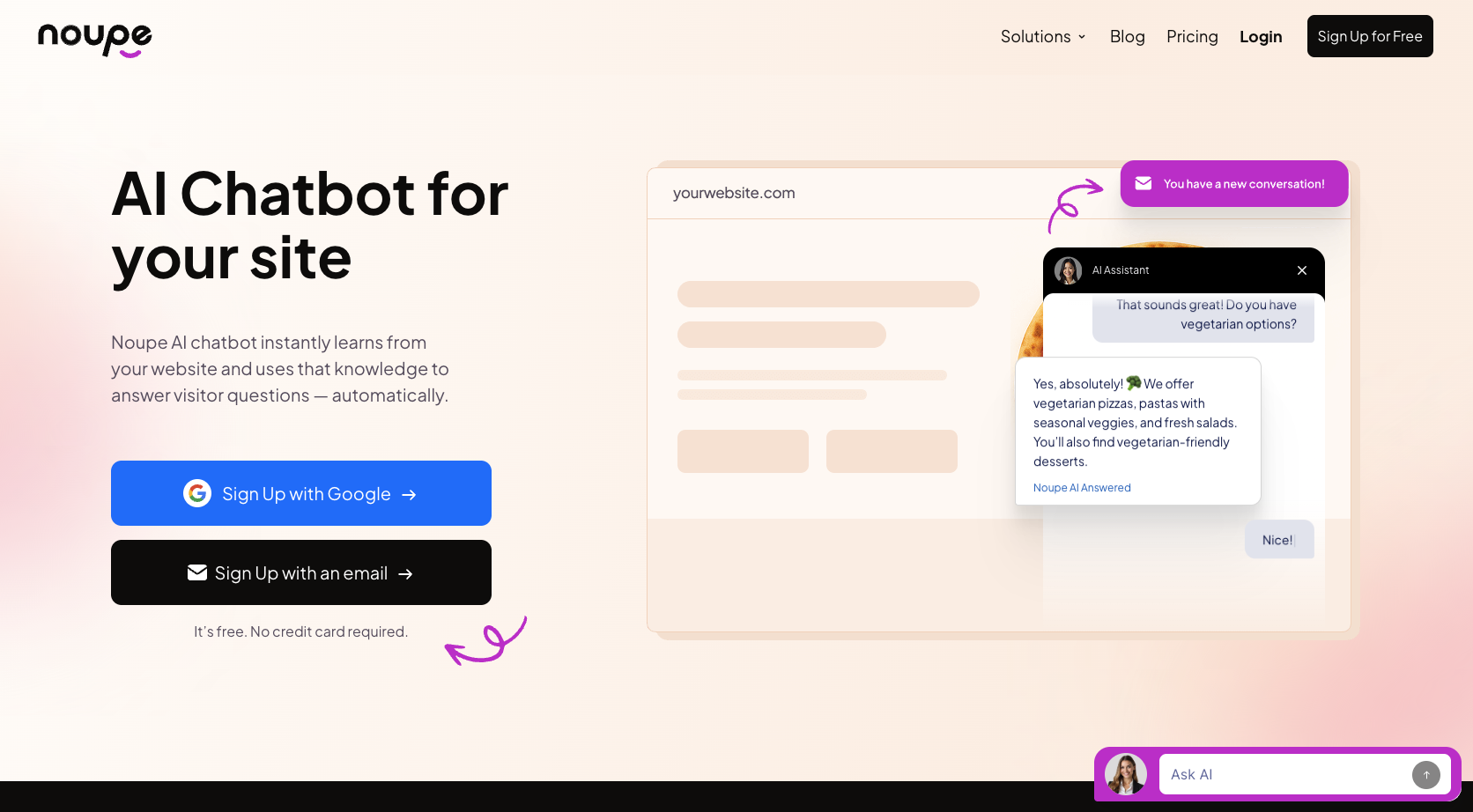
Noupe can read your public pages, then lets you add documents and approved Q&A for anything your site’s missing. It also updates automatically when you add new information to your site, so you’re not constantly rebuilding your chatbot from scratch.
Noupe also includes a shared inbox for your team members, so human employees always get the context they need to pick up a conversation wherever a bot leaves off. It’s not a full AI chatbot call center solution, but it’s ideal for smaller teams looking for a simple way to take extra work off their service team’s shoulders.
Key features:
- Automatic learning from your website content
- Custom knowledge base support
- Instant setup with customization options
- Real-time conversation delivery into a unified inbox
- Automatic multilingual support
- Free initial plan
Pricing: Free for the first 100 conversations, then paid plans start at $20 per month.
Pros:
- Automatically learns from your website content
- Responds in the visitor’s language without extra training
- Complete control over the widget’s appearance and greeting
- Useful omnichannel inbox
- Easy to setup and use
Cons:
- No voice support or advanced contact routing
- Limited reporting features compared to some alternatives
2. Talkdesk: Best for enterprise teams with visual workflows
Best for: Bigger service teams looking for strong enterprise routing capabilities, rapid deployment, plus a smaller learning curve.
Talkdesk is another fantastic Genesys competitor if you’re looking for more than just a chatbot for customer service. It can handle voice, messaging, routing, agent assistance, workforce management, and analytics all in the same toolkit. Plus, it’s user-friendly, quick to set-up since it’s based on the cloud, and ready to scale, too.
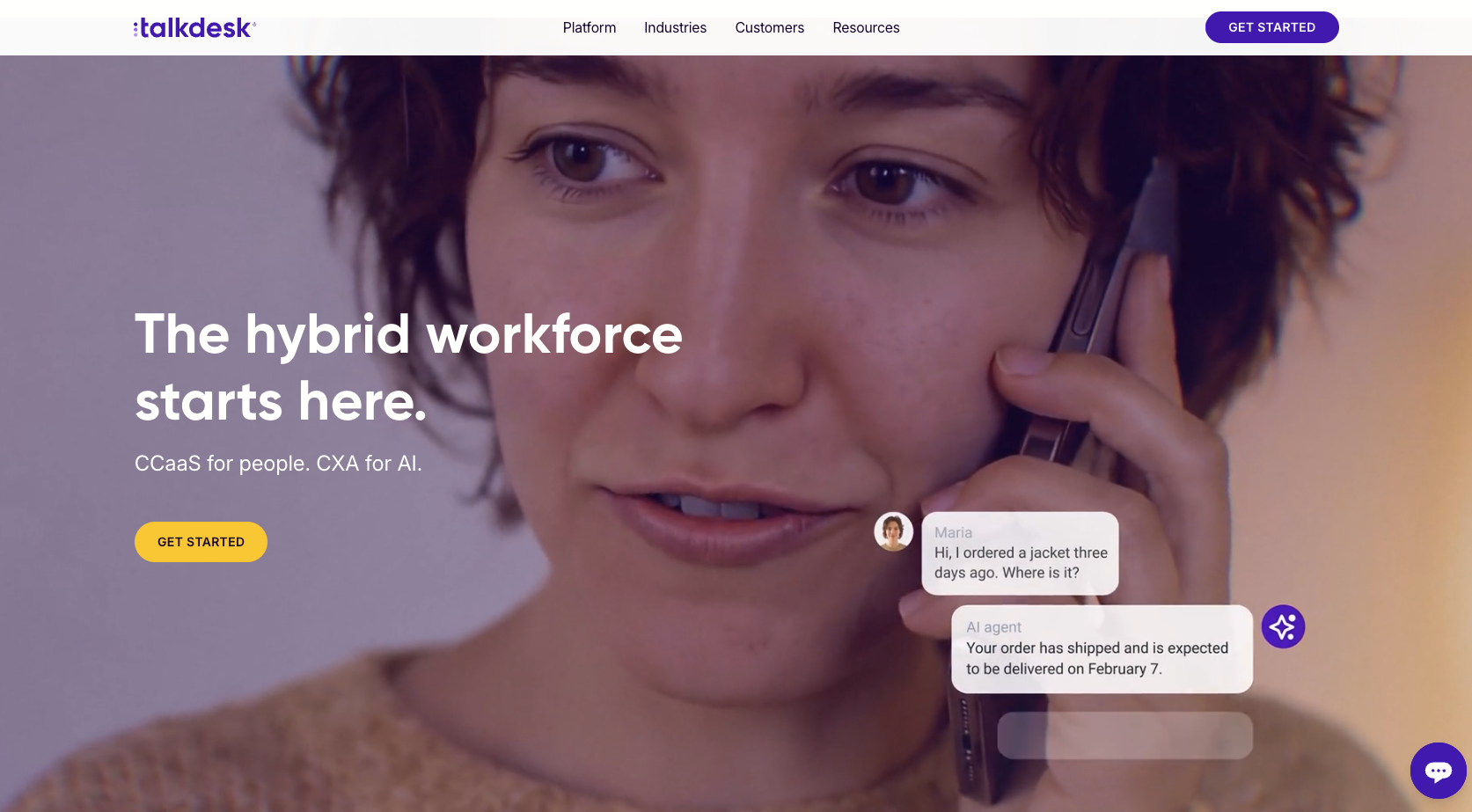
Talkdesk is also a great option if you want deep integrations with tools like Salesforce or Zendesk. One if it’s most impressive features is its visual workflows, which make it easy to set up rules that let bots update accounts, trigger checks, or push work across external systems.
There’s also useful tools for human employees built-in, like real-time transcriptions, automatic call scoring, plus summaries for future work. The reports are a little basic on the initial plans, and the cost can add up quickly if you want premium automation and uptime guarantees, however.
Key features:
- Intuitive drag-and-drop visual workflow builder
- Attribute and skills-based routing across multiple channels
- Copilot, autopilot, and AI agent features
- Integrated interaction and quality analytics
- CRM integrations and WFM capabilities
- Talkdesk Guardian for compliance monitoring
Pricing: The Digital Essentials plan starts at $85 per user per month, while Voice Essentials costs $105 per month.
Pros:
- Straightforward visual tools for routing paths
- Voice and major digital channels support
- Comprehensive automation flows with integrations
- Copilot live guidance for employees
- Useful compliance monitoring features
Cons:
- Expensive pricing with AI and WFM added in
- Some reporting limitations on lower-tier plans
3. NiCE CXone: Best for regulated industries
Best for: High-volume contact centers in regulated industries, and companies looking for complete workforce and compliance control.
NiCE CXone is one of the better Genesys alternatives if you’re interested in exploring chatbot ideas, but you need to make sure your workflows follow strict rules. It’s a popular option for banks, healthcare providers, or global service operations. The system covers voice, digital channels, quality scoring, interaction analytics, routing, forecasting, plus customizable AI agents.
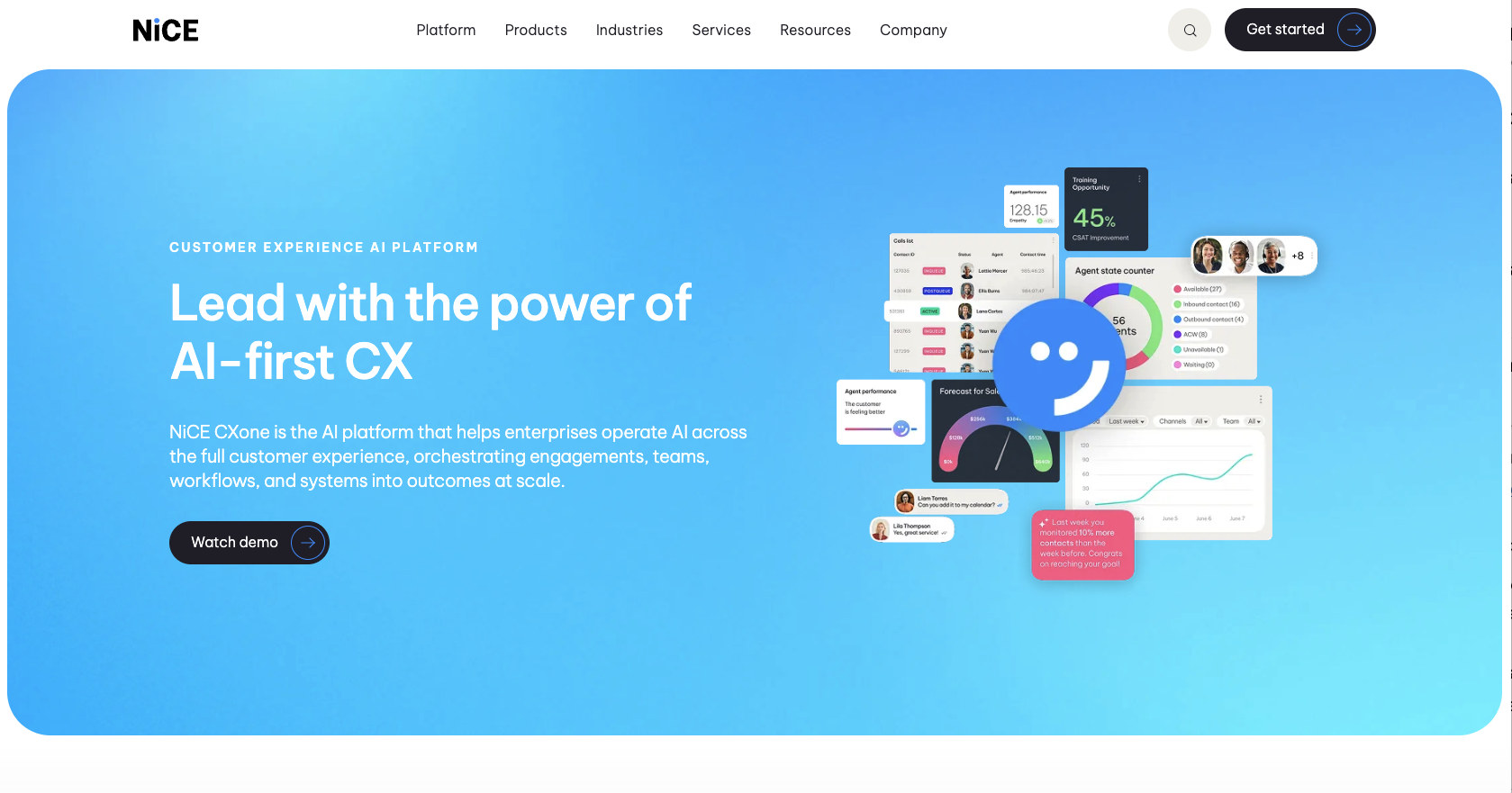
Plus, in 2026, NiCE added a comprehensive Workforce Empowerment suite, to apply scheduling, coaching, quality, and performance controls to both human employees and AI agents. That’s valuable at a time when only around 42% of companies say their risk strategy is prepared for AI adoption.
NiCE integrates with all of the major CRM platforms, including Salesforce, and it’s built on a strong cloud infrastructure that can scale easily as your business grows. Plus, the analytics are excellent, with deep reporting abilities available on most plans.
However, it is one of the more complicated tools for teams to use if they’re building an AI contact center from scratch, and the overall pricing can be expensive when you layer in things like workforce and AI add-ons.
Key features:
- Omnichannel coverage including voice and digital channels
- Enlighten AI for sentiment detection and agent guidance
- Agent assist, conversational AI, and custom agents
- Workforce management and quality management included
- Comprehensive analytics across all channels
- CRM integrations and API connectors
Pricing: Plans start at around $110 to $249 per month, per agent, depending on the package you need. Extra features can come with add-on costs.
Pros:
- Very detailed workforce forecasting and analytics
- Automated quality checks for humans and AI
- Voice, chat, email, and co-browsing support
- Comprehensive compliance controls
- Copilots for both agents and supervisors
- Industry packages for regulated companies
Cons:
- Complicated setup and management
- Expensive higher tiers
4. Five9: Best for inbound and outbound conversations in large companies
Best for: Larger companies handling a lot of inbound and outbound conversations, who also want fantastic supervision tools.
Five9 is one of the Genesys alternatives worth considering if you’re looking for not just omnichannel AI capabilities, but also excellent outbound campaigns and supervisor tools. There’s a predictive dialer to help with engaging leads, blended outbound and inbound queues, live transcription, Agent Assist tools, and integrations with both CRM and WFM platforms.
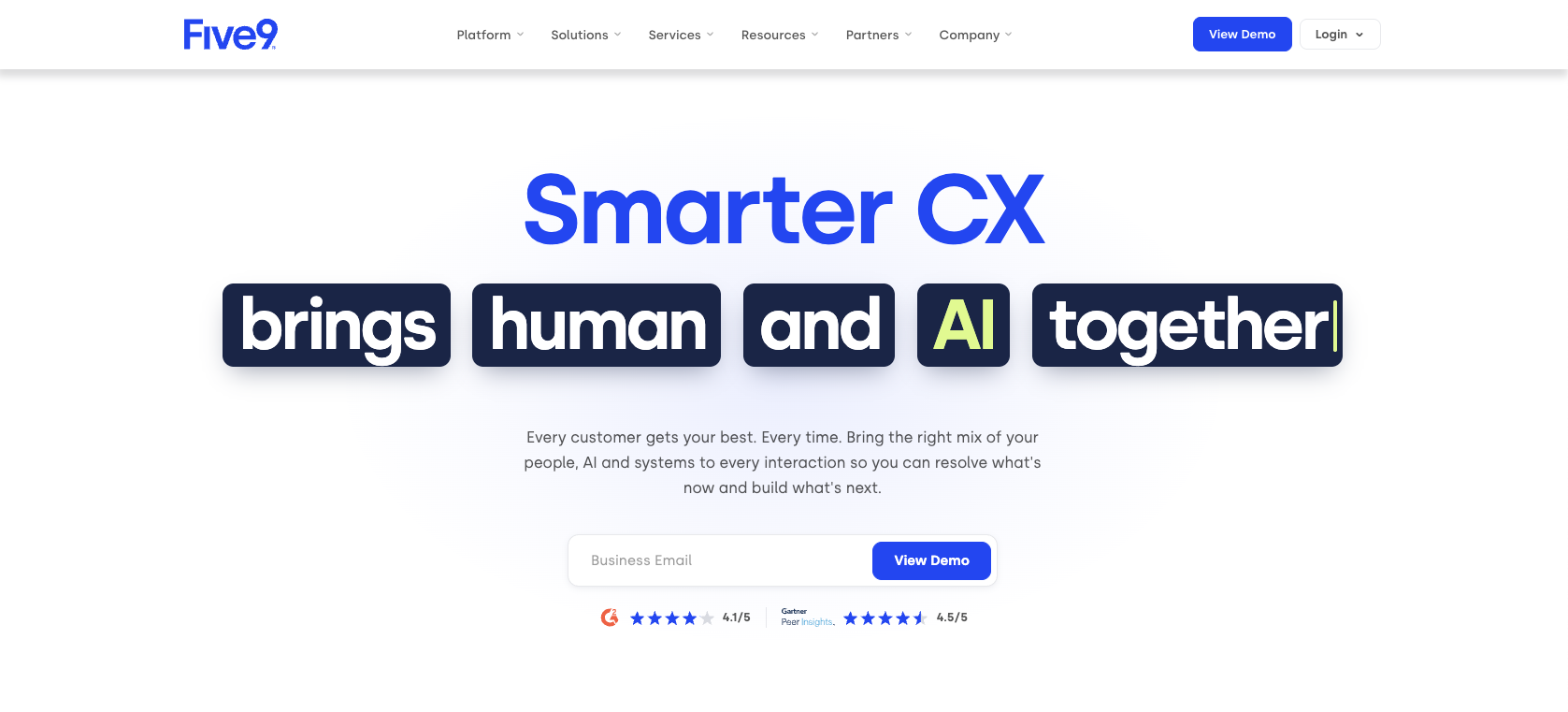
You also get some workforce engagement features built-in, like leaderboards that help encourage stronger performance among teams. Plus, in 2026, Five9 made some significant updates to its Voice AI agents. Now, they’re capable of reasoning through multi-step tasks, taking permitted actions automatically, plus transferring customers to humans with context attached.
Five9 is less suited to smaller teams looking for a basic way to handle chat-based customer service, but if you want an all-in-one toolkit for customer and employee engagement, with voice bots, chatbots, and strong analytical tools in the same place, it’s hard to beat.
Key features:
- Omnichannel support with intelligent routing
- Intelligent virtual agents and agent assist
- AI summaries, overviews, and scoring
- Campaign management and predictive diallers
- Workforce engagement tools included
- Comprehensive interaction analytics, dashboards, and reporting
Pricing: The Digital plan starts at $119, while the Core plan with voice starts at $159 per seat per month. Bundled seats include around 3,000 AI minutes.
Pros:
- Excellent campaign management and outreach tools
- Customizable voice AI agents with live-agent transfer
- Transcription and AI summaries included
- Strong connectors with CRM and UC tools
- Agent assist tools included
Cons:
- Not suitable for smaller teams (50 seat minimum)
- Extra usage charges can apply for AI
5. Amazon Connect Customer: Best for developer-heavy teams
Best for: AWS teams looking for comprehensive control over their contact center and AI architecture, as well as infinite scalability.
Amazon Connect Customer is a brilliant Genesys Competitor if you’re tired of fixed seat licenses and you already know your way around the AWS cloud ecosystem. You get everything you need here, from voice, chat, email, and AI agent coverage, to workforce scheduling, screen recording, and testing capabilities for bots.
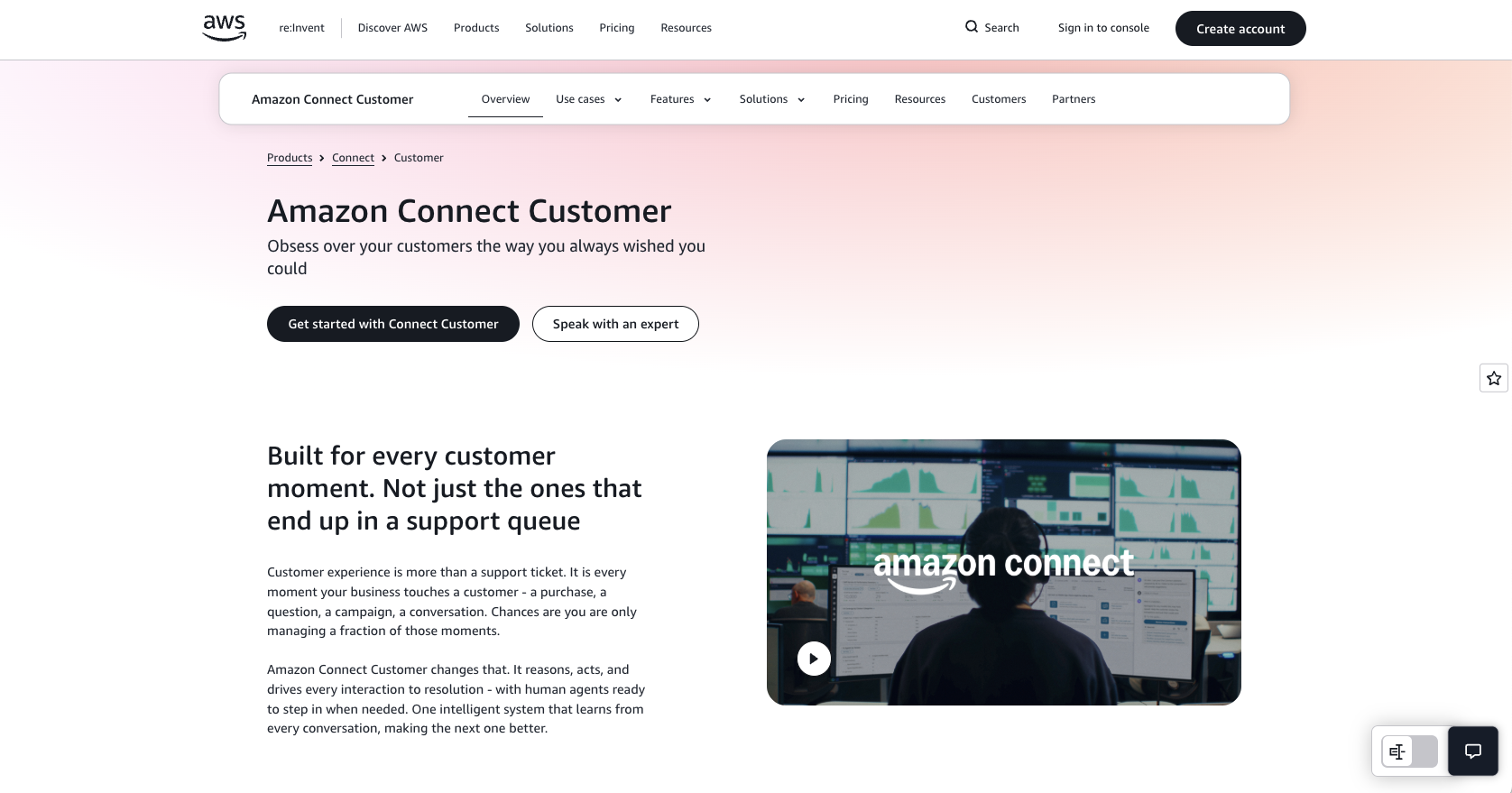
Although Amazon Connect Customer takes a bit more work to set up and manage than some of the other tools on this list, it’s one of the more flexible options. If you have massive fluctuations in call or contact volume, you can scale up and down to protect your budget. There are also no seat minimums, because the whole system operates on a consumption-based pricing model.
Plus, since you get an open toolkit, you can build customize dashboards, add your own routing logic, and integrate whatever you like. In 2026, Amazon also added conversational insights, chat simulation for testing queues, plus tool-selection scores for AI agents.
Key features:
- Omnichannel coverage and routing capabilities
- Conversational IVR, chatbots, and AI agents
- Outbound and inbound campaign support
- Comprehensive customer profiles and analytics
- Workforce management and scheduling tools
- Real-time agent assist
Pricing: The plans are fully usage-based, with voice starting at $0.038/minute, chat $0.01/message, and email $0.08.
Pros:
- No per-seat minimums or long-term contracts
- Full omnichannel functionality
- AI agents, agent assist, plus conversational IVR
- Chat workflow simulation and testing tools
- Built-in workforce forecasting and scoring
Cons:
- Setup can be complicated for beginners
- Costs can add up when you consider storage, AI services, and integrations
6. Nextiva: Best for companies consolidating tech
Best for: Smaller to mid-sized businesses looking for an easy way to align internal conversations with contact center workflows.
Nextiva is one of the better Genesys alternatives for companies who want to combine some of the best contact center software for smaller teams with internal unified communication tools. If you’re sick of dealing with both the complexity and cost that comes with software sprawl, Nextiva aligns enterprise telephony, team messaging, and routing in the same place.
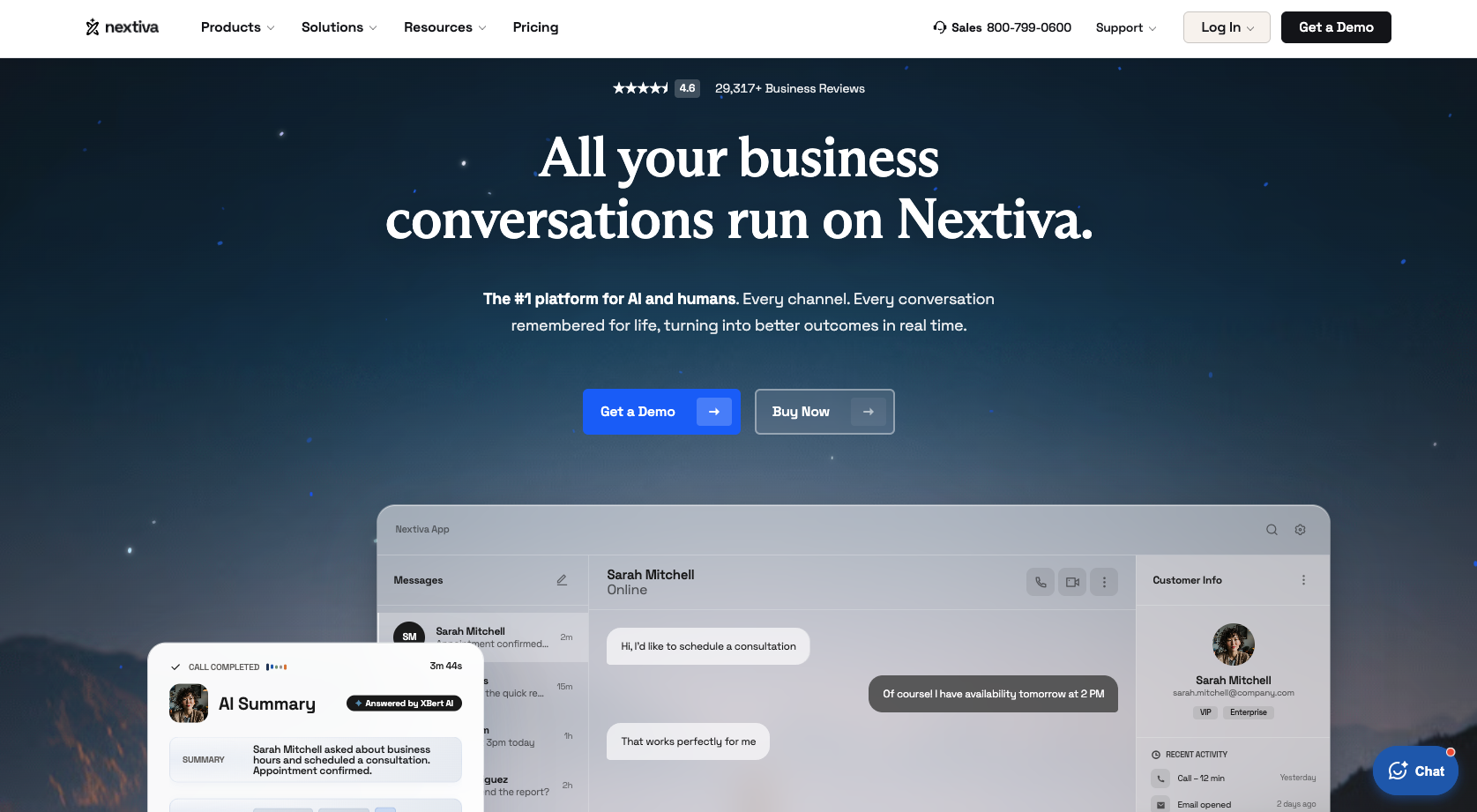
It’s easy to deploy, with a fantastic onboarding wizard for beginners, and visual user management and call routing capabilities. It also integrates with most of the extra software companies need to tie to their contact center tools, like Google Workspace or Salesforce.
Alongside omnichannel routing and conversation management, Nextiva gives businesses a reliable AI-powered customer support system that can answer calls, handle both chat and text, book appointments, and add information to your CRM. It also promises a great 99.999% uptime guarantee, so it’s ideal if you’re trying to cut down on technical glitches.
Key features:
- Comprehensive omnichannel coverage
- Unified inbox and shared workspace
- AI voicemail transcription, routing, and summaries
- Useful onboarding wizard for beginners
- Included collaboration and internal communication tools
- Integrations with CRM and WEM solutions
Pricing: Prices start at about $15 per month per user, but if you want to use the system for outbound campaigns, and you need more advanced contact center capabilities, plans start at $75 per month.
Pros:
- Useful all-in-one platform for business communications and customer conversations
- Skills-based and attribute-based routing
- Strong technical support and reliability
- End-to-end automation through XBert
- Predictive and progressive dialling on higher plans
- Strong integrations with existing workplace tools
Cons:
- Advanced contact center features cost more
- Slightly cluttered backend interface
7. CloudTalk: Best for voice-first teams
Best for: Growing small and mid-sized business focusing mainly on voice-based customer support, and a simple initial setup.
If you’re looking for a Genesys competitor that puts voice interactions first, CloudTalk is a good option. The platform comes with intelligent IVR capabilities, call flows, power dialing, live monitoring, sentiment analysis, plus AI summaries. There are also dfozens of integrations with help desks and CRM tools.
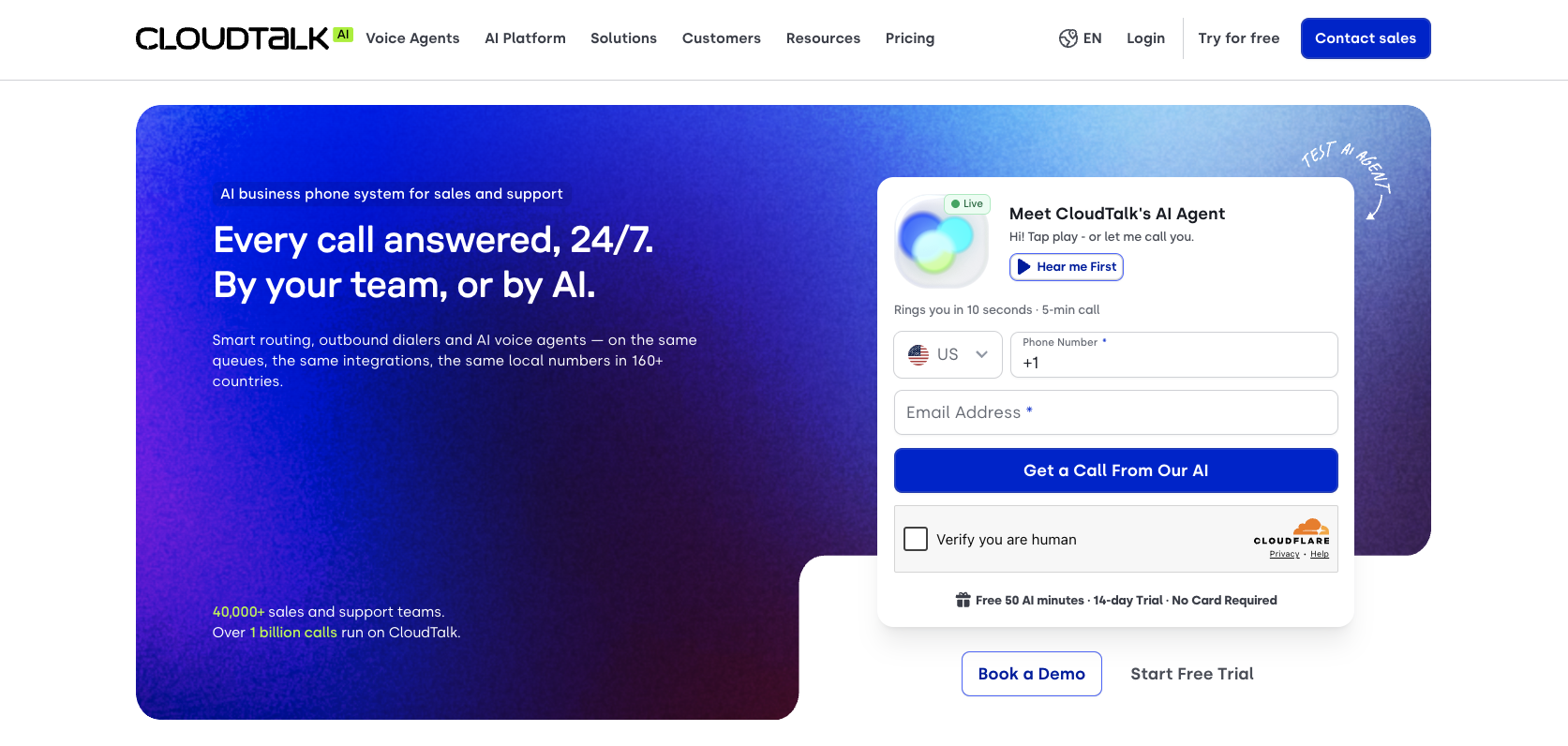
The NLP-powered voice agents can handle both inbound and outbound calls, work from your approved knowledgebase, and hand conversations over to people with context attached. It’s surprisingly easy to set this toolkit up too, with visual builders for everything from chatbot customization to routing design.
Plus, CloudTalk replaces the less predictable Genesys token system for AI spend with flat-rate pricing, and conversation intelligence comes built-in. Still, it’s less likely to appeal to companies who handle most conversations through messaging rather than voice.
Key features:
- AI voice agents with sentiment analysis
- Call routing, IVR, and intelligent flow designer
- Power and parallel outbound diallers
- CRM and help desk integrations
- Real-time dashboards and analytics
- AI conversation intelligence
Pricing: Plans start at $19 per month, although you will need to pay extra for VoiceAgents, specific integrations, or features like parallel dialing.
Pros:
- Visual flow builder with skill-based routing
- Over 95 business app connections
- API tools for end-to-end issue resolution
- Searchable transcripts and call scoring
- Global multi-carrier network
Cons:
- Limited functionality outside of voice
- VoiceAgents come with extra fees
8. Dialpad: Best for AI-native coaching
Best for: Contact center teams that want AI coaching throughout calls, instant transcriptions, plus fast onboarding for teams.
Dialpad is one of the top Genesys competitors for companies that want to use AI to improve employee experiences, as well as customer interactions. If you’re experimenting with AI agents that can guide teams through day-to-day work, Dialpad gives you live transcription, summaries, coaching prompts, CSAT estimates, scorecards, plus sentiment analysis in the same place.
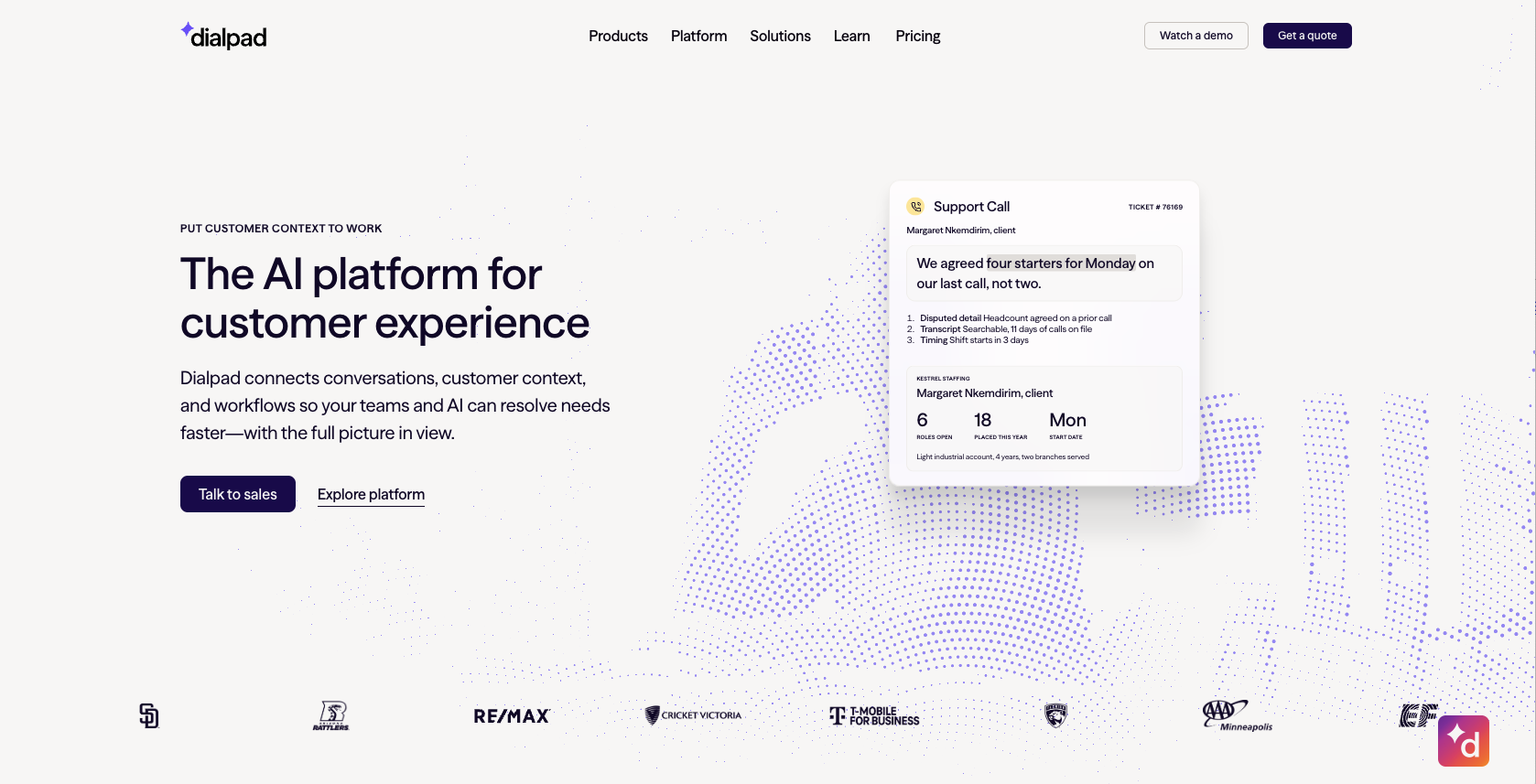
In 2026, it also added a Skill Mining feature to help you examine and learn from older conversations, Agent Studio for building voice and chat agents without code, plus Proving Ground to help you test performance before you launch.
You also get multi-channel messaging, cross-device call flipping, bring your own device support, as well as CRM integrations for all the tools you already use. It’s worth remembering though that lower plans do tend to come with user minimums.
Key features:
- Live transcription, real-time assist, and scorecards
- Sentiment and performance analysis
- Multi-channel messaging and voice support
- Intelligent routing and workflows
- Customizable AI agents
- Integrations with existing business tools
Pricing: Support Essentials starts at $80 per user per month when you pay annually. Cheaper plans are available, but they only cover basic internal phone systems.
Pros:
- Real-time coaching and transcription during calls
- AI-generated recaps and summaries
- LLM scorecards and testing capabilities
- Intelligent omnichannel routing
- Deep integrations with CRM systems
Cons:
- Can be more expensive than alternative tools
- Workforce management is an extra add-on
9. RingCentral RingCX: Best for secure unified telephony
Best for: Companies in regulated industries looking for combined business communications, collaboration, and contact center support.
RingCentral RingCX is one of the more popular cloud call center solutions for businesses in search of a unified solution for managing internal and external communications. If you’re already using something like RingCentral EX for company calling and workforce management, RingCX is the perfect way to take your conversational AI capabilities further.
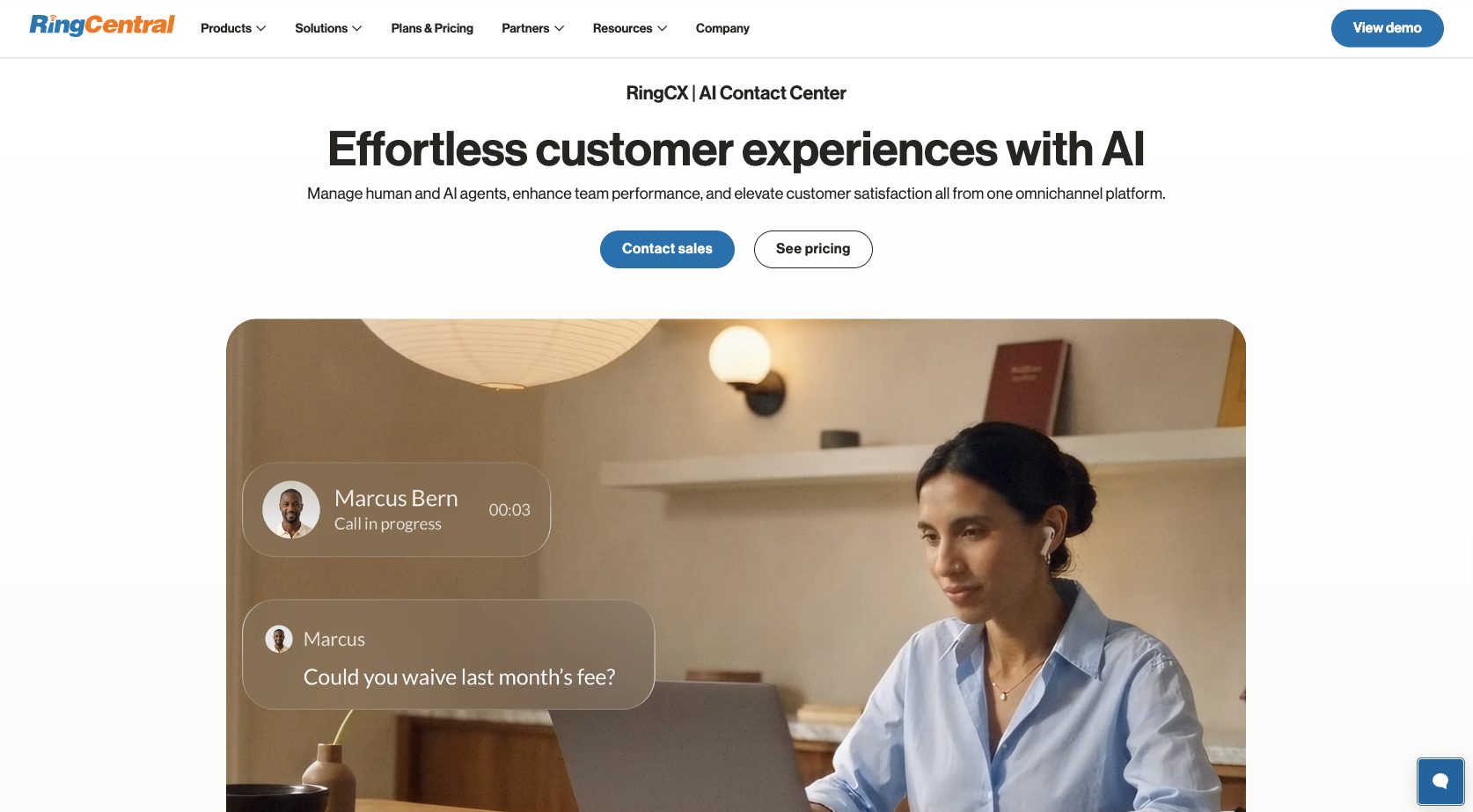
You get omnichannel routing and conversation coverage, live transcriptions, automated summaries, conversation analytics, and workforce management in the same place. Plus, you can connect RingCX with most of the top CRM platforms too.
In 2026, RingCentral made some impressive updates to AIR Pro, with AI agents for automated outreach and handoffs carrying prior context and recordings. There’s also live screen monitoring now, so supervisors can watch and step into calls when necessary.
Key features:
- Omnichannel coverage and routing
- Queue callback and management features
- Live transcriptions, summaries, and conversation analytics
- Integrated workforce management capabilities
- Excellent global redundancy features
- Integrated video workspaces
Pricing: Plans for RingCX start at $65 per user per month, although you may need to purchase RingEX separately.
Pros:
- Coverage of voice plus 20+ digital channels
- AI quality management and WEM tools
- Integrated collaboration features for teams
- Exceptional enterprise-grade security
- Reliable global redundancy
Cons:
- Add-ons and extra WEM tools cost more
- Complicated learning curve for beginners
10. Zendesk Suite: Best for ticket-first teams
Best for: Ticket-first support teams adding AI functionality and enterprise voice, while keeping maintaining a strong employee experience.
Zendesk is one of the more popular Genesys alternatives for companies that generally handle most of their customer service tasks through email, messaging, and tickets. Although it’s better known as a ticketing tool, it does have a full contact center solution now, which pulls Amazon Connect calling functionality into the central Agent Workspace.
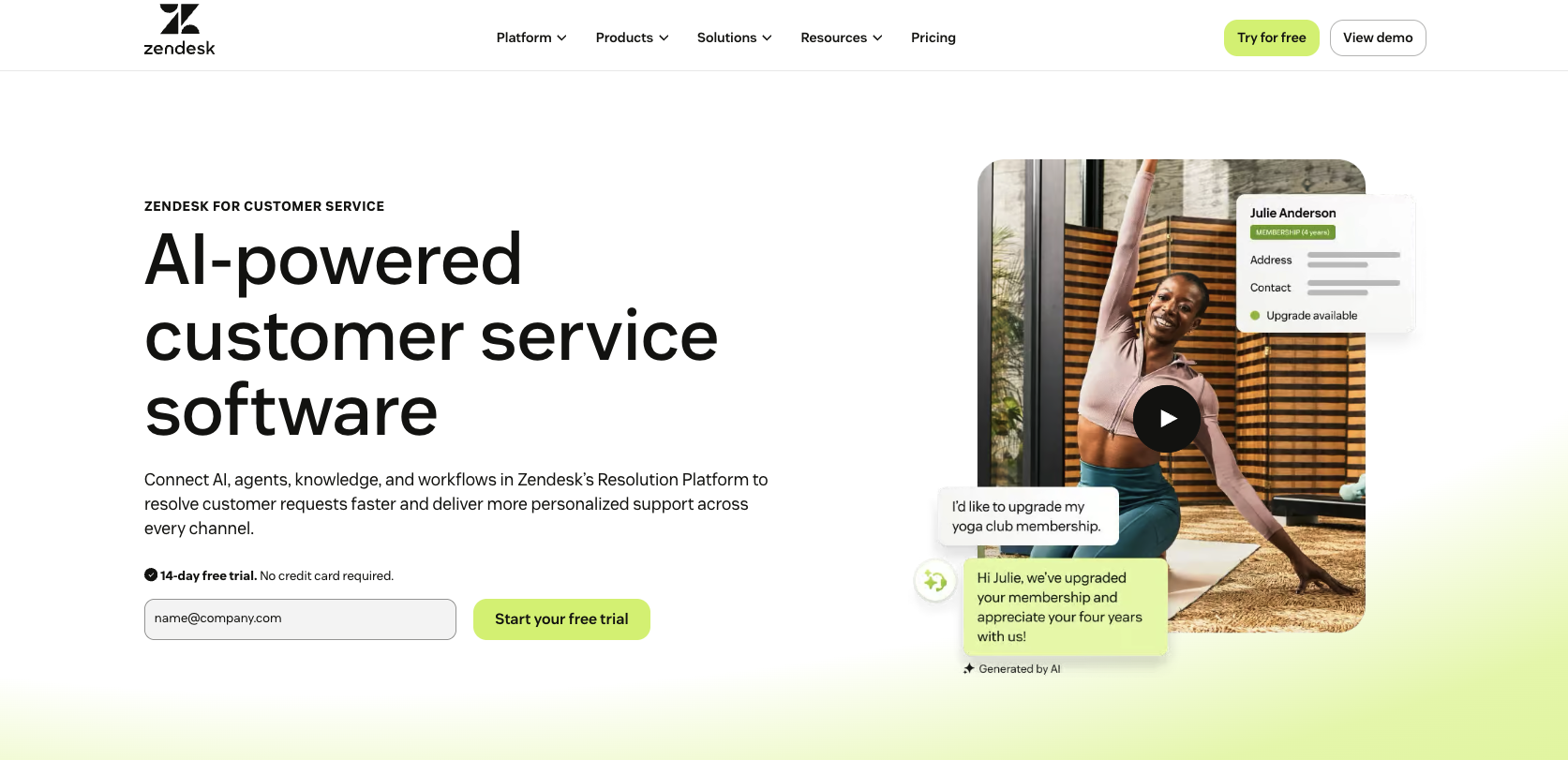
Within the platform, you’ve got omnichannel ticketing workflows, with collision detection, and a comprehensive knowledge base. There are built-in tools for creating custom dashboards, quality assurance, workforce management, plus AI agents.
You also get a Copilot solution, which can take insights from live transcripts, feed questions into Zendesk Knowledge, and return answers from approved sources while employees are in the call. The downside is the combination of ticketing functionality, telephony, and extra features like quality assurance can make Zendesk a little too expensive for smaller teams.
Key features:
- Omnichannel ticket management with collision detection
- Unified agent workspace
- Customizable AI agents and agent copilot
- Quality assurance, and workforce management available
- Comprehensive dashboards and analytics
- Massive selection of integration options
Pricing: Plans start at $55 per agent per month when you pay annually, but you also need the contact center license starting at $83 per month, per agent.
Pros:
- Calls, digital tickets, and routing in the same workplace
- Reliable cloud-based telephony infrastructure
- Excellent AI assist and copilot tools
- QA and workforce management available in the same suite
- Large ecosystem of integrations
Cons:
- Can be expensive compared to other Genesys alternatives
- Limited workspace customization
Which alternative is best for your business?
The best Genesys competitor really depends on whether you’re looking for a comprehensive contact center system, or something that makes automating customer service a bit easier. All of these tools are useful in different ways. Five9 is great for combining Inbound and outbound calling. Both Nextiva and RingCentral work well for aligning external and internal communications.
NiCE CXone is excellent for regulated industries, while Amazon Connect Customer offers a lot of control for companies with fluctuating demand. Talkdesk works well for visual flows and agent oversight, and CloudTalk is brilliant for growing teams that want flexible routing. Then Dialpad is ideal for AI agent coaching, while Zendesk works well for ticket-first teams.
Noupe is really the better option if you just want something simple to help improve customer service, while taking extra work away from your teams. If you don’t have a full contact center, and just need help improving website-based customer service, I’d start with a free trial of Noupe first.